
Triple Whale Alternatives for EU Brands in 2026
Triple Whale alternatives checked on vendor pricing pages, September 2026: free, cheaper, EU-hosted, profit tracking, what replaces Moby. Where we lose, too.

Tilen Ledic
Written by

Triple Whale is one of the most recognised attribution platforms in e-commerce, with 65,000+ brands on its homepage, a free plan that needs no card, and Moby, its own AI agent. Most searches for Triple Whale alternatives start from a store that already uses it and has hit one of four things: attribution numbers that do not match the order export, a paid entry at $219 a month on a 12-month term, US data processing, or a metered AI agent.
I run Enalitica, so read the Enalitica section with that in mind. Every price and feature below was read on each vendor's own site in September 2026, and the table shows where Enalitica loses as well.
Short answer. For a European DTC brand unhappy with Triple Whale's attribution accuracy or price, the shortlist is Enalitica (order-based, hosted on Hetzner servers in the EU, free plan, WooCommerce and Shopify, from €49), Klar (German, profit-first, from €200) and Tracify (German, consent-free tracking, from €500). Triple Whale itself stays the sensible choice for a US-focused Shopify brand that wants Moby doing the analysis. Enalitica does not ship its own agent: you connect the Claude, ChatGPT or Grok you already pay for to your order data instead. For the whole category rather than one replacement, start with the best ecommerce attribution software guide.
Triple Whale Alternatives at a Glance
The table answers what the long search queries ask: platform support, server-side tracking, a journey for every order, whether you can plug in your own AI assistant, profit tracking, EU hosting and the entry price. A dash means the vendor's site did not state it in September 2026; that is not a ✗.
| Tool | Shopify | WooCommerce | Server-side | Journey per order | Your own AI (MCP) | Profit | EU hosting stated | From (Sept 2026) |
|---|---|---|---|---|---|---|---|---|
| Enalitica | ✓ | ✓ (native) | ✓ | ✓ (Growth+) | ✓ (Growth+) | ✓ (paid plans) | ✓ Hetzner, EU | Free / €49 |
| Triple Whale | ✓ | ✓ (beta Nov 2025) | ✗ (client-side pixel) | – | ✓ (Foundation+) | ✓ | ✗ (Google Cloud, EU-US DPF) | Free / $219 |
| Klar | ✓ | ✓ | ✓ | – | ✓ | ✓ | ✓ | €200 |
| Polar Analytics | ✓ | ✗ (roadmap) | ✓ | – | ✓ (Custom plan) | ✓ | ✗ (US and EU) | ~$750 |
| Tracify | ✓ | ✓ | ✓ (consent-free) | – | – | – | ✓ Germany | €500 |
| Admetrics | ✓ | ✓ | ✓ | – | ✓ | ✓ | ✓ | €339 |
| Northbeam | ✓ | via Orders API | ✗ | – | – | – | ✗ (US) | $1,500 |
| Hyros | ✓ | ✓ | ✓ | – | – | ✗ | – | $69 |
| Cometly | ✓ | ✓ | ✓ | – | – | ✗ | – | On request |
| Rockerbox | ✓ | ✓ | ✓ | – | – | – | – | On request |
| Wicked Reports | ✓ | ✓ | ✓ (cookieless mode) | – | – | ✗ | – | $499 |
| Attribuly | ✓ | ✓ | ✓ | – | – | ✗ | – | $8 site / $100 app store |
| Billy Grace | ✓ | ✓ | ✗ (first-party cookies) | – | ✓ (Quin) | ✓ | – | €499 |
Two things stand out. Only Enalitica documents a stored journey for every single order, and only five tools let you connect the AI assistant you already use. On the other side, Enalitica has no marketing mix model and no incrementality experiments, which Northbeam, Rockerbox, Polar and Klar offer, so a brand with millions in yearly ad spend will outgrow it on that axis.
Why Store Owners Look Beyond Triple Whale
Triple Whale does several things well: the free plan gives first and last click attribution with the Triple Pixel from day one, Moby answers questions about your dashboards, and the Shopify integration is mature. The recurring reasons for switching are attribution accuracy, price, and where the data lives.
Attribution accuracy: platform numbers against orders
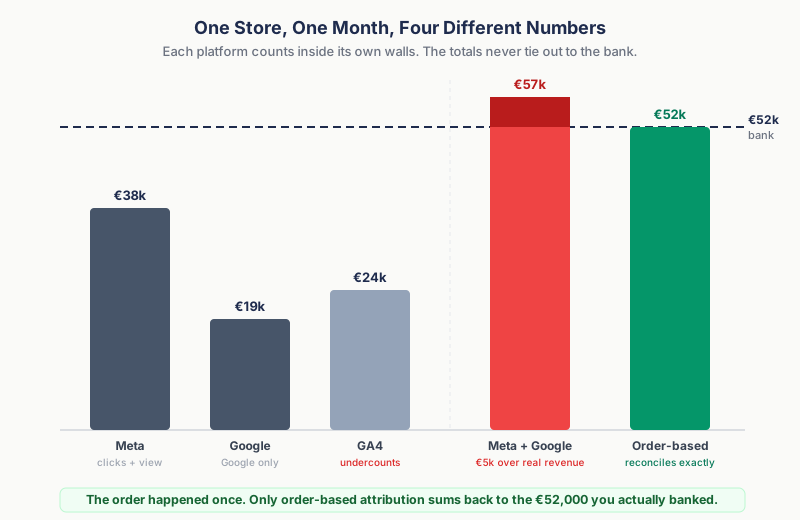
The gap is not a Triple Whale problem, it is a platform problem. Over €700,000 of revenue and more than 10,000 orders went through the stores in Enalitica's data in the 90 days to 25 September 2026, and Meta plus Google Ads reported conversions equal to that whole order count, though email, organic and direct had their share of it too.
In Enalitica's data, Google Ads reported 2.97 times and Meta 4.6 times as many conversions as there were orders carrying their click ID.
The caveat matters: Google's Conversions column can include non-purchase actions, Meta counts view-through and engaged-view conversions, and click capture misses visitors who decline consent. Even so, any tool that starts from the platform numbers inherits that inflation, and a tool that starts from the order export cannot.
Triple Whale pricing in 2026
Triple Whale is priced by annual GMV on its own site; the pricing page shows no amounts. The Shopify App Store listing shows Foundation from $219 and Automate from $749 a month, on 12-month terms, billed monthly or annually with two months free.
Moby is included, but metered. Every paid plan carries a monthly Moby usage allotment sized to the plan and GMV, with a warning at 80 percent, a pause at 100 percent and a one-click top-up. A store that leans on Moby daily should budget for the top-ups, not only the plan.
Shopify-first history and the client-side pixel
Triple Whale started on Shopify, and its app listing, pricing tiers and Moby examples still assume it. WooCommerce is a supported integration (launched as a beta in November 2025), alongside BigCommerce and custom setups, so a WooCommerce store is no longer excluded, but it is not the audience the product was designed around.
The Triple Pixel is a JavaScript snippet in the page header, and Triple Whale documents no server-side pixel. In Europe that pixel runs only after consent, and in a 2023 study of 1.2 million banner interactions just 25 percent of visitors accepted all cookies, with France and Germany rejecting most. Add the roughly 30 percent of users running an ad blocker (GWI, Q2 2025) and a European store loses a large share of journeys before any attribution model runs. Every pixel-based tool here shares that limit; the country-by-country guide shows how wide the gap gets.
Which Triple Whale Alternative Fits a European DTC Brand?
A European DTC brand narrows the list to tools that respect the consent banner and say where the data lives. Enalitica runs on Hetzner servers in the EU and starts from your orders, so a declined banner costs a journey, never the order. Klar states its data is 100 percent hosted in Europe and ISO 27001 certified. Tracify runs exclusively on servers in Germany and tracks without consent under its BISG certification. Admetrics promises EU data residency with no third-country transfer.
The rest is less clear. Polar Analytics is Paris-founded but processes data in the United States and the EU. Triple Whale runs on Google Cloud and lists the EU-US Data Privacy Framework in its trust centre, with no EU hosting option stated, and Northbeam states US servers. The honest question for a European store is not which tool tracks the most but which one shows clearly what it could not track; Enalitica does that with an explicit Unknown row instead of an estimate.
Is There a Free or Cheaper Triple Whale Alternative?
Yes, on both counts. Triple Whale's own Free plan is genuinely free with no card, first and last click attribution and a chat-only Moby. Enalitica's Free plan captures orders and leads server-side and shows a channel summary for the last 30 days, up to 100 orders a month, also with no card. Attribuly has a free tier with light tracking.
Under €100 a month: Enalitica Starter at €49 (500 orders, one store), Hyros from $69 for up to $5k of tracked monthly revenue, wetracked.io at $49 for 500 orders, Trackbee at €79 for Shopify, and Attribuly's $8-a-month website plan, while its Shopify App Store plans start at $100. Triple Whale's paid entry is $219 on a 12-month term, and Enalitica's 14-day trial of a paid plan takes a card while the Free plan does not.
What Replaces Moby, Triple Whale's AI Agent?
Moby is Triple Whale's own AI agent. On the Free plan it chats and drafts creative, on Foundation it analyses your dashboards, on Automate it can act on paid media and run automations, and every paid plan carries a monthly usage allotment with a top-up when it runs out. If you want one vendor to own both the data and the agent, Moby is the most complete version of that on this list.
Enalitica takes the other route and does not ship an agent. On Growth and above you connect the assistant you already use, Claude, ChatGPT or Grok, through a read-only MCP connection (OAuth for those three, an API key for Gemini and others), and ask in plain language which channel paid last month or how order 1947 found you. Moby can change a campaign for you, Enalitica's connection can only read, and the reasoning quality is whatever your assistant brings. Klar, Admetrics, Polar (Custom plan) and Billy Grace also expose an MCP connection. Setup: connect ChatGPT to your store data.
Which Triple Whale Alternative Is Best for Shopify Stores?
For a Shopify store the choice splits by what you want. Polar Analytics is the strongest Shopify-native BI, with a dedicated warehouse and Causal Lift incrementality tests, from about $750 a month. Attribuly is the cheapest way to get multi-touch attribution and abandoned cart flows. Enalitica is the choice when you want every number traceable to an order, Direct and Multi-Touch ROAS side by side, and profit per campaign.
One caveat for Enalitica on Shopify: since Shopify closed admin-created custom apps on 1 January 2026, Enalitica prepares a private app for your store within 24 hours, and you then install and connect it in one click. That is a day's wait an App Store app like Triple Whale does not have. The deeper comparison is in the Shopify attribution guide.
Which Triple Whale Competitors Track Profit, Not Revenue?
Profit tracking needs a cost of goods on every order, and more competitors ask for it than a year ago. Triple Whale computes net profit from COGS, shipping, handling, payment fees and taxes. Klar reports contribution margin CM1 to CM3, Admetrics a contribution profit after products, shipping, returns and fees, Billy Grace a net profit from one COGS percentage, and Polar has contribution margin templates.
Enalitica computes POAS (profit on ad spend) per campaign on paid plans, from purchase prices you upload or sync, including a multi-touch POAS that credits assists. Northbeam, Hyros, Cometly and Wicked Reports stay revenue-first. Whichever you pick, the cost of goods field has to be filled first; an empty field turns every profit number into revenue with a different label.
1. Enalitica
Best for: E-commerce and service businesses that want attribution built on actual orders and leads, with WooCommerce, Shopify and Shopamine support and several stores under one account.
Enalitica starts attribution in your order database, not in a pixel. Every order is synced and enriched with the click IDs it carries (gclid, gbraid, wbraid, fbclid, msclkid, ttclid, dclid and LinkedIn's li_fat_id), the GA4 session and the Google Ads keyword. Click any revenue number and you see the orders behind it.
Keyword-level revenue per order. For orders with a gclid, Enalitica queries the Google Ads API for the exact keyword, match type, ad group, campaign and CPC behind the click, so "which keyword drove order 4521 for €127" has an answer. None of the tools we checked documents that per individual order. Consent is the same for everyone: in the EU the click ID is captured only after the visitor agrees, and Enalitica does not bypass that; the click ID capture guide explains what the store owner controls.
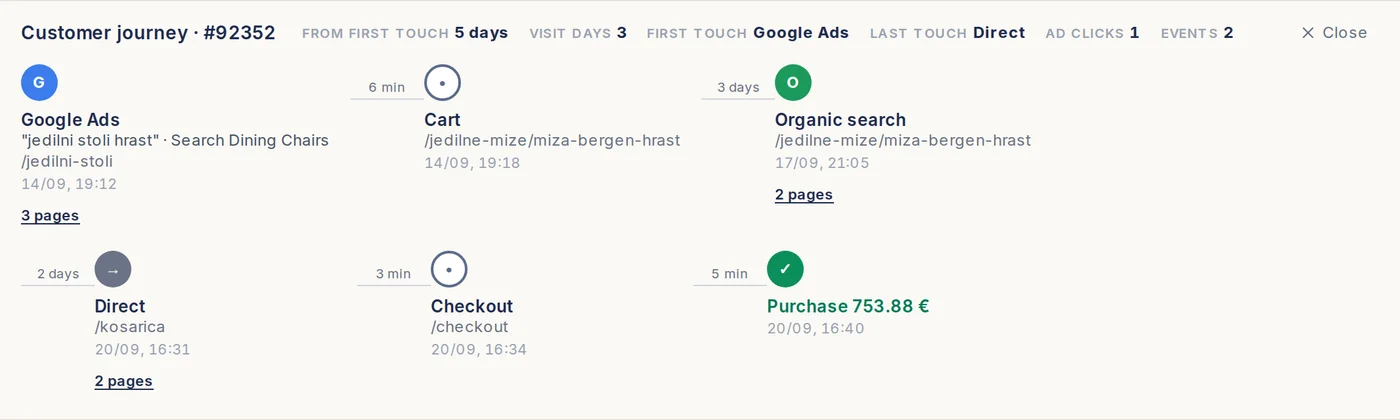
A journey for every order and every enquiry. Enalitica keeps the path behind each order: the ad click with its campaign and keyword, organic and email visits, cart and checkout events, and the time between them. A €754 order shows Google Ads first, organic search three days later and a direct visit at checkout, instead of one "Direct" label. Journeys are on Growth and up. Full walkthrough: customer journey tracking.
In Enalitica's data, of more than 6,000 order journeys in the last 90 days, 42 percent contained an ad click, 26.5 percent closed more than a day after the first touch, and only 1.4 percent touched two ad platforms.
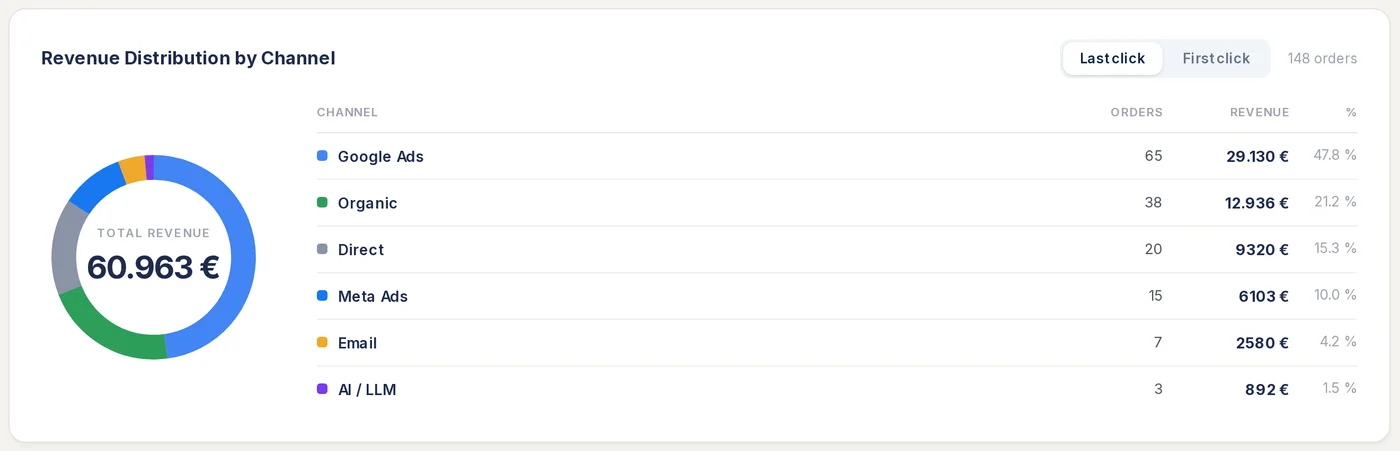
Direct and Multi-Touch revenue side by side. Every channel shows the orders it closed and the orders it appeared anywhere in, so a campaign that looks weak on last click but opens many journeys is not cut by mistake. The Google Ads tab shows both as KPI cards above the campaign table, with per-keyword revenue and the individual orders behind each row; the model is explained in the multi-touch attribution guide.
POAS, direct and multi-touch. On paid plans Enalitica imports product costs from Shopify, WooCommerce, price lists or your ERP, adds shipping, payment fees and packaging, and shows POAS next to ROAS in every campaign table, again as a pair. A campaign with direct POAS below 1.0 but multi-touch POAS above it is assisting profitable sales elsewhere.
Bring your own AI. On Growth and above, your Claude, ChatGPT or Grok reads your Enalitica reports and journeys through a read-only MCP connection with no customer personal data. There is no built-in agent and nothing can be changed through it; see the MCP guide.
Conversions API, LinkedIn and service leads. Enalitica sends conversions back to Meta and Google through their server-side APIs, gives LinkedIn Ads its own channel with spend and li_fat_id orders, and for service businesses attaches the same click IDs to form submissions, phone clicks and email enquiries, so cost per lead by channel and a journey per enquiry replace purchases.
Where Enalitica is not a fit. There is no marketing mix model and no incrementality testing, so a brand that wants a geo holdout needs Northbeam, Rockerbox, Polar or Klar. Shopify connects through a private app prepared within 24 hours rather than an App Store install. And the free plan is a 30-day window with 100 orders, a starting point rather than a permanent home.
Enalitica pricing: free plan, paid from €49 a month
The Free plan needs no card and shows the last 30 days up to 100 orders a month. Paid plans are Starter €49 (500 orders, one store), Growth €149 (1,500 orders, five stores, MCP access) and Agency €349 (6,000 orders, fifteen stores, then €25 per 1,000 orders), each with a 14-day trial that takes a card and charges nothing before day 15. Onboarding imports your recent orders, so the first report is ready the same day, and leads for service businesses are never metered. Book a demo if you want to see which plan fits.
2. Klar
Best for: German and European DTC brands above roughly €1 million in yearly revenue that want profit reporting first and attribution second.
Klar (Klar Insights GmbH, Munich) combines a first-party pixel with data-driven and MMM attribution and reports contribution margin from CM1 to CM3. It connects Shopify, Shopware, WooCommerce, Magento and Amazon, states EU-only hosting, and exposes a read-only MCP server. The German query "Klar oder Triple Whale" has a real answer: Klar if profit per order is the daily question, Triple Whale if you want Moby acting on campaigns.
Pricing starts at €200 a month for Core and €400 with attribution, based on the last 12 months of net revenue, with a 14-day trial and no free plan. Klar itself says it makes sense from about €1 million in annual net revenue.
3. Polar Analytics
Best for: Shopify-native stores that want business intelligence, incrementality testing and AI agents in one platform.
Polar Analytics gives each customer a dedicated Snowflake warehouse, pre-built KPIs and AI agents for data analysis, media buying and email. Causal Lift incrementality testing is the standout: it validates whether a channel drives incremental sales, something an attribution model cannot prove.
The limits are scope, price and location. Polar's connectors cover Shopify, Amazon and TikTok Shop; WooCommerce is on the roadmap. The Core plan starts at about $750 a month under $5 million GMV and scales with each GMV bracket, after a demo, and data is processed in the United States and the EU.
4. Tracify
Best for: DACH e-commerce stores that need consent-free tracking and German data residency.
Tracify GmbH in Munich runs a patented hybrid tracking system that works cookie-free and consent-independent under a BISG certification, on servers exclusively in Germany. Integrations cover Shopify, WooCommerce, Shopware 5 and 6, Magento and custom shops, and an AI model scores each touchpoint on incrementality.
Pricing starts at €500 a month through a demo call. Support is in German with an English product, and the attribution model is a black box compared with a rules engine you can read. For a German, Austrian or Swiss store that wants the strongest consent position, Tracify is the reference.
5. Admetrics
Best for: European stores that want attribution, marketing mix modeling and budget automation in one EU-hosted tool.
Admetrics GmbH in Frankfurt combines first-party, consent-aware tracking with MMM, experimentation and hourly budget automation, plus the Ava assistant and an MCP connection. It integrates Shopify, Amazon, Shopware, Magento, WooCommerce and JTL, promises EU data residency and publishes its own Admetrics vs Triple Whale page.
Pricing is public: Growth €339 a month with €20k of ad spend included, Business €764, Custom from €1,100, with a 21-day trial and no card. There is no free plan.
6. Northbeam
Best for: DTC brands spending well into six figures a month that want multi-touch attribution and a marketing mix model in one platform.
Northbeam combines multi-touch attribution with MMM+ and Apex, which feeds first-party data back into ad platforms, and claims $130 billion in ad-attributed revenue measured with infinite lookback windows. Dedicated success managers make it a serious enterprise tool.
Pricing is public in September 2026: Starter at $1,500 a month, month-to-month, for Shopify brands; Professional at $3,500 a month on annual terms for any platform; Enterprise custom; no free trial. WooCommerce orders arrive through a server-to-server Orders API set up during onboarding, and data sits on US servers. This bracket is compared in the Northbeam alternatives guide.
7. Hyros
Best for: Businesses with long funnels that combine e-commerce with coaching, courses or calls.
Hyros was built for info products and multi-step funnels and expanded into e-commerce, with a one-click Shopify install and a WooCommerce plugin, AI remarketing and cohort and LTV reports by source.
Pricing starts at $69 a month for up to $5k of tracked monthly revenue and scales by revenue tier, with higher tiers through a demo; plans auto-renew with 30 days' notice. Hyros stays revenue-first, with no cost of goods or profit view.
8. Cometly
Best for: Stores on several platforms that also need CRM attribution.
Cometly has the broadest platform list here: Shopify, WooCommerce, BigCommerce, Magento and Wix, plus HubSpot, Salesforce and Pipedrive. Server-side events need no code, AI reports arrive in Slack or email, and Conversion Sync feeds enriched events back to the ad platforms.
Pricing is on request, usage-based on pageviews, with no free trial because attribution needs CRM and ad platform setup first. Profit tracking is absent.
9. Rockerbox
Best for: Enterprise brands with an analytics team that want MTA, MMM and incrementality testing triangulated.
Rockerbox, part of DoubleVerify since the acquisition announced in February 2025, encourages brands to compare MTA, MMM and testing rather than trust one. It integrates Shopify, WooCommerce, Magento and Stripe, holds SOC 2 Type II, and uses a first-party pixel.
The plans page shows no public pricing, demo only, and no self-service tier. It is a strong choice for large brands with dedicated analysts and impractical below that.
10. Wicked Reports
Best for: Stores focused on new customer acquisition that want cookieless, first-party tracking.
Wicked Reports offers a cookieless tracking mode served from your own subdomain, separates new from repeat customer revenue down to the creative, replays history with the Attribution Time Machine, and sends verified new-customer events to Meta through Advanced Signal. WooCommerce is a native integration alongside Shopify, BigCommerce, Stripe and Amazon.
Pricing starts at $499 a month, then $699 and $999, with 5 Forces AI and Advanced Signal only in the top plan or as $199 add-ons, and Enterprise from $4,999. No profit view.
11. Attribuly
Best for: Small Shopify stores that want basic attribution and abandoned cart recovery for very little.
Attribuly's website lists a Pro plan at $8 a month on annual billing with multi-touch attribution, Klaviyo abandoned cart flows and server-side tracking, a 4x ROI guarantee, and a free tier with light tracking. Its Shopify App Store plans differ: Free, ReCapture at $100 and Capture at $450 a month, so check which price applies before you sign up. A WooCommerce plugin exists.
The trade-offs match the price: tight coupling to Shopify and Klaviyo, a thin methodology page and no keyword or profit depth.
12. Billy Grace
Best for: Larger Benelux and European brands that want attribution, MMM and an AI agent from one Amsterdam vendor.
Billy Grace (Fox Technology B.V., Amsterdam, founded 2022) combines multi-touch attribution with unified marketing modeling, a net profit view from one COGS percentage and the Quin AI agent with an MCP connection. It integrates Shopify, WooCommerce, Magento 2, BigCommerce, Salesforce Commerce Cloud and Lightspeed, with first-party cookie tracking rather than server-side.
Pricing starts at €499 a month for under €25k of ad spend and rises to €3,250, with no trial or free tier shown.
Two more you will meet. Search results pair Triple Whale with wetracked.io ($49 a month for 500 orders, Shopify and WooCommerce, a US company) and Trackbee (Dutch, Shopify only, €79 a month, 30-day free trial). Both push conversions back to the ad platforms rather than build a full attribution report, which is a different job.
How to Choose the Right Attribution Tool
The best Triple Whale alternative depends on your platform, market, budget and the decision you need to make.
| Your situation | Best option | Why |
|---|---|---|
| WooCommerce store, any size | Enalitica | Native WooCommerce support with click IDs read from order metadata |
| Shopify store, EU market | Enalitica, Klar or Tracify | EU hosting stated; order-based, profit-first, consent-free respectively |
| Shopify store, budget under $50 a month | Attribuly or Enalitica Free | $8 website plan; free 30-day window with 100 orders |
| Brand above $500k a month in ad spend | Northbeam or Rockerbox | MMM and incrementality built for that scale |
| Courses or coaching plus a shop | Hyros | Built for long, multi-step funnels |
| Profit per campaign, not revenue | Enalitica or Klar | POAS direct and multi-touch; contribution margin CM1 to CM3 |
| One journey per order, readable by your own AI | Enalitica | Stored journeys plus a read-only MCP connection |
| Consent-free tracking in DACH | Tracify | BISG-certified, German servers |
| Want the vendor's own AI agent to act | Triple Whale | Moby on Automate can change paid media |
If your attribution tool shows different numbers than your order database, the attribution tool is wrong. Pixels, models and AI are useful layers on top of confirmed orders, never a replacement for them.
Frequently Asked Questions
Can I use these Triple Whale alternatives with WooCommerce?
Most of them, today. Enalitica, Klar, Tracify, Admetrics, Hyros, Cometly, Rockerbox, Wicked Reports, Attribuly and Billy Grace list WooCommerce as an integration, and Triple Whale supports it since its November 2025 beta. Polar Analytics has it on the roadmap and Northbeam takes WooCommerce orders through a server-to-server API.
Do I need an attribution tool if I already use GA4?
GA4 gives data-driven attribution for free, and for a small store outside the EU it may be enough. In Enalitica's data, only 14.4 percent of nearly 12,000 orders carried a Google click ID and 12.6 percent a Meta click ID, so most orders need the order record, not the session, to be attributed at all. A tool that starts from orders closes that gap; GA4 alone cannot.
How does order-based attribution differ from pixel-based attribution?
Pixel-based tools (Triple Whale, Polar Analytics, Northbeam) run JavaScript on your store and stitch sessions into journeys; if the pixel is blocked or consent is declined, the session is gone. Order-based attribution starts from the order record, which exists whether or not a pixel fired, and reads the click IDs stored with it. The ecommerce attribution guide walks through both.
What attribution data does Triple Whale lose in EU markets?
Whatever happens before consent. The Triple Pixel runs only after the visitor accepts, and in the 2023 banner study above just 25 percent accepted all cookies, with France and Germany rejecting most. Those purchases still appear in Triple Whale's order data, but without a journey, which is why a European store should compare tools on how they report the unknown share rather than on who tracks the most.
Is Triple Whale still worth it in 2026?
Yes for a Shopify brand selling mostly to US customers that wants Moby as the analyst and has the budget for the 12-month term and the usage top-ups. If you need WooCommerce as a first-class citizen, EU hosting, a stored journey per order, profit per campaign, or a cheaper entry, the alternatives above each answer one of those better, and none of them answers all of them at once.
Sources
The outside pages this article relies on. Links checked on 25 September 2026.
- priced by annual GMV on its own site (triplewhale.com)
- Shopify App Store listing (apps.shopify.com)
- monthly Moby usage allotment (kb.triplewhale.com)
- supported integration (triplewhale.com)
- Triple Pixel (kb.triplewhale.com)
- 2023 study of 1.2 million banner interactions (advance-metrics.com)
- 30 percent of users running an ad blocker (backlinko.com)
- 100 percent hosted in Europe and ISO 27001 certified (getklar.com)
- exclusively on servers in Germany (tracify.ai)
- EU data residency with no third-country transfer (admetrics.io)
- processes data in the United States and the EU (polaranalytics.com)
- EU-US Data Privacy Framework (trust.triplewhale.com)
- Hyros from $69 (hyros.com)
- wetracked.io at $49 (wetracked.io)
- Trackbee at €79 (trackbee.ai)
- Shopify App Store plans (apps.shopify.com)
- net profit (kb.triplewhale.com)
- contribution margin CM1 to CM3 (help.getklar.com)
- Shopify, Shopware, WooCommerce, Magento and Amazon (getklar.com)
- read-only MCP server (help.getklar.com)
- Pricing (getklar.com)
- Causal Lift (polaranalytics.com)
- connectors (polaranalytics.com)
- Integrations (tracify.ai)
- Pricing (tracify.ai)
- Admetrics vs Triple Whale (admetrics.io)
- Pricing (admetrics.io)
- $130 billion in ad-attributed revenue (northbeam.io)
- Pricing (northbeam.io)
- server-to-server Orders API (docs.northbeam.io)
- one-click Shopify install and a WooCommerce plugin (docs.hyros.com)
- Shopify, WooCommerce, BigCommerce, Magento and Wix (cometly.com)
- AI reports (cometly.com)
- Conversion Sync (cometly.com)
- Pricing (cometly.com)
- acquisition announced in February 2025 (ir.doubleverify.com)
- integrates (rockerbox.com)
- plans page (rockerbox.com)
- cookieless tracking mode (wickedreports.com)
- Advanced Signal (wickedreports.com)
- native integration (wickedreports.com)
- Pricing (wickedreports.com)
- website (attribuly.com)
- WooCommerce plugin (attribuly.com)
- integrates (billygrace.com)
- Pricing (billygrace.com)
Figures marked "in Enalitica's data" are aggregates from the real orders of the stores we measure, with no names and no individual orders. How we measure.
See your real numbers
Import 30 days of orders or leads during a 5-minute onboarding. Works for e-commerce and service businesses.
See plans and pricing