
Self-Reported Attribution: When the Customer Tells You the Channel
Self-reported attribution explained: how 'where did you hear about us' gives TV, billboards, word of mouth and AI search their own row, no modeling.

Tilen Ledic
Written by
A customer walks into the showroom, orders a wardrobe, and mentions in passing: "I saw you on Google." Self-reported attribution is the discipline of writing that sentence down, and it is the only honest way to give TV ads, billboards, word of mouth and AI recommendations a row in your analytics, because none of them leaves a click to track.
This guide covers what self-reported attribution can and cannot do: how to ask "where did you hear about us", why the customer's answer must never override a real click, and where the temptation to extrapolate turns honest data back into modeling.
Why do offline and walk-in orders end up as Unknown?
Click-based attribution needs a click, and a whole class of valuable channels never produces one. A TV spot, a billboard on the ring road, a friend's recommendation, a ChatGPT answer that names your brand: the customer arrives typing your name directly, and the order lands in the Unknown bucket.
Walk-in and phone orders make it worse. A showroom customer might have started on Google or Instagram, but the order enters the system by hand or through the ERP, with no session attached at all.
Modeling tools respond by estimating the missing journeys. Order-based attribution refuses to guess, which keeps the numbers auditable but leaves Unknown as a silent pile. Self-reporting is the third option: ask the one person who actually knows.
In Enalitica's data, last 90 days to 28 September 2026 (more than 6,500 order journeys), about 1 in 9 orders whose last visit was direct showed another channel earlier in the journey, and only 4.4% had an earlier paid ad click we could see. Enalitica does not reassign the rest to a channel it cannot prove: what consent hides, we mark unknown, and that pile is exactly where a customer's answer helps.
What is self-reported attribution?
Self-reported attribution means asking customers directly how they found you and recording the answer on the order. The e-commerce version is the post-purchase survey, one question on the thank-you page; the showroom version is older than the internet: the salesperson asks, and writes it down.
The answer is a statement, not a measurement. Customers misremember, compress ("Facebook" often means a retargeting ad they were shown after visiting), and skip the question entirely. Treated as testimony rather than truth, it is still far better than a shrug: a declared source beats an unknown one every time.
Nobody can track a friend's recommendation, a billboard, or a ChatGPT answer. The customer can simply tell you, and that answer deserves a row of its own.
Proven, declared, unknown: three classes of truth
An honest attribution system keeps three classes of revenue visibly apart. Proven: orders carrying real click evidence (a Google, Meta or LinkedIn click ID, a tagged link), auditable to the click. Declared: orders where the customer stated a source, auditable to the statement. Unknown: orders with neither, honestly labeled.
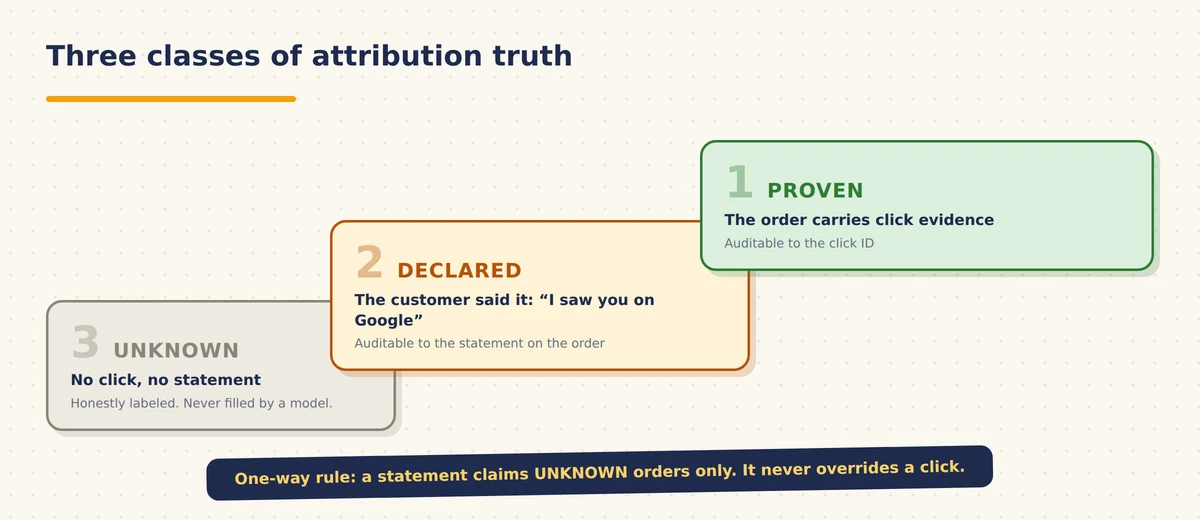
The order of the classes is the whole design. A statement can promote an order out of Unknown, but it must never demote a click: when a customer says "Instagram" and the order carries a Google Ads click ID, the click wins, because the click is evidence and the sentence is memory.
A click is evidence; a customer's answer is memory. A statement may claim an unknown order, never an order with proof.
Why a statement must never override a click
Self-reported answers carry known biases, and respecting them is what separates useful testimony from garbage data. Recency bias makes customers name the last platform they saw, not the one that started the journey. Brand-blur makes "Instagram" and "Facebook" interchangeable in memory. And big brands get named simply because they are memorable.
Tracked journeys show how much a single answer compresses. In the same data, 25.5% of orders touched two or more channels, yet only 1.4% touched two ad platforms, so the usual overlap is not Google against Meta but a paid click next to an organic visit, an email or a direct return.
Assists are uneven as well. Email was an assist (present, but not the last touch) in 35.6% of the orders it appeared in, Meta Ads in only 16.3%, which means the channel a customer remembers is not always the one that did the quiet work earlier.
The protection is structural, not hopeful: the declared source only ever fills gaps. Orders with click evidence keep their proven channel, and the statement is at most a footnote on them. This one rule is why self-reporting can live inside an auditable system without corrupting it.
How to ask "where did you hear about us" well
The question works when it is short, specific and immediate. Five rules cover most of it:
- Offer real names, not categories. "Instagram", "a friend's recommendation", "TV ad", "ChatGPT". A generic "social media" option produces a row nobody can act on. And always include the honest escape, "I already knew the brand": without it, unsure customers pick anything and pollute the real channels.
- Ask immediately. At the till, on the phone, right after checkout. The longer the gap, the more the answer drifts toward whatever the customer saw last.
- Group the answers. Free-text answers are gold for discovering channels you did not list, but they must be filed into a fixed set of groups, or the report fragments into thirty one-off rows.
- Read acquisition answers from new customers only. A loyal customer answering "where did you hear about us" is recalling something from years ago; the answer is trivia, not attribution.
- Ask only when tracking has nothing. An order that already carries a click ID needs no question; asking it adds friction and noise. The question belongs exactly where the order would otherwise land in Unknown or Direct: declined consent (with ad storage denied, Google's tags neither write nor read advertising cookies), a phone call, or a typed-in visit, which counts as Direct, the bucket that quietly collects billboards, word of mouth and dark social (we broke down why direct traffic runs so high separately).
What self-reported data is actually good for
Used within its limits, declared data answers questions click tracking never will. It puts a number next to word of mouth, usually the most underrated channel in any report. It tells you whether the billboard campaign registered at all. And it is the practical way to see AI discovery: visits that click through from ChatGPT, Gemini or Copilot now land in GA4's own AI Assistant channel, but a customer who read a recommendation in a chat and then typed your name leaves no click ID, and will happily say so.
What it is not good for: bidding decisions, ROAS math, or anything requiring precision. A channel's declared revenue is a floor built from the customers who answered, not a measurement of the channel. For causal proof of offline spend, the tool is an incrementality test, not a survey.
The extrapolation temptation
Sooner or later someone proposes the shortcut: "30 percent of declared answers say TV, so let's assign 30 percent of all Unknown revenue to TV." That single step converts honest testimony back into modeling, because the customers who answer are not a random sample of the ones who did not.
Extrapolating declared shares onto the silent Unknown bucket is modeling with extra steps. Declared revenue is a floor, clearly labeled; it is not a distribution key.
If an estimate view is ever useful, it must be labeled as an estimate and kept out of the auditable table, the same discipline that separates a what-if simulator from a report.
How Enalitica records declared sources on orders
Enalitica added declared sources exactly along these lines. On any order (manual, showroom, ERP-imported or web), staff pick "where did the customer hear about us" from a catalog: Google, Facebook, Instagram, TikTok, AI (ChatGPT, Perplexity), a recommendation, "already knew the brand", TV, radio, billboard, print, a trade fair, the physical store. A custom answer takes two clicks, gets filed under one of nine fixed groups, and is saved to the store's own catalog for next time.
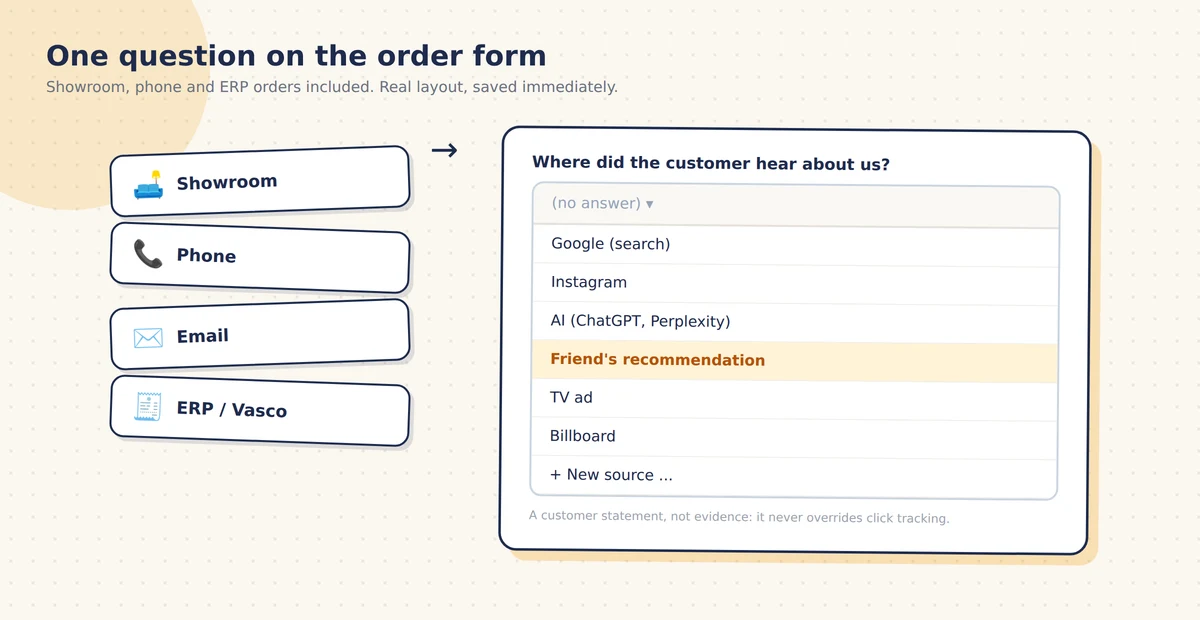
Reporting follows the three-class discipline. Declared orders appear under a dedicated Declared source view in the traffic overview, grouped into stable rows (recommendation, Google, offline media, AI...), carved out of Unknown and visibly separate from click-proven channels. No new tabs appear however many custom sources exist, a statement never overrides a click, and conversion rate stays honestly n/a, because there are no sessions for statements.
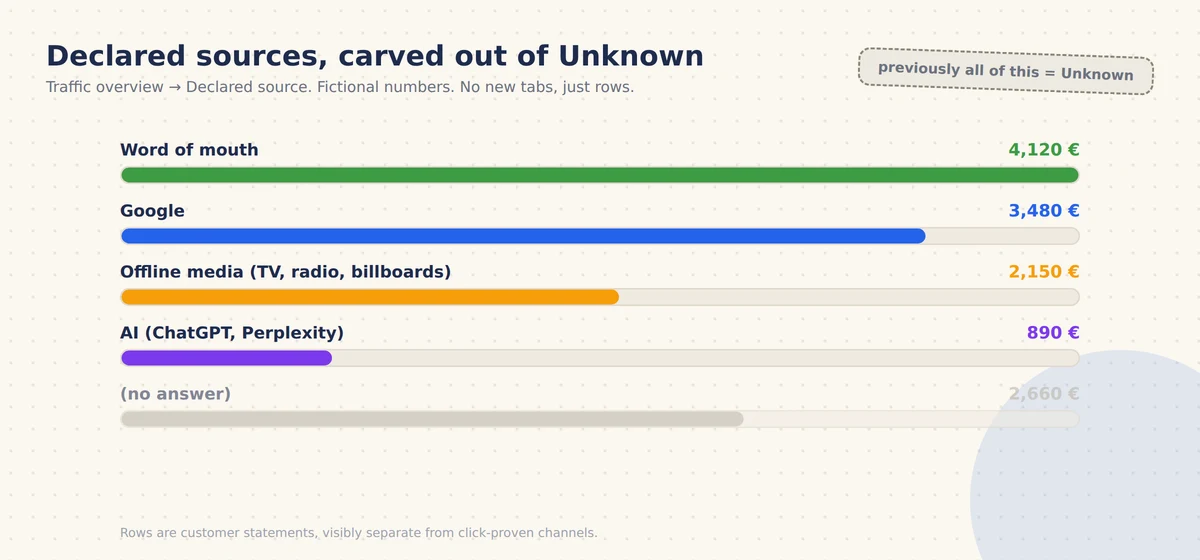
Hybrid businesses gain the most. A store plus a showroom, a brand taking orders by phone or email and entering them afterwards, an ERP-driven operation: exactly where the largest share of revenue never touches a tracked session, one question per order turns the biggest Unknown pile in the report into named channels. The walk-in customer who came because of Google finally counts toward Google, on the strength of their own words, clearly marked as such.
Frequently Asked Questions
What is self-reported attribution?
Self-reported attribution records how customers say they discovered a business, via a post-purchase survey question or by staff asking at the till, and attaches the answer to the order. It covers channels that leave no click: TV, billboards, word of mouth, podcasts and AI recommendations.
How accurate are "how did you hear about us" answers?
Directionally useful, individually unreliable. Customers misremember, name the last platform they saw, and blur Facebook with Instagram. Treat answers as a labeled floor for each channel, never let them override click evidence, and read acquisition answers from first-time customers only.
How do I measure TV and billboard advertising without clicks?
Two honest options exist: ask customers directly and record the answer on the order (self-reported attribution), or run an incrementality test comparing regions with and without the campaign. Modeling tools estimate offline contribution instead, but the estimate cannot be audited.
Can attribution software track ChatGPT and AI recommendations?
Only partially. AI referral visits that click through now get their own AI Assistant channel in GA4, but recommendations read in a chat leave nothing. A "where did you hear about us" answer is currently the most reliable signal for AI discovery, which is why an AI option belongs in every source list in 2026.
Should the customer's answer override click tracking?
No. A click ID is evidence; an answer is memory with known biases. The honest rule is one-directional: a statement may claim an order that would otherwise be unknown, but an order with click evidence keeps its proven channel.
Sources
The outside pages this article relies on. Links checked on 28 September 2026.
- neither write nor read advertising cookies (developers.google.com)
- AI Assistant channel (support.google.com)
Figures marked "in Enalitica's data" are aggregates from the real orders of the stores we measure, with no names and no individual orders. How we measure.
See your real numbers
Import 30 days of orders or leads during a 5-minute onboarding. Works for e-commerce and service businesses.
See plans and pricing