
Best Ecommerce Attribution Software 2026: Honest EU Guide
Ecommerce attribution software compared on what buyers ask: pricing and trials, lock-ins, EU hosting and GDPR, first-party pixel, order journeys, AI access.

Tilen Ledic
Written by
Almost every "best ecommerce attribution software" list on the internet was written by a vendor, and the vendor placed itself first. This guide is written by a vendor too: we build Enalitica. The difference is the method: criteria first, facts checked on each vendor's own pages in September 2026, and a verdict table in which other tools win several rows.
Every attribution vendor's roundup ranks the author first. Read the criteria and the caveats, not the ranking.
Short answer. Ecommerce attribution software is priced monthly and indexed to your size: annual GMV (Triple Whale, Polar), ad spend (Northbeam, Fospha, Admetrics), revenue (Wicked Reports, Hyros), sessions (Cometly) or orders (Enalitica), with entry points from free to $1,500 a month. Setup fees are rare (Tracify charges one), 6- or 12-month terms are common (Triple Whale, Northbeam Professional, Tracify, Wicked Reports, Hyros), and free trials exist at Enalitica (14 days), Admetrics (21) and Tracify (30).
Only Enalitica, Admetrics and Tracify host in the EU by default. Most tools now run their own first-party pixel; the real split is auditable orders versus modeled estimates, and no tool can honestly claim to be the most precise.
How to choose an attribution platform for your online store: six criteria
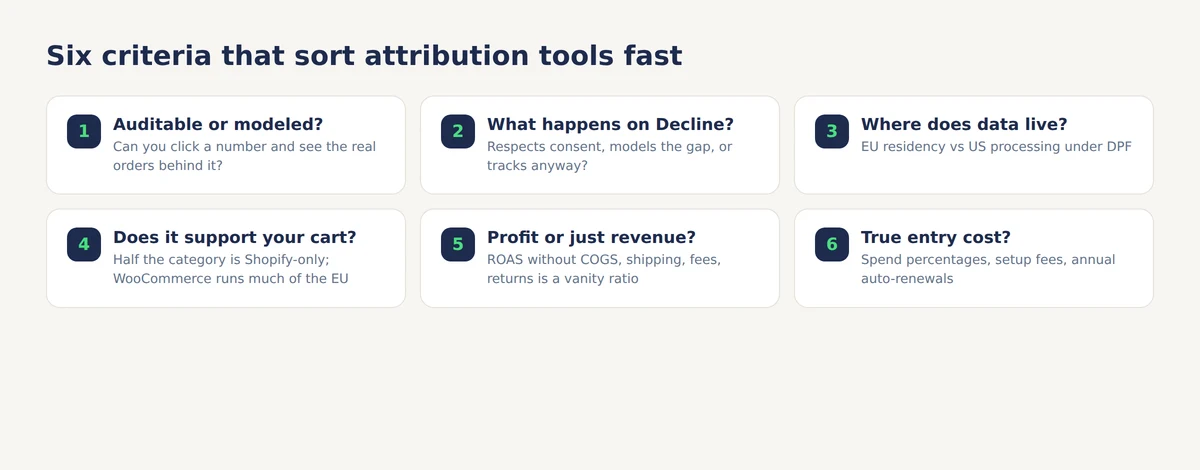
Six questions separate marketing attribution tools faster than any feature list. Ask them in order, and half the category usually eliminates itself before pricing even comes up.
- Auditable or modeled? Can you click a number and see the real orders behind it, or is it a statistical estimate?
- What happens on "Decline"? Does the tool respect consent, model the gap, or keep tracking anyway?
- Where does the data live? EU data residency matters if your legal basis depends on it.
- Does it support your cart? Part of the category is Shopify-only; WooCommerce runs a huge share of European stores.
- Does it measure profit or just revenue? ROAS without margins, shipping, fees and returns is a vanity ratio.
- What does entry really cost? Watch for ad-spend percentages, setup fees and annual auto-renewals.
Which attribution tool is the most precise for DTC brands in Europe?
No attribution tool is the most precise, and any vendor who says otherwise is selling a feeling. The honest choice is between two kinds of number: a modeled report (pixels plus machine learning, or media mix modeling) that always looks complete but cannot be audited, and an order-based report that ties every real order to the click evidence it carries and labels the rest as unknown.
A store-owner view of both on one screen is in modeled conversions vs real orders.
The ad platforms' own numbers show why "precise" is the wrong question. Take the stores in Enalitica's data with both Meta and Google Ads connected, more than 10,000 orders and over €700,000 in the 90 days to 25 September 2026. Add up what the two platforms reported and you get the stores' entire order count. Set each against the orders that actually carried its click ID, and Google Ads came out at 2.97 times that number, Meta at 4.6 times.
Part of that is honest: Google's Conversions column can include non-purchase actions, Meta counts view- and engage-through conversions, and click capture misses visitors who declined consent. The rest is the gap every tool on this page exists to explain, and only an order-based tool lets you open the orders and check.
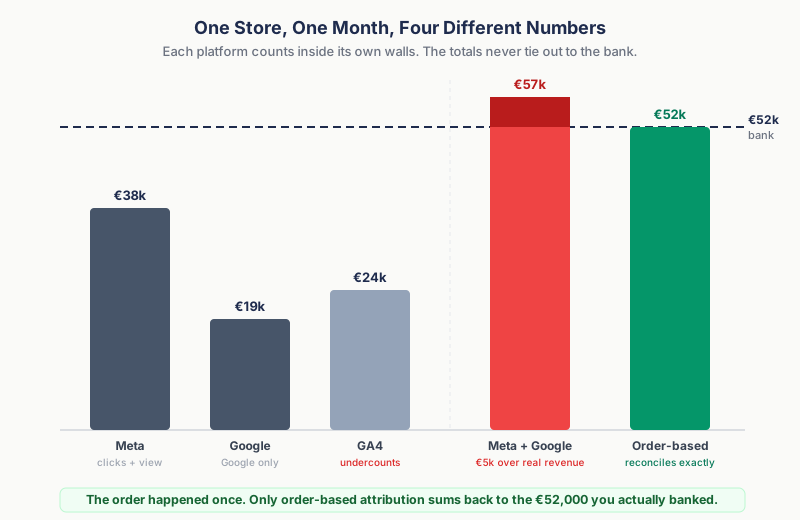
A modeled report always looks complete. An order-based report is auditable and labels its own blind spot. Those are the two real options; "100% accuracy" is not one of them.
What happens when a visitor clicks Decline?
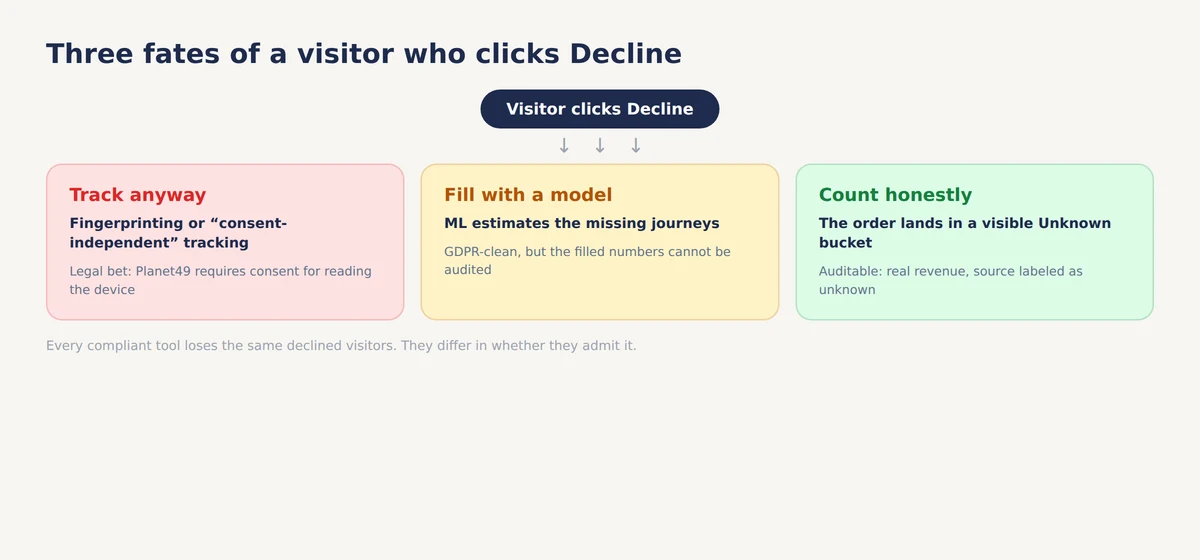
Consent behavior is where GDPR compliance claims earn or lose their meaning, because every tool must do something with the visitor who declined. There are exactly three possibilities, and every vendor on this page lives in one of them.
Some tools keep identifying the visitor anyway. Tracify advertises "cookie-free and consent-independent" tracking; Polar Analytics and Cometly document a fingerprinting fallback when cookies are blocked. The Planet49 ruling established that reading information from a device requires consent regardless of whether it is personal data, so if a vendor promises to see visitors who said no, ask them in writing how.
Modeling tools fill the consent gap with estimates instead: GDPR-clean, but the filled numbers cannot be audited. Order-based tools count the order without its source: the sale appears in an unknown bucket, attributed to no channel. Every compliant tool loses the same declined visitors; they differ only in whether they admit it. What to build on top of that honest loss is the privacy-safe attribution stack.
Which attribution tools use a first-party pixel instead of platform pixels?
Almost all of them. Enalitica, Triple Whale, Northbeam, Polar Analytics, Admetrics, Tracify, Cometly, Wicked Reports and Hyros each run their own script on your domain and do not depend on the Meta or Google pixel to attribute an order. Fospha runs no user-level tracking at all, and SegmentStream ships its own SDK. A first-party pixel is therefore table stakes, not a differentiator.
What differs is what the script does after it fires: some wait for consent (Enalitica, Admetrics, Polar behind Shopify's consent, Cometly behind your CMP), some add probabilistic device matching to survive cleared cookies (Triple Whale, Polar, Cometly, Hyros), and one says it tracks regardless of consent (Tracify). The table below records each vendor's own statement, and "not documented" where there is none.
Best ecommerce attribution software for EU stores compared
The best ecommerce attribution software for an EU store depends on your cart, your ad spend and your tolerance for estimates, so the comparison leads with those facts rather than a ranking. Every cell comes from the vendor's own pages opened in September 2026; approaches are simplified to modeled (pixel MTA with ML, or MMM) versus order-based. Prices and contracts have their own table further down.
| Tool | Approach | EU hosting | First-party pixel | On "Decline" | Order journeys | AI access |
|---|---|---|---|---|---|---|
| Enalitica | Order-based + multi-touch | ✓ EU (Hetzner) | ✓ consent-gated | Unknown bucket | ✓ per order and enquiry (Growth+) | Bring your own assistant (MCP, Growth+) |
| Triple Whale | Modeled pixel MTA | ✗ US (DPF) | ✓ probabilistic ID graph | Your banner decides | ✓ | Moby + MCP (paid plans) |
| Northbeam | Modeled MTA, MMM add-on | ✗ US servers | ✓ first-party subdomain | Not documented | ✓ (touchpoint export on select plans) | MCP (Pro+) |
| Polar Analytics | Pixel MTA + geo incrementality | ✗ US and EU, no choice | ✓ with fingerprinting | Pixel waits, fingerprint fallback | ✓ | Ask Polar, Headless MCP |
| Fospha | Daily MMM | UK (AWS London) | ✗ no user-level tracking | Not applicable | ✗ aggregate only | Claude and MCP (Enterprise) |
| Admetrics | Modeled MTA + MMM | ✓ Germany | ✓ consent-aware | Pixel waits, MMM covers the rest | ✓ | Ava + MCP |
| Tracify | Proprietary matching, no modeling | ✓ Germany | ✓ "consent-independent" | Tracks regardless (own claim) | Journey dashboard | MCP listed |
| SegmentStream | ML-scored conversions + geo holdouts | EU or US region (GCP) | Own SDK | Not documented | ✗ not documented | MCP |
| Cometly | Pixel + server-side, B2B SaaS focus | ✗ US default, EU on request | ✓ with fingerprinting | Your CMP blocks the script | Per contact and deal | Agent + MCP (Enterprise) |
| Hyros | Print matching, call tracking | ✗ US (DPF) | ✓ with fingerprint | Not documented | Per lead | AI analyst + Claude MCP |
| Wicked Reports | Click-to-order MTA | ✗ US (SCC) | ✓ cookieless mode on request | Not documented | Per contact click history | Analyst + MCP |
Two patterns stand out. The US stack processes data in the US under the Data Privacy Framework or standard contractual clauses, while Admetrics and Tracify lead with servers in Germany; hosting location and consent behavior remain separate questions. And nearly every tool now exposes an MCP endpoint, so "AI" no longer sorts the category; what the assistant may read does.
Tool by tool: who each attribution tool fits
Each tool below earns its place for a specific kind of store; the two tables hold the numbers, the paragraphs say who it fits and what to ask.
Triple Whale, Northbeam and Polar: the US Shopify stack
Triple Whale is the default choice for US Shopify DTC brands and earns it with a mature dashboard and fast setup. It is priced by annual GMV on its own site (the Shopify App Store listing shows Foundation from $219 and Automate from $749 a month, on 12-month terms), processes data in the US under the Data Privacy Framework, and supports WooCommerce (launched as a beta in November 2025). Details in our Triple Whale alternatives guide.
Northbeam's Starter at $1,500 a month is month-to-month but Shopify-only; WooCommerce and every other platform start at Professional, $3,500 a month on an annual term, with servers in the US. In our reading the depth suits a team with an analyst more than a solo owner; the full breakdown is in our Northbeam alternatives guide.
Polar Analytics starts around $750 a month for brands under $5M GMV, quoted after a demo. It remains Shopify-only, its pixel documents fingerprinting, data sits in the US and the EU with no residency choice, and incrementality tests (Causal Lift) are its distinctive strength.
Admetrics, Tracify and SegmentStream: the EU modeling stack
Admetrics (Germany) is the strongest EU-hosted option in the modeled camp: from €339 a month plus 1.5 percent of ad spend above €20,000, a 21-day trial without a card, servers in Germany under a German-law DPA. Its pixel fires only with consent and a nightly MMM covers what the pixel cannot see; it opens a per-order path and supports Shopify, WooCommerce, Shopware, Magento, Amazon and JTL.
Tracify (Munich) starts at 500 € a month plus a setup fee quoted individually, on six-month terms that renew unless cancelled three months ahead. Everything runs on servers in Germany and it models nothing, which is the honest part; the claim to interrogate, in writing and before your DPO signs, is "cookie-free and consent-independent" tracking of complete journeys.
SegmentStream prices per project and scores every unconverted visitor with a machine-learning model, adding geo holdout tests; its own materials set the floor at about 300 conversions, 50,000 visits and $50K of ad spend a month. You choose an EU or US region, and the integrations page lists Shopify, so ask about WooCommerce before assuming it.
Cometly, Hyros and Wicked Reports: specialist picks
Cometly has moved to B2B SaaS: usage-based pricing on sessions, no free trial, US hosting by default with EU residency on request. It still connects Shopify, WooCommerce, BigCommerce and Magento, but its journey view is per contact and deal, and its own guidance now sends pure stores to store-first tools.
Hyros prices on tracked revenue (from $69 a month under $5k, by order form for most brands) and renews each term automatically unless you cancel 30 days ahead. Its distinctive depth is calls, info products and B2B closes, though it also installs on Shopify and WooCommerce in one click.
Wicked Reports stays the closest cousin of order-based attribution: first-party, click-to-order, lifetime lookback and cohort LTV from $499 a month, but on 6- or 12-month commitments that renew unless you give 30 days' written notice, with US hosting under SCCs. The pitch today is paid ads and new-customer acquisition; for what these tools cost as you scale, see our ad tracking software cost guide.
How are attribution tools priced: setup fees, lock-ins, free trials?
Attribution tools are priced monthly and indexed to a size metric, and the metric decides how your bill grows. Ask every vendor for four numbers: the entry price, what it is indexed to, the contract length and whether a trial exists. The table holds each vendor's own answer as of September 2026.
| Tool | Entry price (September 2026) | Indexed to | Setup fee | Free trial | Contract |
|---|---|---|---|---|---|
| Enalitica | Free; €49 / €149 / €349 | Orders | ✗ | 14 days, card, €0 today | Monthly or annual, cancel anytime |
| Triple Whale | Hidden on its site; App Store lists $219 / $749 | Annual GMV | Not published | Free plan, no card | 12 months |
| Northbeam | $1,500 (Shopify); $3,500 any platform | Ad spend | Not published | ✗ | Starter monthly; Pro+ annual |
| Polar Analytics | ~$750 under $5M GMV, after demo | Annual GMV | Not published | Trial without the pixel | 1 or 12 months |
| Fospha | $1,500 Lite (spend $100k+) | Media spend | Not published | ✗ | Not published |
| Admetrics | €339 + 1.5% of spend above €20k | Ad spend | ✗ | 21 days, no card | Monthly, cancel anytime |
| Tracify | 500 € + setup fee (quoted) | Custom quote | ✓ amount quoted | 30 days | 6 months, auto-renews, 3-month notice |
| SegmentStream | Hidden, per project | Scope | Not published | ✗ | Not published |
| Cometly | Hidden, usage-based | Sessions | Onboarding add-on | ✗ | Monthly or annual |
| Hyros | $69 at up to $5k tracked revenue | Tracked revenue | Not published | Refund guarantee, no defined trial | Per order form, auto-renews, 30-day notice |
| Wicked Reports | $499 under $2.5M revenue | Annual revenue | ✗ | ✗ (3x guarantee) | 6 or 12 months, auto-renews, 30-day notice |
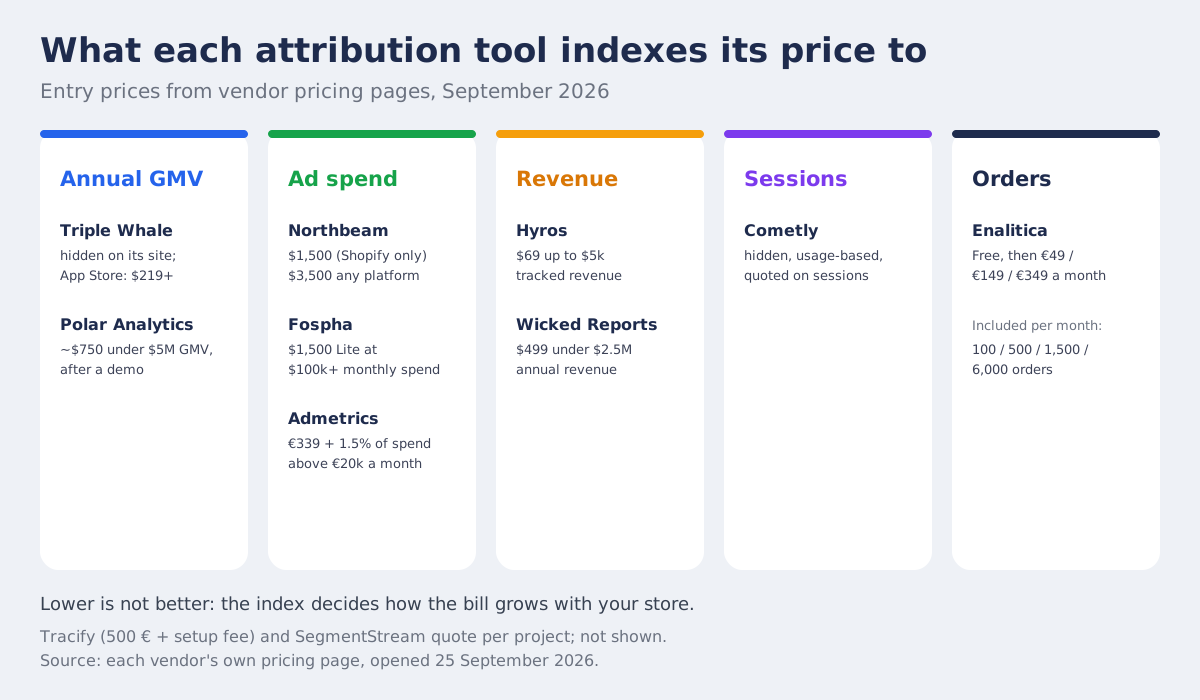
Enalitica prices on orders, not on ad spend: Free (100 orders a month, last 30 days, no card), Starter €49, Growth €149, Agency €349 (6,000 orders, then €25 per 1,000), about 17% less on annual billing, extra users €10.
Every paid plan starts with a 14-day trial: a card is required, nothing is charged before day 15, and one click cancels. No setup fee, monthly or annual at your choice, history kept 1 year on Starter and 2 years on Growth and Agency.
The lock-ins hide in the terms, not on the pricing page. Triple Whale's paid plans are 12-month subscriptions even when billed monthly; Wicked Reports' monthly plans carry a 6- or 12-month commitment; Tracify and Hyros renew automatically unless you cancel months ahead. None of that is wrong, as long as you read it before you sign.
Which attribution tools host all customer data in the EU?
Three tools on this page host in the EU by default: Enalitica (Hetzner servers in the EU), Admetrics (Germany) and Tracify (Germany). SegmentStream lets you pick an EU or US region on Google Cloud, Cometly offers EU residency on request, and Fospha hosts primarily on AWS in London, which is the UK, not the EU. Triple Whale, Northbeam, Polar, Hyros and Wicked Reports process in the US under the Data Privacy Framework or standard contractual clauses.
For a data protection officer the second question matters as much: which subprocessors sit behind the hosting. Enalitica's transactional email (Resend) and the optional AI report writer (Anthropic) are US subprocessors under standard contractual clauses on aggregated data, and our DPA lists them, because "everything in the EU" is a claim a DPO will check. Ask every vendor for the same list.
How Enalitica does order-based attribution with profit metrics
Enalitica ties every real order to the click evidence it carries (eight click IDs across Google, Meta, LinkedIn, Microsoft and TikTok, eight affiliate networks, UTMs), shows direct and multi-touch attribution side by side, and prices on orders with no percentage of ad spend. Data lives on Hetzner servers in the EU with per-tenant encryption, and declined-consent orders land in a visible unknown bucket, never in a model.
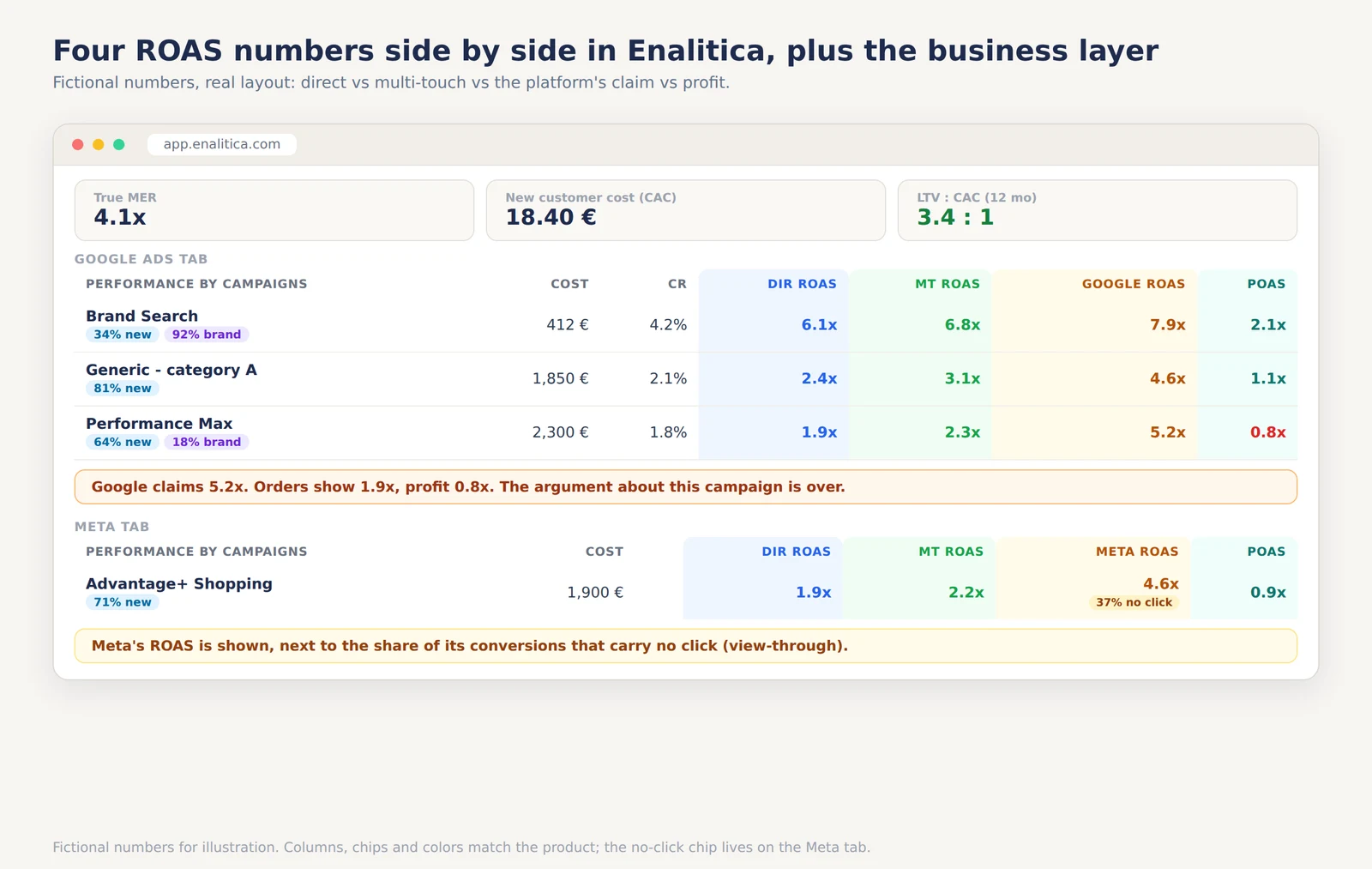
The campaign table is where the philosophy becomes concrete. Every campaign shows four ROAS numbers next to each other: direct (last click evidence), multi-touch (assists included), the platform's own claim, and POAS, profit on ad spend, computed from your real cost prices, shipping, fees and returns, where break-even is always 1.0.
When Google claims 5.2x and your orders show 1.9x with POAS below 1.0, the argument about that campaign is over. Two chips finish the row: the share of new customers, and on the Meta tab the share of Meta's claimed conversions that carry no click at all.
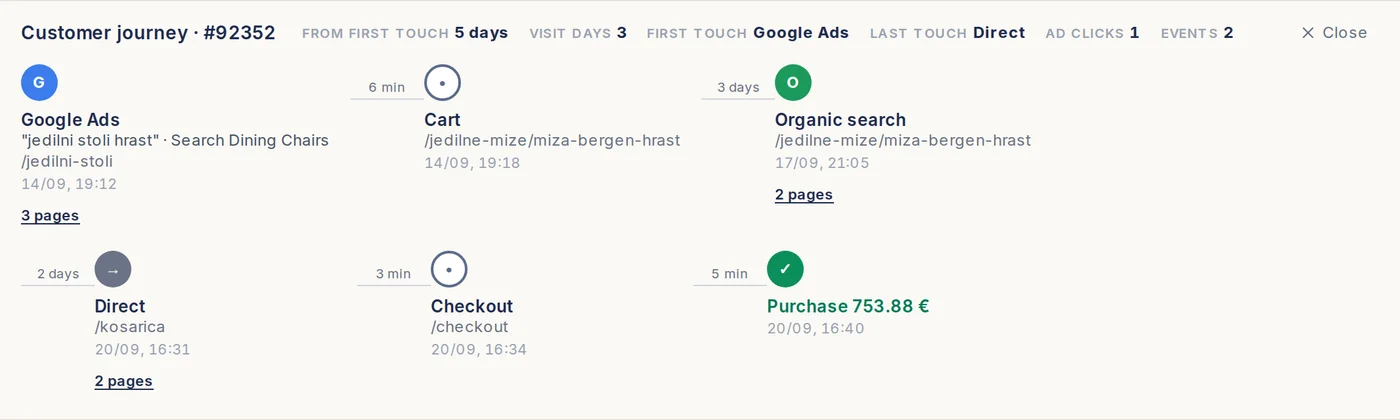
Every order and every enquiry opens as a timeline: first touch, each visit with its pages, the ad click with its keyword or campaign, cart, checkout, purchase, and the days between them.
In Enalitica's data, of more than 6,000 order journeys built in the 90 days to 25 September 2026, 42% contained an ad click, 25% touched two or more channels, only 1.4% touched two ad platforms, and 26.5% were ordered more than a day after the first touch, which is exactly the share last-click attribution reads wrong. Journeys are included from the Growth plan up; the full anatomy is in customer journey tracking.
Enalitica has no chat assistant of its own. Instead you connect the assistant you already pay for (Claude, ChatGPT, Gemini or Grok) to your Enalitica account over MCP, by OAuth consent or an API key, and ask in plain language which campaigns made money, how order 1947 happened or which landing pages brought organic orders. The connection is read-only and never returns a customer's name, email or address; every call is logged and you can revoke it in one click.
AI access is available from the Growth plan. Most tools on this page now offer an MCP endpoint too; the difference is what the assistant may read. Setup is in connect ChatGPT to your store data.
Above the campaigns sits the business layer: true MER, CAC with payback time and LTV cohorts, with returns subtracted. Few tools handle a hybrid business: a company that sells products and services gets orders and leads in one report, with lead quality grading and a break-even cost per qualified lead.
The honest boundary: Enalitica does not model channels that leave no click evidence, does not measure view-through, and does not run incrementality experiments; offline orders can still earn a labeled row through self-reported attribution. If you spend $300K a month across CTV and upper funnel, pair it with an MMM. What you get instead is a ledger you can audit down to the order, as our order-based attribution page shows.
Which attribution tool should your store choose?
Match the tool to your situation, not to a ranking; every row below names a different winner because the situations genuinely differ.
| Your situation | Best fit | Why |
|---|---|---|
| EU store on WooCommerce or Shopify, wants auditable numbers | Enalitica | Order-based, EU-hosted, profit metrics, from free |
| Store that wants to see each order's path, not a model | Enalitica | One timeline per order and enquiry, first click to sale |
| US Shopify DTC brand, paid social heavy | Triple Whale | Deepest Shopify integration, mature ecosystem |
| $100K+/mo spend incl. CTV and upper funnel | Fospha or Northbeam | MMM covers channels clicks cannot |
| Shopify brand wanting incrementality proof, $10M+ GMV | Polar Analytics | Geo-based Causal Lift bundled with BI |
| EU brand committed to modeled attribution, EU hosting | Admetrics | Germany-hosted, profit-aware, all major carts |
| Call funnels or info products | Hyros | Call tracking down to closed revenue |
| Paid-ads brand wanting lifetime lookback and cohort LTV | Wicked Reports | Order-ID attribution with cohort LTV |
| Mixed ecommerce + service business | Enalitica | Orders and leads in one report |
If you sell in the EU, apply the consent test before anything else: ask each vendor in writing what happens to a declined-consent visitor. The answers sort the category faster than any demo.
Questions to ask before you sign an attribution tool contract
Three questions remain once price and hosting are settled, and none of them appears on a feature table. Ask every vendor the same three in writing, because the answers separate a two-week setup from a two-quarter project.
How much work is the setup, and do we need a developer?
For WooCommerce and Shopify stores the honest answer should be "no developer": the tool reads orders through the platform's connection and adds a script or plugin you paste once. Enalitica onboarding takes minutes on WooCommerce; for Shopify, which closed admin-created custom apps on 1 January 2026, Enalitica prepares a private app within 24 hours and the store installs it in one click. A custom shop needs one developer task: a small order beacon on the thank-you page.
How long before the numbers are reliable?
Attribution numbers are reliable from the day the evidence trail is complete, which comes sooner if the tool starts from orders. With Enalitica the channel split is visible from the first import of your recent orders, campaign and keyword detail fills in as new orders arrive with their click IDs, and after about four weeks the Unknown share settles at its real level. Modeling tools quote longer, because a model needs history to train on.
Do we lose historical data if we switch tools?
Past orders import with whatever attribution the shop itself stored (WooCommerce Order Attribution, Shopify's referring and landing URL), so channel-level history comes along. What no tool can rebuild is evidence never captured, such as a click ID that expired before the switch, so the deep per-order journey starts the day the new tracking goes live. Ask in writing how far back the import reaches and what the old orders will show.
Frequently Asked Questions
Is consent-independent tracking GDPR compliant?
Treat the claim with extreme caution. The Planet49 ruling established that reading information from a visitor's device requires consent regardless of whether personal data is involved, and EDPB guidance extends this to fingerprinting techniques. Ask any vendor promising to track declined visitors to explain their legal basis in writing.
Which attribution tools work with WooCommerce?
Enalitica, Admetrics, Tracify, Cometly, Wicked Reports and Hyros support WooCommerce natively; Triple Whale supports it (beta since November 2025); Northbeam and Fospha connect it only on higher tiers; SegmentStream lists Shopify; Polar Analytics is Shopify-only. In Europe, where WooCommerce powers a large share of stores, this matters more than US-centric lists admit.
What is the difference between modeled and order-based attribution?
Modeled attribution estimates the full journey with machine learning, so reports look complete but cannot be audited. Order-based attribution ties each real order to its actual click evidence, sums channels to 100 percent of revenue, and labels evidence-free orders as unknown instead of distributing them by formula.
Do attribution tools respect cookie consent?
The compliant ones do, and that means they all lose the same declined visitors. Modeling tools fill that gap with estimates; order-based tools show it as an unknown bucket. Tools claiming full coverage regardless of consent are making a legal bet, not a technical breakthrough.
Figures marked "in Enalitica's data" are aggregates from the real orders of the stores we measure, with no names and no individual orders. How we measure.
See your real numbers
Import 30 days of orders or leads during a 5-minute onboarding. Works for e-commerce and service businesses.
See plans and pricing