
Northbeam Alternatives 2026: Cheaper, Shopify, WooCommerce
Northbeam alternatives compared on vendor pricing (September 2026): cheaper tools for Shopify and WooCommerce, MMM options, AI access, and who each one fits.

Tilen Ledic
Written by

You spend $30,000 a month on ads across Google, Meta and TikTok. Someone in a founder group says "just get Northbeam, it is what the serious brands use", so you open the pricing page: Starter is $1,500 a month and Shopify-only, and any other platform means the $3,500 Professional tier on an annual contract. Your store runs on WooCommerce. Now what?
That moment is why this guide to Northbeam alternatives exists. Northbeam is a capable enterprise measurement platform, and in October 2025 it added Clicks + Deterministic Views, which matches verified impressions from Meta, TikTok, Snap and Pinterest to conversions. It is also priced and built for a narrower audience than its reputation suggests.
I build order-based attribution at Enalitica, so read the Enalitica parts knowing that. Every vendor fact below was checked on the vendor's own pages in September 2026.
Short answer. The right alternative depends on your platform, your ad spend and the question you need answered:
- Cheaper: ThoughtMetric at $99 a month, Hyros from $69, Enalitica on a free plan or from €49.
- Shopify brand under $50K a month: Triple Whale (free plan, then priced by GMV), ThoughtMetric, Enalitica.
- WooCommerce: Enalitica (native on every plan), ThoughtMetric, Cometly, Wicked Reports.
- Omnichannel, MMM, CTV: Fospha from $1,500 a month at $100K+ spend, Prescient AI, Measured, Haus, Paramark; Rockerbox and Polar add tests to attribution.
- No data warehouse: none of the tools below asks you to build one. Polar ships its own Snowflake database; elsewhere warehouse export is an optional add-on.
- AI: most tools now expose a read-only MCP connection. Enalitica lets you connect your own Claude, ChatGPT, Gemini or Grok on Growth and up, and shows every order's customer journey on the same plans.
Northbeam Alternatives Compared: Price, Platform, Journeys, AI
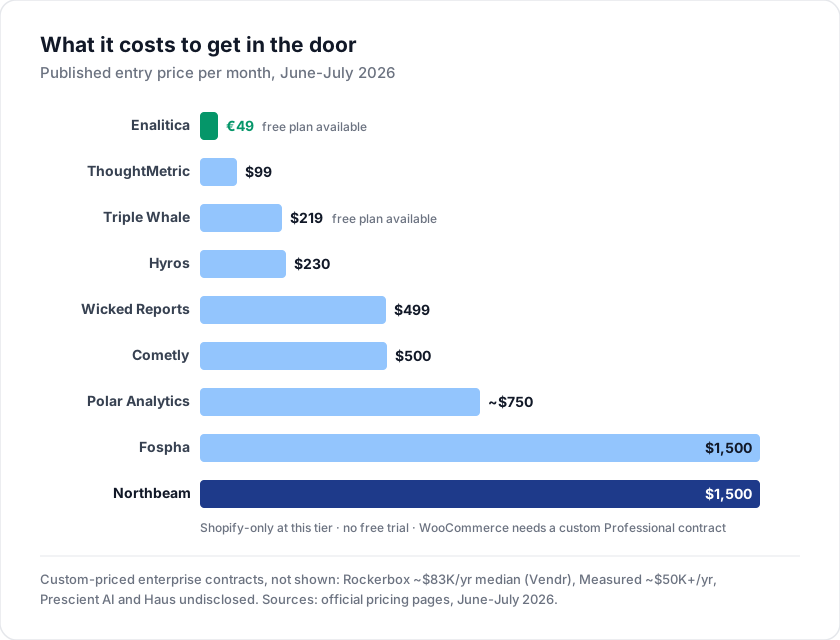
Two columns decide most of this comparison: entry price and e-commerce platform. Two newer ones matter more every month: whether the tool shows the journey behind one order, and whether your own AI assistant can read the data. Prices are the vendors' published figures for September 2026; "quote" means the page shows none.
| Tool | Method | Shopify | WooCommerce | Entry price (Sept 2026) | Journey per order | Your AI (MCP) |
|---|---|---|---|---|---|---|
| Enalitica | Order-based | ✓ | ✓ native | Free / €49 | ✓ Growth+ | ✓ Growth+ |
| Triple Whale | Pixel MTA | ✓ | ✓ (beta since Nov 2025) | Free plan, then by GMV; App Store lists $219 | ✗ | ✓ |
| Polar Analytics | Pixel MTA + geo tests | ✓ | ✗ (roadmap) | from ~$750 under $5M GMV | ✗ | ✓ |
| Rockerbox (DV) | MTA + MMM + tests | ✓ | ✓ | quote, demo only | ✗ | not found |
| Fospha | Daily MMM | ✓ | Pro tier | $1,500 at $100K+ spend | ✗ | not found |
| Hyros | Server-side MTA + calls | ✓ | ✓ | from $69 at $5K tracked revenue | partial | ✓ |
| Cometly | Pixel + server MTA | ✓ | ✓ | quote, by pageviews | ✗ | ✓ Enterprise |
| Wicked Reports | Click-to-order MTA | ✓ | ✓ | $499, month-to-month | ✗ | ✓ |
| ThoughtMetric | Pixel MTA | ✓ | ✓ | $99, 14-day trial | ✗ | ✓ connectors |
| Measured, Haus, Prescient, Paramark | MMM + experiments | ✓ | mostly ✗ | quote; Paramark $100K/yr | ✗ | Haus agent |
| Northbeam | Pixel MTA (+ MMM+ Enterprise) | ✓ | Professional+ | $1,500 Shopify; $3,500 Professional | ✗ | ✓ Pro+ |
Why Do Brands Leave Northbeam?
Brands look for a Northbeam alternative for three reasons, and none of them is that Northbeam is bad: the price assumes enterprise ad spend, the entry tier is Shopify-only, and the output is a modeled estimate rather than a list of orders.
The price assumes you are bigger than you are. On Northbeam's pricing page Starter is $1,500 a month, metered on pageviews, month-to-month, Shopify only. Any other platform means the $3,500 Professional tier on an annual term, plus the 4 to 8 weeks of implementation Northbeam's docs describe, and above $250,000 a month in ad spend Northbeam recommends Enterprise.
You pay for depth you may never use. MMM+ and incrementality are Enterprise options. A store spending $40,000 a month across Google and Meta has too little signal for either, and pays for a platform designed around them.
The output is still modeled. Northbeam starts from tracked events, now enriched with verified views, and models its way to revenue. That is a sound approach at enterprise scale, but the number never reconciles to the one dataset you already trust: your order database. If the dashboard says a campaign drove $18,400 and you cannot list the orders behind it, you are trusting the model.
This is not a Northbeam problem, it is a dashboard problem. Put Meta's reported conversions next to Google's for the 90 days to 25 September 2026 in Enalitica's data and the sum matches the stores' full order count (more than 10,000 orders, over €700,000 of revenue), as if e-mail, organic and direct had sold nothing.
Google Ads reported 2.97 times and Meta 4.6 times as many conversions as there were orders carrying their click ID. Google's Conversions column can include non-purchase actions, Meta counts view-through and engage-through, and click capture misses visitors who declined consent, so read it as reported conversions versus orders carrying the click, not as a verdict.
A tool that starts from orders cannot inflate this way; the ecommerce attribution guide walks through the whole reconciliation.
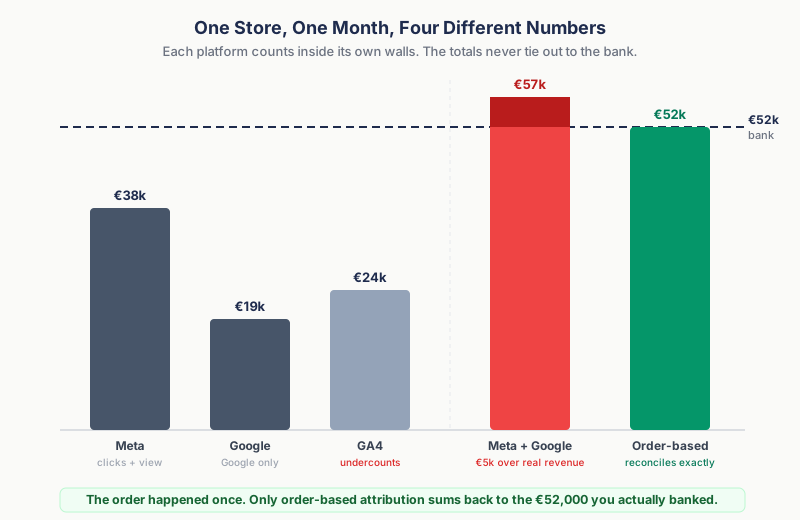
Northbeam is a good tool sold to a narrower audience than its reputation suggests: Shopify, enterprise spend, and an analyst to read the models.
What Is the Cheapest Northbeam Alternative for a Shopify Brand?
The cheapest credible Northbeam alternatives for a Shopify brand are Hyros from $69 a month, ThoughtMetric at $99, and the free plans of Triple Whale and Enalitica, with Enalitica's paid plans from €49. All four connect to Shopify without a developer, and none asks for an annual contract at the entry tier except Triple Whale.
What each price buys differs. ThoughtMetric is pixel-based multi-touch attribution for 50,000 pageviews, every feature on every plan, 14-day trial with no card. Hyros starts at $69 for up to $5,000 of tracked monthly revenue and scales with revenue. Triple Whale's free plan needs no card; paid tiers are quoted by annual GMV on 12-month terms.
Enalitica's free plan captures orders and click IDs server-side and shows a channel summary for the last 30 days, no card, up to 100 orders a month. Be realistic about what $99 buys: solid pixel attribution, not keyword-level order data or a media mix model. For a store under $10,000 a month in ad spend that is often enough; first-year totals are in our ad tracking software cost guide.
MTA, MMM, Incrementality or Order-Based: Which Are You Buying?
"Northbeam alternative" hides four product categories, and comparing across them without knowing it is how brands end up in a bad annual contract. Ninety seconds of theory saves the mistake.
Multi-touch attribution (MTA) tracks users across touchpoints with a pixel and splits conversion credit per journey. Daily, granular, campaign-level, but it only sees what it can track, and modeling fills the gaps. Northbeam, Triple Whale, Hyros and Cometly live here; the mechanics are in our multi-touch attribution guide.
Media mix modeling (MMM) ignores individual users and correlates aggregate spend with revenue over time, so it can credit channels no pixel sees: TV, CTV, podcasts, Amazon halo. It is the only category that answers "do our upper-funnel channels drive sales", and it needs volume. Fospha, Prescient AI and Paramark are MMM-first.
Incrementality testing runs controlled experiments, usually geo holdouts, to measure what ads cause rather than what they correlate with. Measured and Haus are built around it; Polar (Causal Lift) and Rockerbox offer it alongside attribution. Tests need statistical power, which means real spend, and they answer strategic questions quarterly. What a small store can still learn is in our advertising incrementality guide.
Order-based attribution starts from the confirmed orders in your store database and attaches the evidence each order carries: click IDs, campaign, keyword, session. Nothing is modeled; orders without evidence are labeled unknown instead of estimated. Enalitica works this way, and Wicked Reports is the closest neighbour with its click-to-order model.
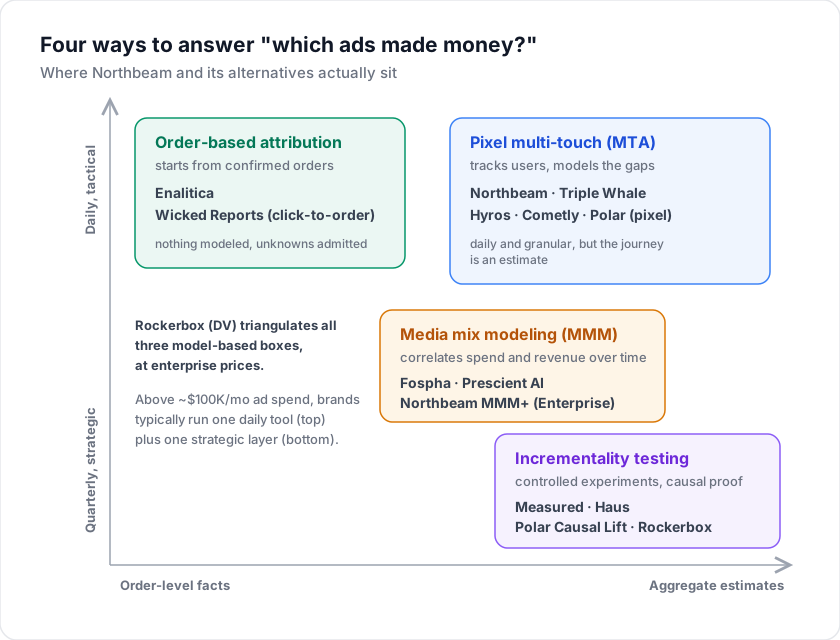
None of the four requires you to build a data warehouse: Polar runs on a Snowflake database it provisions for you, and Triple Whale, Cometly and Prescient sell warehouse export as an add-on.
How omnichannel is a typical mid-size store? Across more than 6,000 customer journeys in Enalitica's data (90 days to 25 September 2026), 42% contained an ad click and 25% touched two or more channels, but only 1.4% touched two or more ad platforms. 26.5% of buyers ordered more than a day after their first measured touch and 7.1% more than a week after.
Below enterprise spend, the cross-channel question is mostly ads versus organic, e-mail and direct, which an order-level journey answers without a model. CTV and podcasts carry no click, which is where MMM earns its place; above roughly $100,000 a month the sensible setup is an always-on attribution ledger plus MMM or experiments for budget strategy.
Enalitica: Order-Based Attribution With Journeys and AI Access
Best for: WooCommerce and Shopify stores that want attribution built on actual orders instead of a modeled estimate, at a price that does not assume enterprise ad spend.
Full disclosure: Enalitica is my product. I will keep this factual.
Enalitica starts from the opposite end of the problem than Northbeam. It syncs every real order from your WooCommerce, Shopify or Shopamine backend and works backward to the marketing that drove it: eight click IDs (gclid, gbraid, wbraid, dclid, fbclid, msclkid, ttclid, li_fat_id), GA4 session data, and the exact Google Ads keyword and campaign behind the click, pulled through the API.
Every number traces to orders. Click any revenue figure and you see the orders behind it: when the dashboard says Google Ads drove €15,011 last month (illustrative), that is 28 specific orders, not a modeled share. Each channel shows direct and multi-touch revenue side by side, and one owner per order means the channels sum to exactly 100% of real revenue.
A customer journey for every order and every enquiry. Open any order and the timeline unfolds under it: the first measured visit, each ad click with its campaign and keyword, organic, e-mail, direct and AI-assistant visits, the pages read, cart and checkout events, the gaps between touches, and the purchase.
Nothing is modeled for display: the journey reuses the click IDs and sessions attribution already stored, so report and journey never disagree. Included from the Growth plan up; the full anatomy is in customer journey tracking.
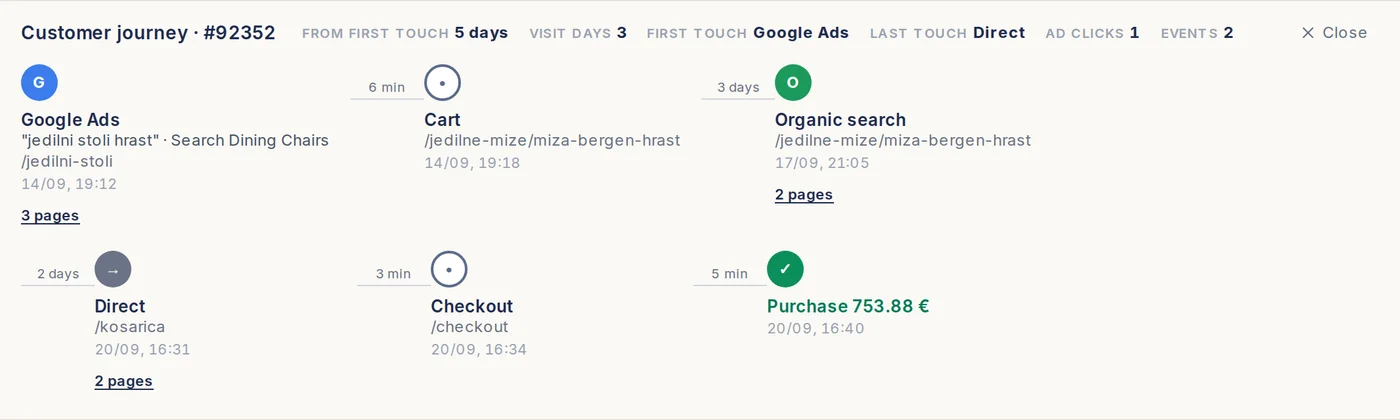
In Enalitica's data, one buyer in four touched two or more channels before ordering, and one in fourteen took more than a week. A journey per order shows which channel opened the sale and which closed it, for that one order.
Bring your own AI, read-only. Enalitica does not ship its own chat agent. Instead it exposes an MCP endpoint, so the Claude, ChatGPT, Gemini or Grok you already pay for connects over OAuth or an API key and reads more than twenty queries: month overview, channel and campaign performance, the journey of one order or enquiry, journey patterns, keyword waste, lead quality.
Read-only, no customer personal data in any answer, every call logged, Growth plan and up. Setup is in connect ChatGPT to your store data.
Profit per campaign, not just revenue. Enalitica imports what each product costs you, adds shipping, payment fees and packaging, and shows POAS next to ROAS in every campaign table, as a pair: direct POAS for the orders a campaign closed, MT POAS for every order it assisted. The rule is to pause only when both sit below 1.0.
WooCommerce native, Shopify in one click. Northbeam's $1,500 Starter is Shopify-only; Enalitica was built on WooCommerce first (I ran a WooCommerce store for 15 years) and reads WooCommerce 8.5+ attribution metadata on every plan, including the free one. For Shopify, Enalitica prepares a private app for your store within 24 hours, then you install and connect it in one click.
Verified purchase events go back to Meta via CAPI and to Google via Enhanced Conversions, and LinkedIn Ads gets its own channel.
The honest boundary. Enalitica has no MMM and no incrementality experiments. If you spend $300,000 a month across eight channels including CTV and need to model channels that carry no click, Fospha, Prescient or Measured belongs in your stack. Enalitica does not bypass consent either: orders from visitors who declined tracking are labeled unknown, not modeled.
The pitch is precision on the data you are allowed to have, hosted on Hetzner servers in the EU. How that differs from a server-side pixel is in server-side tracking vs order-based attribution.
Enalitica pricing: free plan, paid from €49 a month
The free plan needs no card and shows the last 30 days for up to 100 orders a month. Paid plans start at €49 (Starter), then €149 (Growth, with AI access and up to five stores) and €349 (Agency, 15 stores, 6,000 orders included). Every paid plan has a 14-day trial: card required, nothing charged before day 15.
Onboarding imports your recent orders at once, and connecting Google Ads or Meta backfills 12 months of cost history, so attribution is real on day one. Book a demo or start on the free plan and check the numbers against your own order export.
Triple Whale: Shopify-First Attribution With Moby AI
Best for: Shopify DTC brands that want attribution, an AI analyst and creative reporting in one polished package.
Triple Whale is the most-cited Northbeam alternative because it serves the same DTC audience one bracket down. Pricing starts with a free plan that needs no card; paid tiers are priced by annual GMV on its own site, and the Shopify App Store listing shows Foundation from $219 and Automate from $749 a month, on 12-month terms even when billed monthly.
Moby, its AI operator, reads your data and on Automate acts in ad accounts; a read-only Triple Whale MCP connects Claude and ChatGPT.
The trade-offs: MMM and incrementality live only in the Enterprise product Compass, and WooCommerce is a supported integration that launched as a beta in November 2025, secondary to the Shopify experience. Our Triple Whale alternatives guide covers that side of the market in depth.
Polar Analytics: Shopify BI With Causal Lift Tests
Best for: Shopify brands above roughly $5M GMV that want business intelligence, attribution and geo tests in one platform.
Polar calls itself the number one Northbeam alternative, and the pitch has substance: a BI layer on a dedicated Snowflake database per customer, 62 AI agents plus an MCP for Claude and ChatGPT, the Polar Pixel, and Causal Lift, geo-based incrementality tests run by a Polar data scientist. Pricing in Polar's terms starts at $750 a month under $5M GMV, sold after a demo.
Evaluate Polar knowing three things. It is Shopify (plus Amazon, Walmart, TikTok Shop) with WooCommerce on the roadmap. Its pixel uses digital fingerprints to stitch sessions, which in EU markets sits in murky consent territory. And data is processed in the US and the EU.
Rockerbox (DV): MTA, MMM and Tests Triangulated
Best for: Enterprise brands that want MTA, MMM and incrementality reconciled in one place and have the team to operate it.
Rockerbox is the closest like-for-like Northbeam replacement. DoubleVerify announced its acquisition for $85 million in February 2025, and the platform combines multi-touch attribution, media mix modeling and incrementality testing so the three check each other. Integrations include Shopify, WooCommerce and Magento.
There is no public pricing: the plans page leads to a demo, so budget for a dedicated measurement line and someone to run it.
Fospha: Daily MMM for Paid-Social Brands
Best for: Paid-social-heavy DTC brands spending $100K+ a month, especially in the UK and EU.
Fospha is what MMM looks like productized for DTC: the model refreshes daily and, on Pro, reports to ad level, covering the channels MTA structurally undercounts. Pricing is public: Lite at $1,500 a month for $100K to $500K of monthly media spend, Pro at $2,000 plus a percentage of spend, 24 months of history from day one, go-live by day 28.
Shopify comes on Lite; WooCommerce, Magento and marketplaces on Pro. Fospha is a badged TikTok measurement partner.
The floor is the point: $100K a month in spend. Fospha is not a cheaper Northbeam but a different methodology at the same altitude, and there is no user-level view, so you will never trace one order to one keyword.
Hyros: Server-Side Tracking for Call Funnels
Best for: Funnels with calls, webinars or high-ticket sales alongside e-commerce.
Hyros tracks well: long-lived first-party identity, click-ID attribution, call tracking to closed revenue, enriched conversions back to the platforms, and a Claude MCP interface. Pricing is one plan from $69 a month for up to $5,000 of tracked monthly revenue, scaling by revenue rather than ad spend; Shopify installs in one click and WooCommerce through a plugin.
Read the terms before signing: the order auto-renews for a period equal to the initial term unless cancelled at least 30 days before it ends. A store with a normal checkout gets less from Hyros than a business with a sales team does.
Cometly: Four Carts and a B2B Roadmap
Best for: Stores on platforms few others support, and teams running e-commerce and B2B pipelines together.
Cometly's argument is coverage: Shopify, WooCommerce, BigCommerce and Magento are all native integrations, combined with a first-party pixel, server-side tracking and standard MTA models. Pricing is sized on pageviews and quoted on a call, with monthly or annual billing and no free trial; MCP access and warehouse syncs are Enterprise-only.
One caveat: the homepage now leads with attribution for B2B SaaS, HubSpot and Salesforce first, e-commerce second. Note which way the roadmap points.
Wicked Reports: Click-to-Order Attribution With LTV Cohorts
Best for: Stores with serious e-mail and CRM programs that want attribution tied to customer lifetime value.
Wicked Reports is philosophically the closest tool here to Enalitica: attribution tied to order IDs and CRM records rather than modeled sessions, with lifetime lookback and cohort LTV reporting. It resolves identity through Klaviyo, HubSpot and Keap and covers Shopify, WooCommerce, BigCommerce and, through a dedicated integration, Magento 2.
Pricing starts at $499 a month, month-to-month, with Meta CAPI and its 5 Forces AI as $199 add-ons on the lower tiers, plus an MCP server for Claude and ChatGPT.
The trade-off is cadence: reports are processed once a day, so there is no real-time view. If you think in LTV cohorts rather than last week's ROAS, it is a genuine contender.
ThoughtMetric: The $99 Pixel Attribution Tool
Best for: Stores under $10K a month in ad spend that want multi-touch attribution without a contract.
ThoughtMetric charges $99 a month for 50,000 pageviews ($83 on annual), every feature on every plan, with a 14-day trial and no card. It integrates Shopify, WooCommerce, BigCommerce and Magento, combines pixel data with post-purchase surveys, and offers AI connectors for Claude and ChatGPT. It does not offer order-level keyword data or modeling of untracked channels.
MMM and Incrementality Tools: Measured, Haus, Prescient, Paramark
Four tools answer the strategic question ("what would sales have been without this channel?") rather than the daily one. All are quote-based except Paramark, all assume six-figure monthly spend, and none replaces the attribution layer underneath.
Measured: experiments as the source of truth
Measured, founded in 2017 with $35B+ of media measured, runs geo and audience experiments and calibrates a causal MMM with them; there is deliberately no user-level tracking. It has a Shopify integration, claims WooCommerce and Magento connections in its FAQ, and publishes no pricing.
Haus: geo tests with a self-serve posture
Haus runs geo-based tests on Meta, Google and TikTok in the US, added a Causal MMM in October 2025, integrates Shopify and Amazon, and ships an AI agent called Architect. Four tiers, none priced publicly.
Prescient AI: daily Bayesian MMM with retail coverage
Prescient AI is built for brands spending $100K+ a month, on annual contracts, with a daily-updated Bayesian MMM, halo decomposition and unusual retail coverage (Amazon, Walmart, Target, Kroger, Costco). Shopify, BigCommerce and Salesforce Commerce Cloud; no WooCommerce. Campaign-level output only, by design.
Paramark: MMM and tests with public pricing
Paramark combines MMM, geo and audience holdouts and scenario planning, priced from $100,000 a year (Advanced at $150,000 for $10M+ of spend). It is not a pixel-attribution replacement but a layer above one.
Which Northbeam Competitors Have AI Tools?
By September 2026 nearly every tool on this list exposes a read-only MCP connection, so the question is no longer "does it have AI" but what the AI is allowed to read.
- Northbeam: a read-only MCP for Professional and Enterprise, no in-app agent.
- Triple Whale: Moby, an AI operator that reads and (on Automate) acts, plus an MCP.
- Polar: 62 agents, Ask Polar and an MCP, with a free early-access MCP for Shopify brands over $1M GMV.
- Cometly: an in-app agent and, on Enterprise, an MCP. Wicked Reports: 5 Forces AI plus an MCP. Hyros: a Claude MCP interface. ThoughtMetric: AI connectors for Claude and ChatGPT. Haus: the Architect agent.
- Enalitica: no in-app agent; an MCP for your own Claude, ChatGPT, Gemini or Grok on Growth and up, plus a monthly AI report on every paid plan.
An assistant connected to modeled data reasons over a model; connected to order-based attribution and stored journeys, it reasons over orders.
How to Choose Between Northbeam and Its Competitors
Start from your constraint, not from feature lists.
| Your situation | Best option | Why |
|---|---|---|
| WooCommerce store, any size | Enalitica | Native WooCommerce attribution from the free plan; Northbeam needs the $3,500 Professional tier |
| Under $50K a month in ad spend | Enalitica, ThoughtMetric, Triple Whale | Below this line modeled MTA and MMM lack signal; order-level tools and cheap pixels fit |
| Shopify DTC, $10K to $150K a month | Triple Whale or Enalitica | Triple Whale for the AI and BI suite, Enalitica for order-level journeys and EU hosting |
| Want your ChatGPT or Claude on the numbers | Enalitica (Growth), Polar, Triple Whale, Northbeam Pro | All expose a read-only MCP; the data behind it differs |
| Want incrementality proof, Shopify, $5M+ GMV | Polar Analytics | Causal Lift geo tests bundled with BI |
| $100K+ a month, paid-social heavy | Fospha | Daily MMM, public pricing, TikTok measurement partner |
| $100K+ a month, experiments as ground truth | Measured, Haus, Paramark | Purpose-built incrementality programs |
| Call funnels or info products in the mix | Hyros | Call tracking to closed revenue |
The bottom line: if you spend enterprise money across many channels and employ someone to interpret models, Northbeam earns its fee, and so do Rockerbox, Fospha, Measured and Prescient. Most stores searching for alternatives have a simpler problem: knowing, with numbers you can defend, which ads drove which orders. That needs your order database and the discipline to attribute only what the evidence supports.
Frequently Asked Questions
What is the cheapest Northbeam alternative?
Hyros from $69 a month (up to $5,000 of tracked monthly revenue) and ThoughtMetric at $99 a month are the cheapest dedicated attribution tools with published prices in September 2026. Triple Whale and Enalitica both have free plans without a card; Enalitica's paid plans start at €49. At these prices you get pixel or order-level attribution, not MMM.
Does Northbeam support WooCommerce?
Yes, but not at the advertised entry price. Northbeam's $1,500 Starter is for Shopify brands only; WooCommerce, BigCommerce, Magento and custom builds need the Professional tier at $3,500 a month on an annual term, and Northbeam's docs plan 4 to 8 weeks for a non-Shopify implementation.
What minimum ad spend does Northbeam expect?
Northbeam publishes tier positions, not model minimums: Starter for brands spending under $1.5M a year on ads, Professional for up to $500K a month, and Enterprise recommended above $250K a month. Below those lines, order-level tools fit better than modeled confidence.
What is Clicks + Deterministic Views?
Northbeam's attribution model since October 2025. Instead of modeling view-through conversions, it ingests verified impression data from Meta, TikTok, Snap, Pinterest, Axon, Vibe and MNTN and matches it to conversions; clicks still come first, and views get credit only when a journey has no click. It is on every Northbeam tier, and a deterministically matched view is still a view, so decide for yourself whether it deserves revenue credit.
Can I connect ChatGPT or Claude to a Northbeam alternative?
Yes, at most of them. Northbeam (Pro and Enterprise), Triple Whale, Polar, Wicked Reports, Hyros, ThoughtMetric and Enalitica (Growth and up) all expose a read-only MCP connection, so your own assistant can query the data. What differs is what sits behind the connection: modeled sessions at the pixel tools, confirmed orders and stored customer journeys at Enalitica.
Sources
The outside pages this article relies on. Links checked on 25 September 2026.
- Clicks + Deterministic Views (northbeam.io)
- Northbeam's pricing page (northbeam.io)
- 4 to 8 weeks of implementation (info.northbeam.io)
- ThoughtMetric (thoughtmetric.io)
- Hyros (hyros.com)
- Triple Whale's free plan (triplewhale.com)
- Triple Whale MCP (kb.triplewhale.com)
- launched as a beta in November 2025 (triplewhale.com)
- number one Northbeam alternative (polaranalytics.com)
- dedicated Snowflake database (polaranalytics.com)
- MCP (polaranalytics.com)
- Causal Lift (polaranalytics.com)
- terms (polaranalytics.com)
- pixel uses digital fingerprints (polaranalytics.com)
- DoubleVerify announced its acquisition (ir.doubleverify.com)
- Integrations (rockerbox.com)
- plans page (rockerbox.com)
- Pricing is public (fospha.com)
- TikTok measurement partner (fospha.com)
- WooCommerce (docs.hyros.com)
- terms (hyros.com)
- native integrations (cometly.com)
- Pricing (cometly.com)
- homepage (cometly.com)
- dedicated integration (wickedreports.com)
- Pricing (wickedreports.com)
- Shopify, WooCommerce, BigCommerce and Magento (thoughtmetric.io)
- Measured (measured.com)
- Shopify integration (measured.com)
- Haus (haus.io)
- Causal MMM in October 2025 (haus.io)
- Prescient AI (prescientai.com)
- retail coverage (prescientai.com)
- Paramark (paramark.com)
- MCP for Professional and Enterprise (docs.northbeam.io)
Figures marked "in Enalitica's data" are aggregates from the real orders of the stores we measure, with no names and no individual orders. How we measure.
See your real numbers
Import 30 days of orders or leads during a 5-minute onboarding. Works for e-commerce and service businesses.
See plans and pricing