
Server-Side Tracking vs Order-Based Attribution
Server-side tracking fixes the data your browser pixel loses. It is still an estimate. What CAPI and fingerprinting solve, what they don't, and where order-based attribution differs.

Tilen Ledic
Written by

You moved to server-side tracking. Maybe you set up the Meta Conversions API, maybe you stood up a server-side GTM container, maybe you bought a tool that does it for you in five minutes. The good news arrived fast: ad blockers stopped eating your data, Meta's reported conversions jumped, and your ROAS looked healthier than it had in a year.
Then you opened your bank statement, and it still did not match a single dashboard.
This is the part nobody tells you when they sell you server-side tracking. It is the right move for one specific problem, and it genuinely solves it. But it solves capture, not attribution. Those are two different jobs, and confusing them is how stores end up paying for "100% accurate tracking" and still cannot answer the only question that matters: which channel actually drove the revenue in my account?
I have built both sides of this. Enalitica sends server-side conversions to Meta and Google, and it also runs order-based attribution. So this is not "server-side bad, order-based good." It is a map of what each one is for, where the "100% accuracy" claims come from, and why capture and accuracy are not the same word.
What Server-Side Tracking Actually Is
A normal tracking pixel fires in the customer's browser. Server-side tracking moves that event to your server: the customer buys, your backend records it, and your server sends the conversion straight to the ad platform over an API. Meta's Conversions API (CAPI), Google's Enhanced Conversions, a server-side GTM container (Google calls the approach server-side tagging), and tools like Hyros all work this way.
The advantage is real and worth stating plainly. A server-side event does not run in the browser, so it is not killed by an ad blocker, not purged when Safari ITP (Intelligent Tracking Prevention) caps cookie lifetime at 7 days, and not lost when a customer denies iOS App Tracking Transparency. The browser pixel that misses 30 to 50% of events in privacy-strict markets gets most of that capture back. If your problem is that Meta and Google under-report your conversions and bid badly as a result, server-side tracking is the correct fix. Do it.
So if it works, why are your numbers still wrong?
What a Server-Side Pixel Fixes: Capture
Capture is the problem of getting the event recorded at all. This is where server-side wins, and it wins clearly.
When the Meta Pixel is blocked, the order still happened, but Meta never hears about it, so it cannot optimize toward customers like that one. Send the same conversion server-side and Meta hears about it regardless of the browser. The platform's bidding algorithm gets a fuller, cleaner signal, which is the entire point of CAPI. For the mechanics of doing this well, see our Meta Conversions API guide, and if you are routing it through server-side GTM, the three setup options compared here.
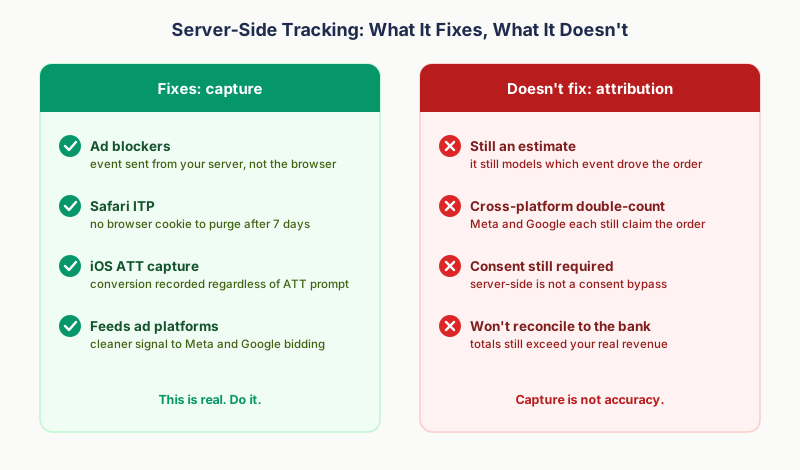
Better capture means a better signal to the ad platform, and a better signal means better bidding. That is genuinely valuable. It is also the end of what server-side tracking does for you. Capture is not attribution.
What a Server-Side Pixel Does Not Fix: Attribution
Here is the part the five-minute setup does not mention. Even with perfect capture, a server-side pixel is still event-based. You end up with a pile of events (page views, add-to-carts, ad clicks, purchases) and you still have to stitch them into a customer journey and model which event drove which order. The capture got better. The modeling did not go anywhere.
That modeling step is why the number is still an estimate. However clean your server-side data, the answer to "which channel earned this order" is an informed guess, computed by a model, not a fact read off the order. For the full breakdown of why that distinction decides whether your numbers are usable, see the complete guide to ecommerce attribution.
And there is a second problem server-side does not touch: it is still per-platform. Your server-side conversions go to Meta so Meta can optimize. They also go to Google so Google can optimize. Neither platform knows what the other did, so when a customer touches both before buying, each applies its own attribution window and claims the order in full. You have recovered the data beautifully and handed it to two walled gardens that will each count it in full. The dashboards still sum to more than your revenue. We walk through exactly how that double-count happens in how Meta, Google, and Enalitica count conversions.
Where Server-Side Tracking's "100% Accurate" Claim Comes From
Walk the server-side tracking market and you will see the same promise everywhere: 95% accuracy, 99% accuracy, "closer to 100%." It is worth understanding what that number actually measures, because two very different things hide inside it.
The first is match rate: the share of conversion events your server successfully delivers to the ad platform and the platform manages to match to a user. A high match rate is good. It is also not the same as knowing which channel drove the sale. You can deliver 99% of your conversions to Meta and Meta will still over-claim them, because match rate says nothing about cross-channel truth.
The second is the quiet one. The last stretch toward "100%" often comes from fingerprinting: building a device signature from signals like IP, user agent, screen, and fonts so the tool can keep matching a user "even when cookies are blocked." That phrase sounds like a free win. In the EU it is a legal problem.
Under the EDPB's Guidelines 2/2023 on the technical scope of Article 5(3) of the ePrivacy Directive, device fingerprinting requires consent in exactly the same way cookies do. "Works even when cookies are blocked" does not mean "legal when consent is denied." When the UK's ICO signalled it might take a softer line on fingerprinting, the response was sharp enough that the position was walked back. So when a tool advertises near-100% accuracy in a market with 25% consent rates, ask which of the two numbers it means, and whether the last few points are being bought with a technique you would not want to defend in a data-protection audit.
Server-Side Is Not a Consent Bypass
This is the honest boundary, and it applies to us too. A consent-aware tool, Enalitica included, does not set its identifiers when a customer's CMP says marketing cookies are denied. Those orders show as Direct or Unknown. We do not fabricate a source for them, and we do not fingerprint our way around the banner.
That means a flat truth worth repeating to anyone selling you a perfect number: in a strict EU market, nobody compliantly attributes 100% of orders. The non-consented share is untrackable for every honest tool, server-side or not. What you can legitimately fix is the technical loss on the consented traffic, and what you should be suspicious of is any product whose accuracy only makes sense if consent did not exist.
Order-Based Attribution: Measurement, Not Optimization
Server-side tracking and order-based attribution are not competitors. They do different jobs.
Server-side tracking's job is optimization: feed each ad platform the cleanest possible conversion signal so its algorithm bids well. Order-based attribution's job is measurement: give you one ledger of which channel drove which order, reconciled to your actual revenue.
Order-based attribution starts where the others end up: the order. The click ID (GCLID, GBRAID, WBRAID, FBCLID) is read at the customer's first landing and written onto the order's own metadata at checkout, first-party data stored in your own shop database. There is no event-to-order matching afterward and nothing to model, because the order already carries the click that drove it. One order gets one primary channel by a deterministic rule, so the totals across channels sum to the number in your bank instead of exceeding it. That is the difference between an estimate and an exact figure, and it is the whole argument of the ecommerce attribution pillar.
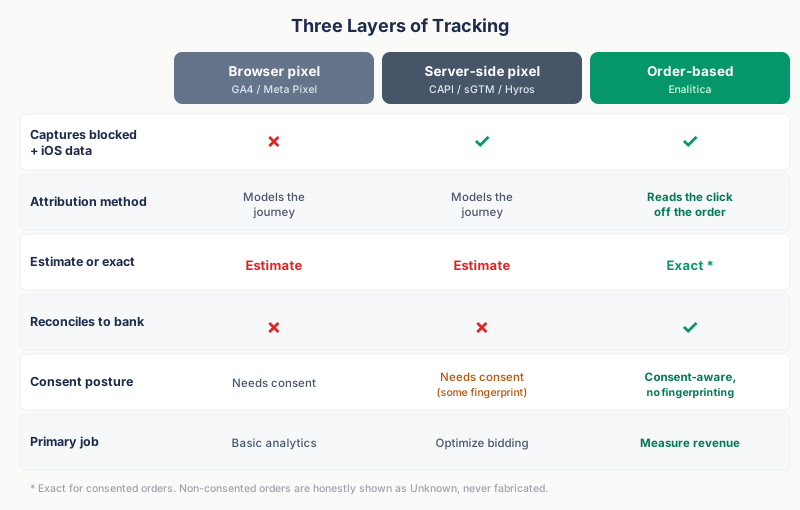
Here is the part that resolves the false choice: you do not pick one. Enalitica reads your real WooCommerce and Shopify orders, attributes each to one channel with the click stored on it, and also sends server-side conversions back to Meta and Google so their bidding still gets clean signal. You get the optimization benefit of server-side and the measurement benefit of order-based from the same source of truth, instead of bolting a server-side pixel onto a store and hoping the dashboards reconcile themselves. They will not. How much attribution a Shopify order carries on its own, and where that ends, is covered in our guide to Shopify attribution.
Browser Pixel vs Server-Side Pixel vs Order-Based Attribution
| Capability | Browser pixel (GA4 / Meta Pixel) | Server-side pixel (CAPI / sGTM) | Order-based (Enalitica) |
|---|---|---|---|
| Survives ad blockers | ✗ | ✓ | ✓ |
| Survives Safari ITP | ✗ | ✓ | ✓ |
| Recovers iOS ATT-denied clicks | ✗ | Partial | ✓ (GBRAID / WBRAID) |
| Attribution method | Models the journey | Models the journey | Reads the click off the order |
| Estimate or exact | Estimate | Estimate | Exact (for consented orders) |
| Cross-platform double-count removed | ✗ | ✗ | ✓ |
| Reconciles to your bank revenue | ✗ | ✗ | ✓ |
| Consent posture | Needs consent | Needs consent (some fingerprint) | Consent-aware, no fingerprinting |
| Primary job | Basic analytics | Optimize ad bidding | Measure revenue |
The pattern reads left to right. Server-side fixes the capture column. Only order-based changes the attribution rows.
Do You Need Server-Side Tracking or Order-Based Attribution?
- Your Meta and Google under-report and bid badly. You need server-side tracking. Set up CAPI and Enhanced Conversions, or a tool that does it cleanly, and feed the algorithms real conversions. This is the right tool for that job.
- Your dashboards disagree and you cannot trust any ROAS number. Server-side will not fix this. You need order-based measurement, one ledger reconciled to revenue.
- Both, which is most stores spending real money. Use server-side to optimize and order-based to measure. Make sure they draw from the same orders, or you have just added a third number to reconcile.
On WooCommerce specifically, both halves of this setup, capture and server-side sending, are walked step by step in the complete WooCommerce conversion tracking guide.
Server-Side and Order-Based Implementation Checklist
- Send server-side conversions for the optimization win. CAPI for Meta, Enhanced Conversions for Google. This genuinely improves bidding. Treat it as an ads tool, not a measurement tool. If a browser pixel keeps running alongside, deduplicate the two streams with a shared event ID so the same purchase is not counted twice.
- Do not confuse match rate with attribution accuracy. A 99% match rate to Meta tells you nothing about whether Meta deserves the order. They are different metrics.
- Audit any "near 100%" claim for fingerprinting. If a tool stays accurate when consent is denied, ask how. In the EU, fingerprinting needs consent like everything else.
- Capture click IDs onto the order. GCLID, GBRAID, WBRAID, FBCLID in order metadata is the foundation of exact attribution. Here is how to do it in WooCommerce.
- Reconcile to the bank, not to a dashboard. Your test for any conversion tracking setup is whether channel totals sum to actual revenue. If they exceed it, you are still estimating.
- Keep one source of truth. If your server-side pixel and your attribution tool read different data, you will spend your Mondays reconciling them. Drive both from the order.
Frequently Asked Questions
Is server-side tracking accurate?
For capture, yes. Server-side tracking records conversions that a browser pixel loses to ad blockers, Safari ITP, and iOS ATT, so it sees far more of your events. For attribution, it is still an estimate. A server-side pixel is event-based: it stitches sessions and models which event drove the order. Better capture does not remove the modeling step, so "accurate" applies to how many events it records, not to which channel truly earned each sale.
Does server-side tracking bypass ad blockers?
Yes, for the conversion event. Because the event is sent from your server rather than the browser, an ad blocker running in the customer's browser cannot stop it. That is the main reason to use it. It does not, however, let you track a customer who declined consent. Bypassing a browser ad blocker and bypassing a consent decision are different things, and only the first is legitimate.
Is server-side tracking GDPR compliant?
Server-side tracking can be compliant, but moving tracking to the server does not remove the need for consent. The ePrivacy Directive governs storing or accessing information on a user's device regardless of where the processing happens. If your server-side setup still relies on identifiers set or read on the device without consent, it has the same legal exposure as a browser pixel. Compliance is about consent, not about where the code runs.
Is fingerprinting legal in the EU?
Generally not without consent. The EDPB's Guidelines 2/2023 confirm that device fingerprinting falls under Article 5(3) of the ePrivacy Directive, the same provision that governs cookies, so it requires consent unless a narrow exemption applies. A tool that maintains tracking accuracy "even when cookies are blocked" by fingerprinting is not escaping consent law, it is taking on the same obligation under a different name. Treat any accuracy claim that depends on it with caution.
What is the difference between server-side tracking and the Conversions API?
The Conversions API is Meta's specific server-side endpoint for sending conversions. Server-side tracking is the general approach, of which CAPI is one instance, alongside Google's Enhanced Conversions, server-side GTM containers, and various tools. They are the same family: send the event from your server instead of the browser. None of them changes how attribution is modeled once the events arrive.
Can I use server-side tracking and order-based attribution together?
Yes, and most stores spending real money should. They solve different problems: server-side feeds the ad algorithms clean signal for better bidding, order-based gives you one reconciled ledger for measurement. Enalitica does both from the same orders, sending server-side conversions to Meta and Google while attributing each order deterministically. The key is that both draw from one source of truth, so you are not reconciling a third number.
Will server-side tracking make my ROAS match my bank account?
No. Server-side tracking improves how many conversions each platform sees, which often makes the per-platform ROAS numbers go up, not converge. Each platform still counts in its own walled garden, so the totals still exceed your revenue. The only thing that makes channel totals reconcile to your bank is attributing each order to one primary channel, which is what order-based attribution does and what no server-side pixel does on its own.
See your real numbers
Import 30 days of orders or leads instantly during 5-minute onboarding. Works for e-commerce and service businesses.
Start free