
Best GA4 Alternatives in 2026: No Banner, EU, Ecommerce
GA4 alternatives checked on vendor pages, September 2026: Matomo, Plausible, Umami, PostHog. Prices, real no-banner rules, EU hosting and what none can see.

Tilen Ledic
Written by
Google's analytics still runs on 47.3% of all websites (W3Techs, September 2026), yet more and more stores replace it over consent, complexity and hidden data. GA4 alternatives are no longer a niche search, and most of the lists that answer it were never checked against the vendors' own pages.
This one was: every price and privacy claim below was read on the vendor's site, the legal part cites regulators, and the Enalitica section says what our own tool does not do. Verified 25 September 2026.
Short answer. Matomo is the only GA4 alternative that keeps sessions, ecommerce reports and funnels; self-hosted it is free, Matomo Cloud starts at 22 € a month for 50,000 hits. Plausible (from $9), Umami (self-host free) and Fathom (from $15) drop cookies and most of the banner problem, but see aggregates, not buyers. PostHog is product analytics, not a marketing report.
None of them, GA4 included, can tell you which order came from which ad, because none of them reads your orders. Enalitica does that job and is not a GA4 replacement for on-site behaviour. GA4 itself stays the sensible choice when its problems do not hurt you and your agency lives in it.
Why stores look for GA4 alternatives at all
Stores look for GA4 alternatives for three reasons that reinforce each other: consent losses, legal history and everyday complexity. Any one of them alone is survivable; together they push a growing share of stores toward Matomo, a cookieless tool, or out of site analytics entirely.
The first reason is consent. GA4 identifies users with the two-year _ga cookie, so in the EU that measurement needs consent, and every declined banner is a session GA4 can only model. Google's behavioural modelling kicks in only above 1,000 denied events a day for seven days, and it estimates users and journeys rather than counting them.
The second is legal history. Austria's data protection authority (13 January 2022), France's CNIL (February 2022) and Italy's Garante (9 June 2022) each found that Google Analytics transferred visitor data to the US without adequate protection. The Commission's adequacy decision of 10 July 2023 settled the transfer question for certified US companies; it did not touch the consent question.
The third reason is everyday practice. GA4 withholds rows behind data thresholds, samples explorations above 10 million events, a pain we met while tracking AI traffic in GA4, and lets payment gateway referrals corrupt sources unless cleaned by hand.
And whichever tool you pick, one thing we measure daily stays: in Enalitica's data, of nearly 12,000 orders in the last 90 days, only 14.4% carried a Google click ID and 12.6% a Meta click ID. Everything analytics infers about the rest is a model; the order export is not.
Can you replace Google Analytics without a cookie banner?
Yes, but "cookieless" is a technical description, not a legal permit. EU law (ePrivacy Article 5(3), as read by the Court of Justice in Planet49 and by the EDPB's 2024 guidelines) requires consent for storing or reading anything on a visitor's device, personal data or not.
A tool that sets no cookie and reads nothing from the device avoids that rule. A tool that only hashes IP and user agent server-side is where vendors and regulators can still disagree, and no EU-wide list of approved tools exists.
Cookieless describes the technique. Consent is decided by what the tool stores or reads on the device, and by the regulator in your country.
Plausible, Fathom, Umami, Simple Analytics and Pirsch build on exactly that: no cookies, no local storage, a daily-rotating hash, aggregates only. France is the one country with a formal exemption scheme (see Matomo below). Slovenia's Information Commissioner says the opposite for cookies: in its 2023 guidelines analytics cookies are never necessary and always need prior, active consent.
The trade-off is the whole decision: the fewer identifiers you keep, the fewer questions you can answer. Aggregates tell you traffic and sources; sessions and users (Matomo, GA4, PostHog with cookies) tell you journeys and cohorts but need the banner; orders tell you money without either, because the order itself is the record.
In Enalitica the order is always counted, and the click ID that names its channel is captured only where the visitor allowed it, so the missing part is labelled unknown instead of modelled. Where the legal line runs is covered in is cookieless tracking legal.
The map of replacements: four categories of analytics
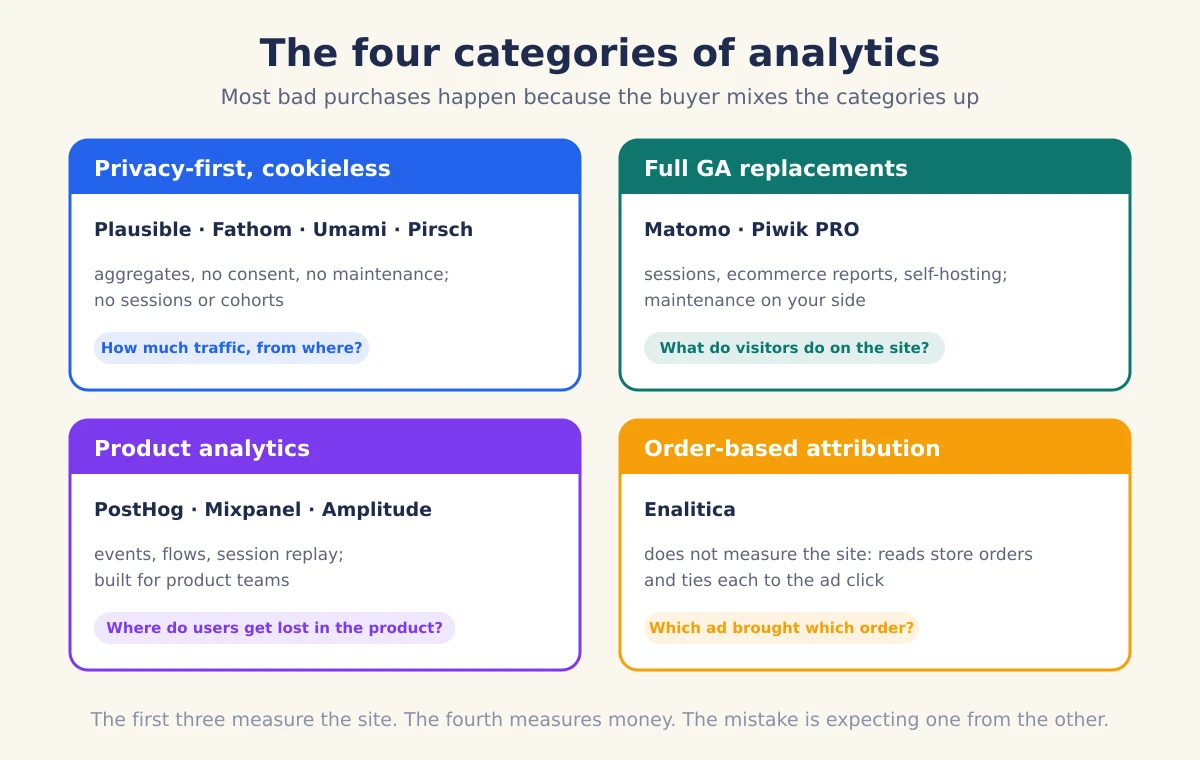
Replacements for Google's analytics fall into four categories, and most bad purchases happen because a buyer mixes them up. Before comparing any two tools, place each in its category and check that the category even answers your question.
- Privacy-first, cookieless analytics (Plausible, Fathom, Umami, Simple Analytics, Pirsch): tiny scripts, aggregated data, no banner. How much traffic, from where; not who bought what.
- Full GA replacements (Matomo, Piwik PRO): sessions, ecommerce reports, goals, self-hosting. The only category that can take over everything GA4 does.
- Product analytics (PostHog, Mixpanel, Amplitude): events, funnels, session replay. Built for teams improving an app or a checkout, not for "which ad sells".
- Order-based attribution (Enalitica): does not measure the site at all; reads orders from the store and ties each one to the click that brought it, the twin for money we took apart in server-side tracking vs order-based attribution.
Matomo vs Google Analytics: the only feature-for-feature swap
Matomo (Piwik until 2018) is the most serious alternative to Google's analytics and, by W3Techs' count, the largest at 1.4% of all websites, 2.4% of sites with a known analytics tool (September 2026). Open source since 2007, it offers what the privacy category deliberately lacks: sessions and visitor journeys, ecommerce reports with revenue per source, goals, funnels and site search, with paid add-ons for heatmaps, session recordings and A/B tests.
Three benefits set it apart. The first is data ownership: the self-hosted edition is free and the data never leaves your server. Matomo 6 needs PHP 8.1+ and MySQL 8.0+ or MariaDB 10.6+, and Matomo Cloud says data and backups stay in Europe.
The second is the consent exemption in France: CNIL runs a scheme under which audience measurement may run without a banner if it serves only the publisher, never follows people across sites, shares nothing and keeps trackers to 13 months. Matomo and Piwik PRO both state CNIL confirmed their exempt configuration in 2021.
The catch stores must know: in the exempt configuration ecommerce tracking, User ID, heatmaps and session recordings are switched off, and Matomo's own FAQ says ecommerce analytics cannot be made consent-exempt. Since July 2025 CNIL publishes no tool list, only a self-assessment; outside France the exemption does not exist.
The banner-free Matomo and the Matomo with revenue per source are two different configurations. CNIL's exemption covers the first.
The third is an open API: all reporting, down to individual visits via the Live API, is available through a documented HTTP API with a token. Since May 2026 Matomo also ships an official MCP server, so Claude or ChatGPT can query your Matomo data, on Cloud and On-Premise.
The honest downsides: Matomo Cloud starts at 22 € a month (annual) or 26 € monthly for 50,000 hits, with a 21-day trial; a hit is any tracked pageview, event, download, outlink or search, so an event-heavy store burns a plan fast. Self-hosting puts maintenance and security patches on your plate, premium add-ons are not free on your own server, and the interface is functional, not pretty.
Choose Matomo if you want GA4's depth with the data on your own server, or you accept the banner-free configuration without ecommerce reports, and someone will own the updates. Skip it if nobody will maintain a server, or your reporting lives inside Google Ads where the native GA4 link already does the work.
When is Plausible or Umami enough?
Plausible or Umami is enough when you need one thing from analytics: an honest view of traffic with no consents and no maintenance. That covers more stores than the industry admits, but only if money is measured elsewhere.
Plausible (Estonian company, AGPLv3, hosted on Hetzner in Falkenstein, Germany) ships a 2.5 KB script, sets no cookies and prices by pageviews from $9 a month for 10,000 pageviews, with a 30-day trial and no card. Revenue goals, filterable by source and campaign, and the Stats API are Business-plan features (from $19).
Umami is MIT-licensed open source you can host for free, sets no cookies and has an API with a key. Both show sources, UTM campaigns, entry pages and goals.
What they cannot do matters just as much: without users and cross-visit sessions there are no cohorts, no journeys, no ecommerce reports with revenue per campaign, and no way to credit a purchase to an ad clicked three days earlier. That is the design, not a flaw: aggregates without personal data are exactly why no banner is needed.
That gap is not a corner case. In Enalitica's data, across more than 6,000 customer journeys, 26.5% of orders came more than a day after the first touch, 7.1% more than a week after, and 25% touched two or more channels. A hash that rotates every 24 hours cannot connect any of them; what a stored journey looks like is in customer journey tracking.
Choose Plausible or Umami if you want traffic numbers you can read in two minutes, the banner gone, and money measured elsewhere: in orders, in Enalitica, in your ERP. Skip them if you expect campaign ROAS or revenue per channel, remarketing audiences, or decisions built on cohorts and user journeys.
PostHog vs GA4: product analytics, not a marketing report
PostHog is open-source product analytics: events, funnels, session replay, feature flags and A/B experiments in one tool. A store usually meets it while fixing a checkout, not while shopping for a GA4-style marketing report, and PostHog overlaps with GA4 far less than comparison articles suggest, although its web analytics dashboard covers visitors, referrers, UTMs and landing pages.
PostHog Cloud is free for 1 million events and 5,000 session recordings a month, with an EU region in Frankfurt where IP capture is off by default. Self-hosting is MIT-licensed but unsupported; PostHog itself points most users to Cloud.
By default PostHog sets cookies and its own GDPR guide says to run a banner. cookieless_mode: "always" stores nothing on the device and PostHog says a banner is then not needed, at the price of a persistent visitor identity, the very thing product analytics is best at. Its reports think in events and funnels, not "revenue per campaign this month"; Mixpanel and Amplitude sit in the same category with the same trade-off.
Choose PostHog next to GA4 if you are fixing a funnel, want session replay and experiments in one tool, and someone will maintain a tracking plan. Skip it if you want a marketing report, hoped it removes the banner by default, or nobody will define the events.
Fathom, Piwik PRO, Simple Analytics, Pirsch and Cloudflare in brief
Beyond Matomo, Plausible, Umami and PostHog, five names show up in every search for GA4 replacements. Each deserves a verdict, even a short one.
- Fathom Analytics: privacy category, from $15 a month for 100,000 pageviews, 7-day trial with a card, no free plan. EU visitors are processed on EU servers with the IP stripped before anything reaches its US infrastructure. UTM tracking, purchase events with a value and a reporting API are all listed; how far the API breaks traffic down by campaign we could not confirm, so treat it as a partial pass.
- Piwik PRO: Matomo's enterprise sibling from the same Piwik roots. The free Core plan was retired with the pricing change of 4 August 2025; entry is now Business from 36 € a month (2 million actions, 25-month retention, 30-day trial), with data centres in Germany, the Netherlands, Sweden and outside the EU. Aimed at banks, healthcare and the public sector more than ecommerce.
- Simple Analytics (Netherlands, data stays in the Netherlands, free plan for hobby sites, self-serve from 20 € a month) and Pirsch (made and hosted in Germany, from $6 a month for 10,000 pageviews, 30-day trial without a card): solid, cookieless, EU-owned, with the same category limits as Plausible.
- Cloudflare Web Analytics: free on every plan and cookieless. The data is queryable through the GraphQL Analytics API (the
rumPageloadEventsAdaptiveGroupsdataset), but those datasets are adaptively sampled and the metrics stay coarse: a free thermometer, not a reporting source.
Comparison: GA4, Matomo, Plausible, Umami, PostHog
Every cell comes from the vendor's own pages opened in September 2026. A dash means the vendor's site did not state it; that is not a ✗.
| GA4 | Matomo | Plausible | Umami | PostHog | |
|---|---|---|---|---|---|
| Price | free | self-host free / Cloud from 22 € | from $9 (pageviews) | self-host free / cloud | 1M events + 5k replays free |
| Open source | ✗ | ✓ | ✓ | ✓ | ✓ |
| Works without a consent banner | ✗ | ✓ CNIL config (ecommerce off) | ✓ | ✓ | ✓ only in cookieless mode |
| Sessions and visitor journeys | ✓ | ✓ | ✗ | ✗ | ✓ |
| Ecommerce revenue per source | ✓ | ✓ | revenue goals (Business plan) | partial | ✓ (events) |
| Documented export API | ✓ (BigQuery/Data API) | ✓ | ✓ (Business plan) | ✓ | ✓ |
| Your own AI assistant (MCP) | – | ✓ official | community server | – | – |
| Journey for every store order | ✗ | ✗ | ✗ | ✗ | ✗ |
No site analytics, Google's or alternative, can say which order came from which ad, because none of them ever sees the order.
The last row is the point, not a joke: Enalitica has that journey from the Growth plan up, and that row decides the category, not the tool. Plausible's MCP server is a community build, not an official integration; Matomo's is official. The order question needs data from the store, as we broke down in the ad tracking cost guide.
What Enalitica measures instead of GA4, and what it does not
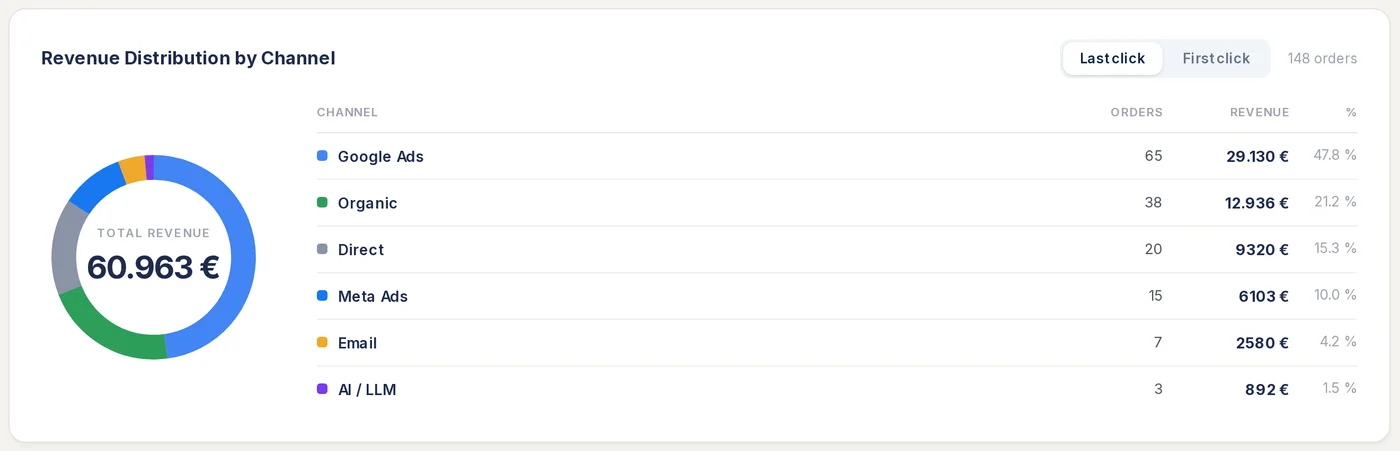
Enalitica is not a GA4 replacement for on-site behaviour, and this post would be dishonest if it pretended otherwise. It reads the orders from your WooCommerce, Shopify, Shopamine or custom shop, ties each one to the click IDs its own consent-gated script captured (gclid, gbraid, wbraid, fbclid, msclkid and three more) and shows revenue and profit per channel and campaign with the real orders behind every number.
From the Growth plan up it also stores a customer journey for every order and every enquiry: first touch, ad clicks, sessions, pages, the purchase, with the days between them. That is the one thing no site analytics on this page can produce, because none of them holds the order.
On Growth and up you can connect the AI you already pay for (Claude, ChatGPT, Grok, or Gemini by API key) to that data through a read-only MCP connection with no customer personal data; how that works is in connect ChatGPT to your store data.
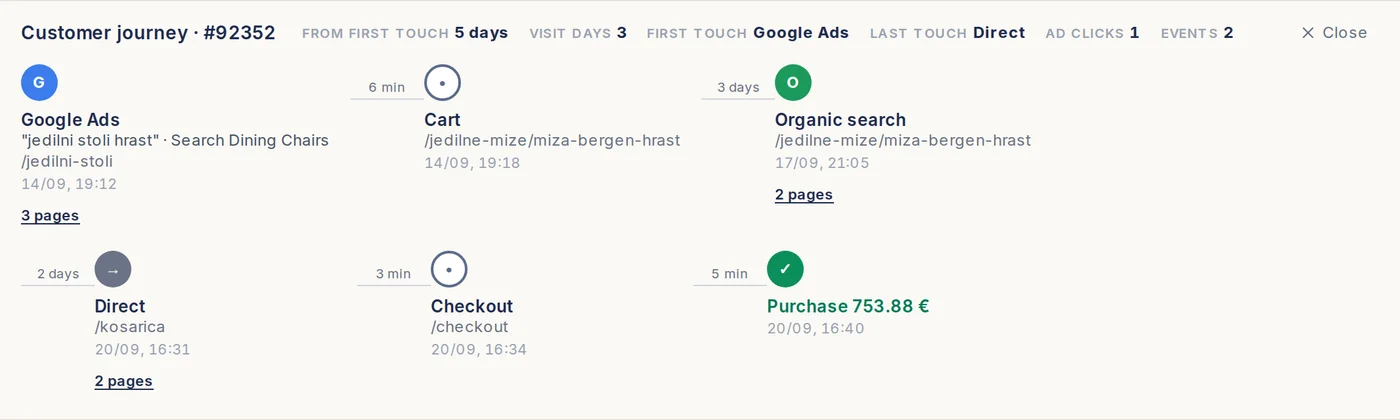
The difference between a session channel and an order's origin is measurable. Enalitica's data holds more than 10,000 orders from stores with GA4 connected; GA4 named a channel for 99% of them, yet for more than one in five orders that carried a Google Ads click ID (21%) GA4 credited the purchase session to something else, usually organic or direct.
That is not GA4 being wrong: GA4 answers which session bought; the click ID answers which ad started it.
What Enalitica does not do: pageview-level content reports, heatmaps, session replay, cohorts of anonymous visitors, or site-wide behaviour analytics. For traffic context it connects GA4 today (sources, landing pages, events, funnel). Any other provider's API must give us token access, a source/medium/campaign breakdown, daily granularity for any period, and entry pages.
Matomo meets all four plus per-visit data; Plausible and Umami meet the four with aggregates. We have not built those connectors yet and will build one with the first client who needs it; order attribution never depended on which site analytics you run. To see it on your own orders, see plans and pricing or book a live demo.
Do you still need site analytics next to order attribution?
Yes, but for a different question. Site analytics (GA4, Matomo, Plausible) answers "what happens ON the site": how much traffic, from where, what people read, where they drop off. Order-based attribution answers "what paid off": which campaign brought which orders and how much profit remains after purchase prices and returns.
One is the traffic thermometer, the other is the till. Trust the orders for money (no sampling there, no thresholds, no declined cookies), and pick site analytics by category for behaviour: Plausible or Umami for peace and zero maintenance, Matomo for depth and ownership, PostHog for a product team fixing the funnel, GA4 if its problems do not hurt you. There is only one wrong purchase: expecting any site analytics to be the till.
Frequently Asked Questions
Is Google Analytics even legal in the EU?
Yes, using it is legal today: the Commission's adequacy decision of 10 July 2023 settled the US data transfers that Austria, France and Italy had ruled unlawful in 2022. The consent requirement remains, GA4's _ga cookie needs it, and CNIL's audience-measurement exemption was never granted to Google's analytics, so every declined banner still means a modelled session.
Which analytics works without a consent banner?
Plausible, Umami, Fathom, Simple Analytics and Pirsch are designed without cookies or local storage, so nothing is stored on or read from the device, which is what ePrivacy Article 5(3) regulates. Matomo and Piwik PRO achieve the same in France through CNIL's exempt configuration, with ecommerce tracking off. GA4 and PostHog with cookies need the banner; PostHog's cookieless mode does not, at the cost of returning-visitor identity.
Is PostHog a good alternative to GA4?
For a product team yes, for marketing reporting no. PostHog beats GA4 at events, funnels, session replay and experiments, and its free tier of one million events and 5,000 recordings a month is generous, but it does not remove the banner by default and does not produce the channel and campaign revenue reports a marketing team expects.
Does Enalitica replace Google Analytics?
No. Enalitica measures orders, channels, profit and the journey behind each order and enquiry; it does not report on-site behaviour, content or heatmaps. Most clients keep GA4, Matomo or Plausible for traffic and use Enalitica for money.
Does Enalitica connect to Matomo or Plausible?
Not yet. GA4 is the site analytics Enalitica connects today, as traffic context next to the orders. Matomo, Plausible and Umami have documented APIs that meet our four conditions, and we will build the first connector with the first client who needs it; order attribution in Enalitica works independently of the site analytics you choose.
Sources
The outside pages this article relies on. Links checked on 25 September 2026.
- 47.3% of all websites (w3techs.com)
- two-year _ga cookie (support.google.com)
- behavioural modelling (support.google.com)
- Italy's Garante (9 June 2022) (garanteprivacy.it)
- adequacy decision of 10 July 2023 (commission.europa.eu)
- data thresholds (support.google.com)
- samples explorations above 10 million events (support.google.com)
- Planet49 (curia.europa.eu)
- EDPB's 2024 guidelines (edpb.europa.eu)
- daily-rotating hash (plausible.io)
- 2023 guidelines (ip-rs.si)
- W3Techs' count (w3techs.com)
- PHP 8.1+ and MySQL 8.0+ or MariaDB 10.6+ (matomo.org)
- data and backups stay in Europe (matomo.org)
- CNIL runs a scheme (cnil.fr)
- Matomo (matomo.org)
- Piwik PRO (piwik.pro)
- exempt configuration (matomo.org)
- ecommerce analytics cannot be made consent-exempt (matomo.org)
- documented HTTP API with a token (developer.matomo.org)
- official MCP server (matomo.org)
- Matomo Cloud (matomo.org)
- 21-day trial (matomo.org)
- Estonian company (plausible.io)
- AGPLv3 (plausible.io)
- 2.5 KB script (plausible.io)
- from $9 a month (plausible.io)
- Revenue goals (plausible.io)
- Stats API (plausible.io)
- MIT-licensed (raw.githubusercontent.com)
- sets no cookies (docs.umami.is)
- API with a key (docs.umami.is)
- web analytics dashboard (posthog.com)
- PostHog Cloud (posthog.com)
- EU region in Frankfurt (posthog.com)
- Self-hosting (posthog.com)
- cookieless_mode: "always" (posthog.com)
- from $15 a month (usefathom.com)
- processed on EU servers (usefathom.com)
- all listed (usefathom.com)
- pricing change of 4 August 2025 (piwik.pro)
- Business from 36 € a month (piwik.pro)
- Netherlands (simpleanalytics.com)
- made and hosted in Germany (pirsch.io)
- free on every plan (developers.cloudflare.com)
- rumPageloadEventsAdaptiveGroups dataset (developers.cloudflare.com)
- adaptively sampled (developers.cloudflare.com)
- community build, not an official integration (plausible.io)
Figures marked "in Enalitica's data" are aggregates from the real orders of the stores we measure, with no names and no individual orders. How we measure.
See your real numbers
Import 30 days of orders or leads during a 5-minute onboarding. Works for e-commerce and service businesses.
See plans and pricing