
Privacy-Safe Attribution: Replacing Last-Click Without Fingerprinting
Privacy-safe attribution defined properly: why last-click is dying, the four-layer stack that replaces it, and a migration checklist for stores.

Tilen Ledic
Written by
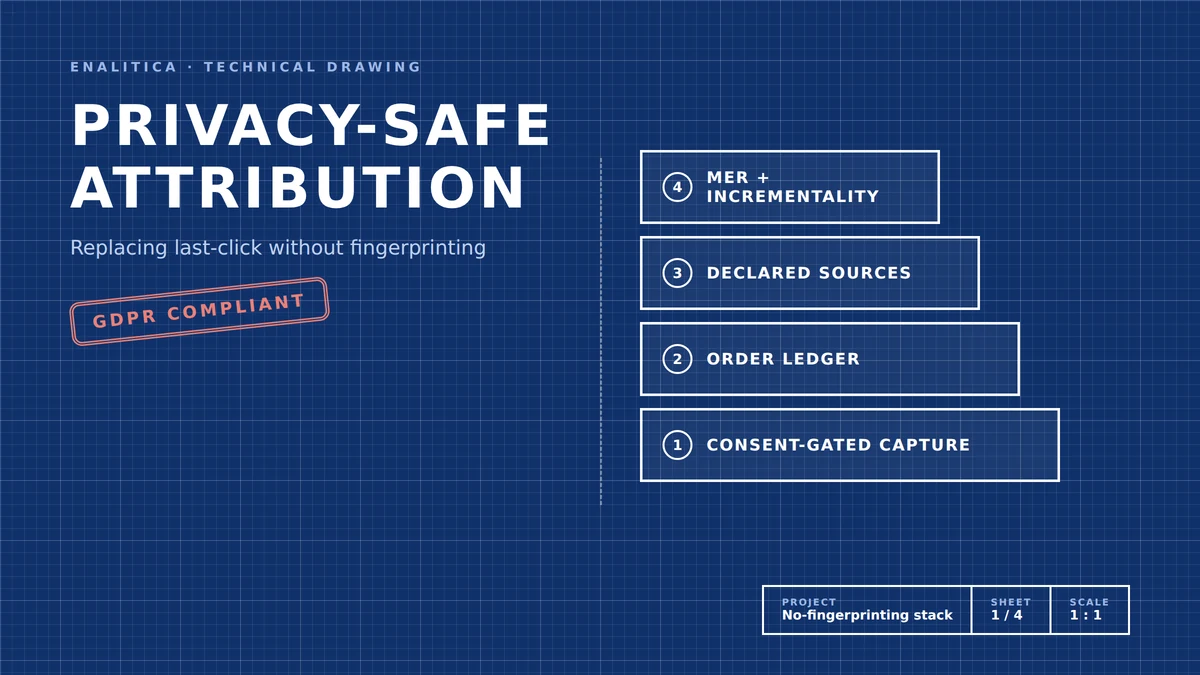
Privacy-safe attribution is usually presented as a resignation: give up user-level truth, retreat to aggregate models, accept blur. This guide argues the opposite. What you actually have to give up is tracking people without consent; order-level truth survives just fine, and the four-layer stack below is how.
The industry consensus says privacy-safe means media mix modeling and estimates. We build attribution for EU stores for a living, and our position is different: a store's own orders, captured with consent on its own domain, are the most privacy-safe dataset in existence, and they happen to be the most auditable one too.
Privacy-safe does not mean giving up order-level truth. It means giving up tracking people who said no. Those are very different sacrifices.
Why is last-click attribution failing?
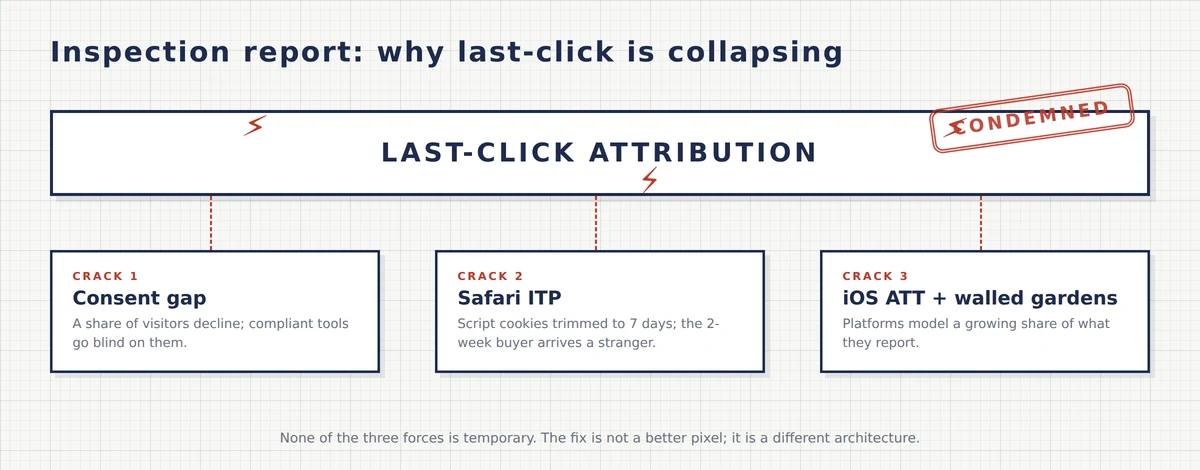
Last-click attribution assumed one thing: that the click before the purchase is observable. Three forces broke that assumption, and none of them is temporary.
Consent gaps. In the EU, a meaningful share of visitors decline tracking, and every compliant tool goes blind on them from the first pageview.
Browser defenses. Safari's ITP caps cookies set by script to a seven-day expiry, so a customer who clicks an ad and buys two weeks later arrives as a stranger; Firefox and Brave apply their own versions.
Walled gardens. iOS App Tracking Transparency requires apps to get permission before tracking people across other companies' apps and websites, which cut the signal Meta's pixel relied on. That is why every platform now models a growing share of what it reports.
The result is familiar from every store's analytics: platform numbers that disagree with each other, GA4 undercounting, and a Direct bucket that swallows a little more revenue each quarter.
What privacy-safe attribution actually means
Privacy-safe attribution is measurement that satisfies three conditions at once, and most tools marketed under the label fail at least one of them.
- No identification without consent. No fingerprinting fallbacks, no "consent-independent" tracking, no probabilistic matching of people who declined. If a method reads the visitor's device to recognize them, it needs consent, full stop.
- First-party data only. Evidence lives on your domain and in your order database: your cookies, your click IDs, your customers' own statements. Nothing depends on third-party cookies or cross-site identity graphs.
- No hidden modeling. Whatever the report claims, you can audit: a click ID on an order, a statement recorded on it, or an honest Unknown. Estimates are allowed only when labeled as estimates.
Notice what the definition does not require: giving up the order level. That is the industry's false addition, and the rest of this guide is the architecture that proves it.
Do you have to choose between order-level truth and privacy?
Search for privacy-safe measurement and the consensus answer is aggregate: media mix modeling, incrementality testing, server-side pipelines, all valuable, all blurry at the level where daily decisions happen. The implication is that user-level and privacy-safe cannot coexist, so retreat to statistics.
The implication is wrong for one structural reason: a store already owns the ground truth. Every order is a real, consented business record: the customer handed over their data to buy something. Attaching the click evidence that same customer's consented session produced is not surveillance; it is bookkeeping. The privacy problem was never "knowing which ad led to an order"; it was tracking people across the web who never agreed to it.
A store's own orders, captured with consent on its own domain, are the most privacy-safe marketing dataset in existence. Retreating to aggregate models means abandoning data you legitimately own.
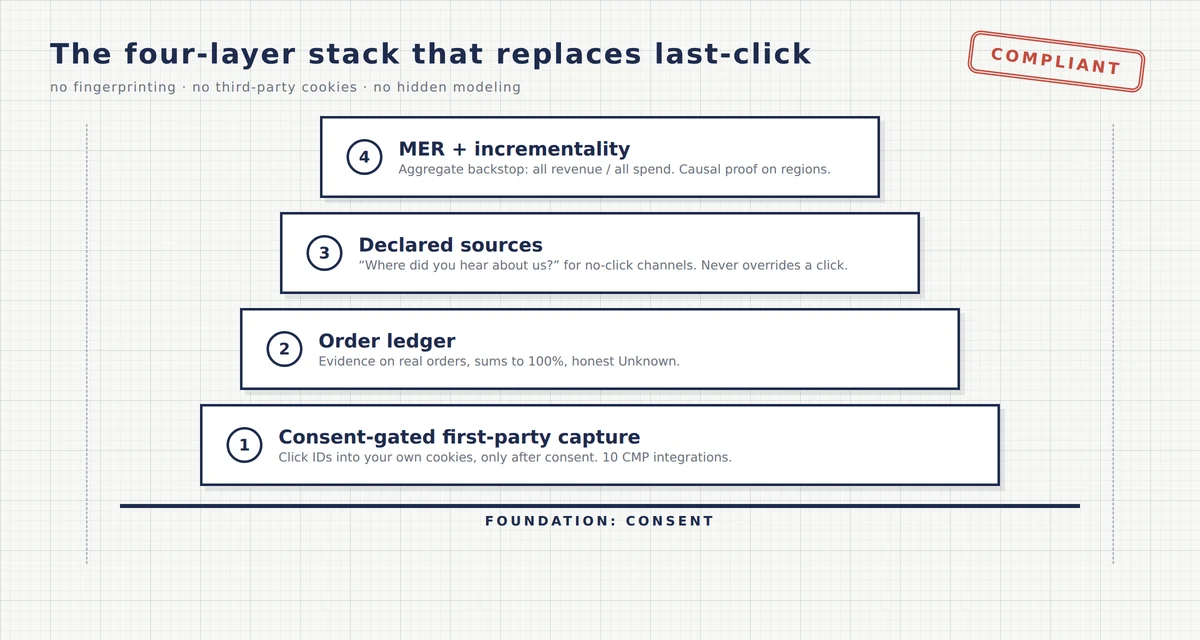
Layer 1: consent-gated first-party capture
The foundation is a script on your own domain that captures click IDs and campaign parameters into first-party cookies, only after consent. Gated means gated: before the visitor accepts, nothing is stored and nothing is read; after a decline, the pageview stays anonymous forever.
This layer must speak your consent platform's language, whatever it is: Cookiebot, CookieYes, OneTrust, Complianz, iubenda, Google Consent Mode, the IAB TCF signal. A capture script that ignores the CMP is not privacy-safe regardless of where its cookies live.
The honest cost: declined visitors are lost to click attribution. That loss is shared by every compliant tool on the market; the difference is whether the report admits it, a point our cookieless tracking legality guide examines in detail.
Layer 2: the order-based ledger
The second layer changes the direction of measurement: instead of starting from tracked sessions and modeling toward revenue, start from confirmed orders and attach the evidence each one carries. A click ID makes the order proven; no evidence makes it honestly Unknown; channels sum to exactly 100 percent of real revenue.
Click evidence covers less than most people expect. In Enalitica's data, last 90 days to 28 September 2026, 26.4% of nearly 12,000 orders carried any paid click ID. The rest were attributed from the session, referrer or landing page, or marked Direct or unknown, and what consent hides stays marked unknown instead of being modeled into a channel.
This is the layer that rescues order-level truth. Nothing about it requires identifying anyone without consent, because it only ever joins two things the store already owns: its order database and the consented click evidence from layer 1. The full comparison with modeled approaches is in our attribution software guide.
Layer 3: declared sources for channels without clicks
Billboards, TV, word of mouth and AI recommendations the buyer acts on days later never produce a click, consented or not. The privacy-safe answer is not a model; it is the customer's own voice: ask "where did you hear about us" and record the answer on the order.
A statement is first-party data in its purest form, volunteered by the person it concerns. Kept in its place (it may claim orders that would otherwise be Unknown or Direct, never orders with click evidence), it gives no-click channels a labeled row without a single estimated number. The mechanics, biases and rules are in our self-reported attribution guide.
Layer 4: MER as backstop, incrementality as proof
Aggregate methods belong in the stack, in a supporting role rather than as the whole building. MER (total revenue divided by total marketing spend) is computed from two numbers no privacy regulation can touch, which makes it the perfect sanity check: if per-channel attribution looks great while MER sinks, something is claiming credit it did not earn.
And when a real causal question matters (does this TV spend actually work?), the honest instrument is an incrementality test, not a filled-in journey. Aggregate answers for aggregate questions; the order ledger for the daily ones.
What to avoid: the shortcuts that reintroduce risk
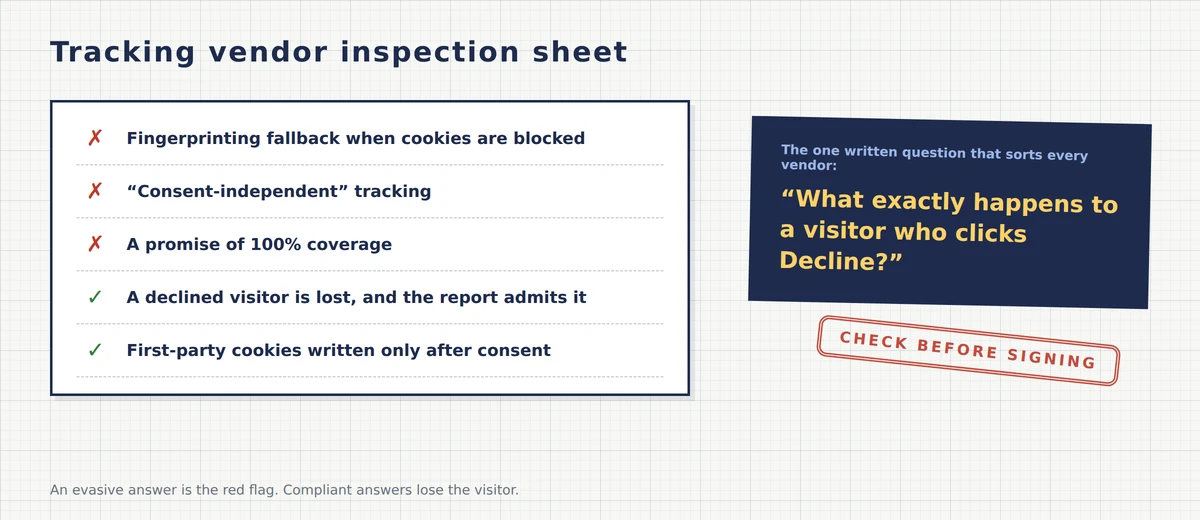
Two shortcut families undo the whole stack. Fingerprinting fallbacks: when cookies are blocked, some tools silently switch to device-signature matching, which the EDPB guidelines on Article 5(3) of the ePrivacy Directive place under the same rule as cookies: consent, unless a narrow exemption applies. "Consent-independent" tracking: any vendor promising to see visitors who declined is making a legal bet with your name on the checkout page.
The test is one written question to the vendor: what exactly happens to a visitor who clicks Decline? Compliant answers lose that visitor; evasive answers are the red flag. The vendor comparison applies this test to ten tools.
Migration: replacing last-click in practice
Replacing last-click is a sequence, not a leap. Six steps cover a typical store:
- Audit your consent gate. Confirm the capture script fires only after acceptance, on every template, in every language variant.
- Move capture first-party. Click IDs and UTMs into cookies on your own domain, written by your own script.
- Anchor reporting in orders. Revenue per channel from the order database, with an explicit Unknown row; retire session-based revenue as the source of truth.
- Add declared sources. One question at the till, on the phone, or on the order form; grouped answers, click always wins.
- Put MER above the channel table. One honest ratio as the ceiling every channel claim must fit under.
- Label every estimate. Whatever modeled numbers remain (platform ROAS, projections), mark them as claims, never mix them into the auditable ledger.
How Enalitica ships the privacy-safe stack
Enalitica is this architecture as a product. The tracking script gates strictly behind ten consent integrations (Cookiebot, CookieYes, OneTrust, Complianz, iubenda, WP Consent API, Shopify Privacy, Google Consent Mode, TCF, plus its own banner) and contains no fingerprinting of any kind. Capture is first-party on your domain, with 90-day cookies for click IDs.
The ledger side follows the layers exactly: orders with click evidence sum to 100 percent, declined and evidence-free orders land in a visible Unknown row, customer statements get their own Declared source view, and true MER sits above it all. Data is hosted on EU servers (Helsinki) with per-tenant encryption, so the privacy posture holds at the infrastructure layer too.
The boundary, stated plainly: Enalitica does not recover the visitors who declined, does not model view-through, and does not promise 100 percent coverage, because under the definition above, no honest tool can.
Frequently Asked Questions
What is privacy-safe attribution?
Privacy-safe attribution is marketing measurement that identifies nobody without consent, runs entirely on first-party data, and contains no hidden modeling. It replaces last-click tracking with a stack of consent-gated capture, order-based reporting, declared sources and aggregate backstops like MER.
Is server-side tracking privacy-safe?
Not by itself. Server-side tracking changes where data is processed, not whether consent exists; a server-side pixel that fires for declined visitors is as non-compliant as a browser pixel doing the same. Privacy-safety comes from the consent gate and data policy, not from the architecture diagram.
Can attribution work without consent banners at all?
Only at the aggregate level. MER and media mix modeling need no personal data, and incrementality tests run on regions rather than people. Anything that connects an individual visit to an individual order requires a lawful basis, and for tracking technologies in the EU Article 5(3) of the ePrivacy Directive allows storing or reading information on a device only with consent or where strictly necessary, which marketing measurement is not.
Does privacy-safe attribution mean less accurate numbers?
It means fewer numbers, not falser ones. You lose the visitors who declined and the channels that leave no click, and both losses are visible instead of papered over with estimates. A smaller auditable number beats a complete unverifiable one for every budget decision.
Is MMM the only privacy-safe way to measure marketing?
No. MMM is privacy-safe but aggregate; it cannot tell you which campaign closed yesterday's orders. An order-based ledger built on consented first-party evidence is equally privacy-safe and stays at the order level. The strongest setup uses both, each for the questions it can actually answer.
Sources
The outside pages this article relies on. Links checked on 3 October 2026.
- caps cookies set by script to a seven-day expiry (webkit.org)
- requires apps to get permission before tracking people (developer.apple.com)
- EDPB guidelines on Article 5(3) of the ePrivacy Directive (edpb.europa.eu)
Figures marked "in Enalitica's data" are aggregates from the real orders of the stores we measure, with no names and no individual orders. How we measure.
See your real numbers
Import 30 days of orders or leads during a 5-minute onboarding. Works for e-commerce and service businesses.
See plans and pricing