
Affiliate Attribution for E-commerce: Stop Paying Twice for One Order
Affiliate attribution for e-commerce: how network click IDs work, why coupon sites take the last click, and how to catch orders claimed twice.

Tilen Ledic
Written by
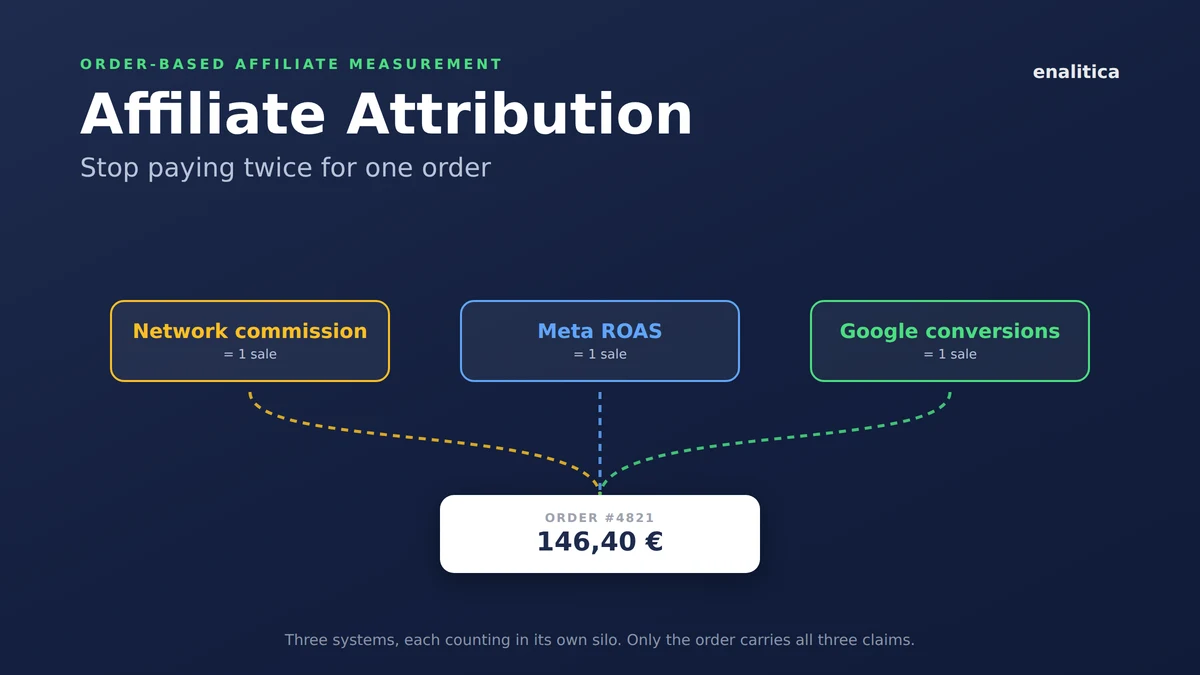
Affiliate attribution is the part of e-commerce measurement where the referee is also a player. The affiliate network that decides whether a partner earned a commission is the same company that gets paid when the answer is yes. Store owners rarely check that answer against anything, and that is how the same sale quietly ends up paid for twice.
The mechanics below apply to any store with a partner program: which URL parameters prove a partner click, why the network's number and the ad platform's number overlap, and how to reconcile both against the one record that cannot be double counted.
One sale can appear on three reports at once: the network's commission invoice, Meta's ROAS and Google's conversions. Only the order knows it was one sale.
How affiliate tracking works: click IDs, cookies and postbacks
Affiliate tracking runs on the same mechanism as ad tracking: a click identifier in the URL, a cookie that remembers it, and a report that claims the sale. When a visitor clicks a partner's link, the network appends its click ID to your landing URL, and each network has its own parameter name.
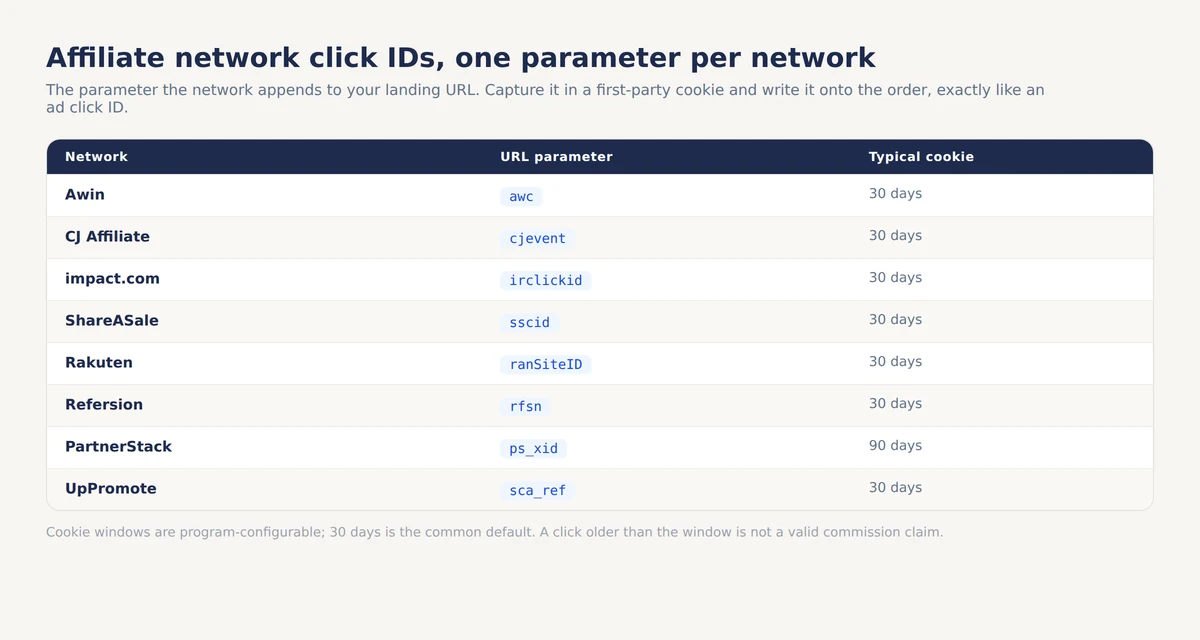
The click ID is stored in a cookie, typically for about 30 days (Awin calls 30 days the industry standard). When an order happens inside that window, the store (or its plugin) reports the sale back to the network in a postback, the network matches it to the click, and the partner earns the commission.
Two properties of this design matter for everything below. The network only ever sees its own click, never your other channels. And the network both measures the conversion and profits from it, which is a reason to verify, not necessarily to distrust.
Why do affiliate networks and ad platforms claim the same order?
Affiliate networks and ad platforms claim the same order because each system counts in its own silo. A buyer clicks a partner's review on Monday, gets a Meta retargeting ad on Wednesday, and searches your brand on Google before buying. The network reports one commission-earning sale, Meta reports one conversion, Google reports another. Three claims, one order.
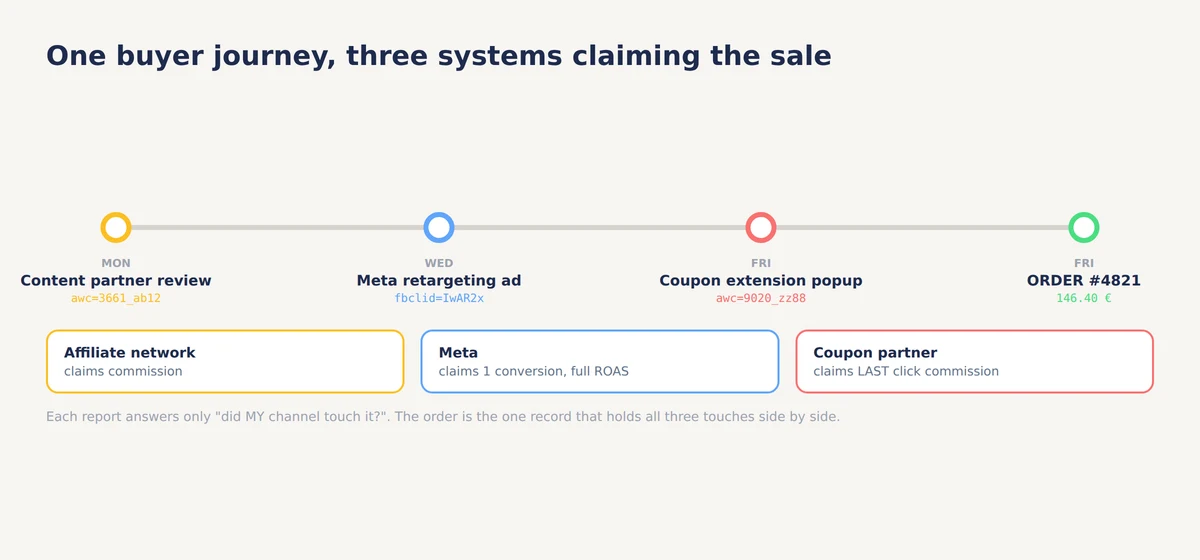
The cost is not academic. The commission is real money out, and the inflated platform ROAS steers next month's budget. Multi-channel orders are common, not an edge case. In Enalitica's data, last 90 days to 28 September 2026 (more than 6,500 order journeys), 25.5% of orders touched two or more channels, so on a store with a real partner program the overlap is a monthly line item, not a rounding error.
None of the three reports is lying. Each one is answering "did my channel touch this sale?", and the honest answer is often yes for all of them. The question nobody in that setup answers is the one that costs money: how many touches were there in total, and which ones would the sale have happened without? That is what advertising incrementality asks.
Recommendation widgets play the same game one level down, at the order line; how to read their revenue claims is in our ecommerce product attribution guide.
Affiliate attribution needs one source of truth: the order
Affiliate attribution stops being a shouting match between reports the moment every claim is written on the same record: the order. An order can hold the partner's click ID, the ad platform's click ID, the UTM parameters and the coupon code side by side. Reports can disagree forever; a single order carrying all the evidence cannot.
This is order-based attribution applied to partners, and it is the same approach we use for e-commerce attribution generally: capture every click ID in a first-party cookie, write them onto the order at checkout, and treat the order as the record of the journey.
The order is the only place where all the claims meet. The network sees its click, Meta sees its pixel, Google sees its tag; none of them sees the others. Your order data is the one dataset where "the network claims this sale AND Meta claims this sale" is a checkable statement instead of a suspicion.
Coupon sites and the last click before checkout
Coupon publishers earn a large share of affiliate payouts by being the last click, not the first cause. A buyer who is already at your checkout opens a new tab, searches "your brand discount code", clicks a coupon site, and returns. The coupon site's cookie is now the freshest, and last-click commission rules pay it for a sale that was already happening.
Browser coupon extensions industrialise the same move: one click in a popup can register a partner touch seconds before purchase. How often that happens differs by program, and the click-to-order gap per partner, covered below, is how you measure it on your own orders.
A coupon click that happens twenty seconds before checkout is rarely the reason the sale happened. Last-click commission rules pay it as if it were.
Coupon partners are not automatically bad partners; a code that closes a hesitating buyer has real value. The point is that their share is only interpretable when you can see what else touched the order, which is the same logic as payment gateways stealing the last click in GA4.
How to tag affiliate links so measurement is possible
Affiliate links are measurable when every partner link carries both the network's click ID and your own UTM parameters. The network parameter pays the commission; the UTMs let your own analytics see the partner. Relying on only one of the two is how partner traffic vanishes into referral, a bucket that was the last touch on 6.4% of orders in Enalitica's data; what consent hides is marked unknown rather than handed to a partner.
The working convention fits in three rules:
utm_medium=affiliateon every partner link, no exceptions, so the channel is nameable even when the network cookie is blockedutm_sourcenames the partner (or the network when partners rotate), so revenue splits by partner in your own reports- coupon codes are per-partner and never published outside that partner's content, so a code redemption is partner evidence on its own
How click IDs get from the URL into a cookie and onto the order is the same mechanics as ad tracking; the WooCommerce conversion tracking guide walks that chain station by station.
The last rule quietly becomes the most valuable one. A partner-exclusive coupon code survives everything that kills cookies: ad blockers, Safari's storage limits, cross-device journeys and consent declines. When the click trail is gone, the code still names the partner.
Reconciling the network invoice against your own orders
A monthly reconciliation of the network's commission report against your own orders takes about an hour and pays for itself almost every time. The network reports the orders it claims; your database holds what those orders actually carried. Compare them line by line on the order ID.
Four questions catch most of the leakage:
- Does every claimed order actually exist, with a matching amount, and was it not cancelled or returned?
- Does the claimed order carry that partner's click ID or code, or was the partner's cookie merely the freshest one?
- Which claimed orders ALSO carry a paid click ID, so the commission and the ad spend paid for the same sale?
- Are commissions claimed on orders from your own brand-name searches, which were coming anyway?
Most networks accept disputes inside a validation window, commonly 30 days. Without your own order-side evidence there is nothing to dispute with; with it, the conversation with a partner or network becomes short and factual.
When does an affiliate partner deserve the credit?
An affiliate partner deserves the credit when the order would plausibly not exist without them, and the order data itself carries the two strongest signals of that. A content partner whose orders are mostly new customers with a multi-day gap between click and purchase is introducing people to the store. A partner whose orders are mostly returning customers minutes after their click is intercepting demand.
Both signals are measurable per partner: the share of first-time buyers, and the average days from click to order. Ranking partners on those two numbers, next to revenue, reorders most programs noticeably, and usually in favour of the smaller content partners.
The multi-touch view completes the picture: a partner who assists sales that finish through search deserves better than their last-click column suggests, which is the same argument multi-touch attribution makes for every channel.
How Enalitica catches affiliate clicks and shows both claims
Enalitica captures the click IDs of eight affiliate networks (Awin, CJ, impact.com, ShareASale, Rakuten, Refersion, PartnerStack, UpPromote) the same way it captures ad click IDs: in a first-party cookie that lives 90 days, written onto the order at checkout. Partner links tagged with utm_medium=affiliate are recognised even without a network parameter.
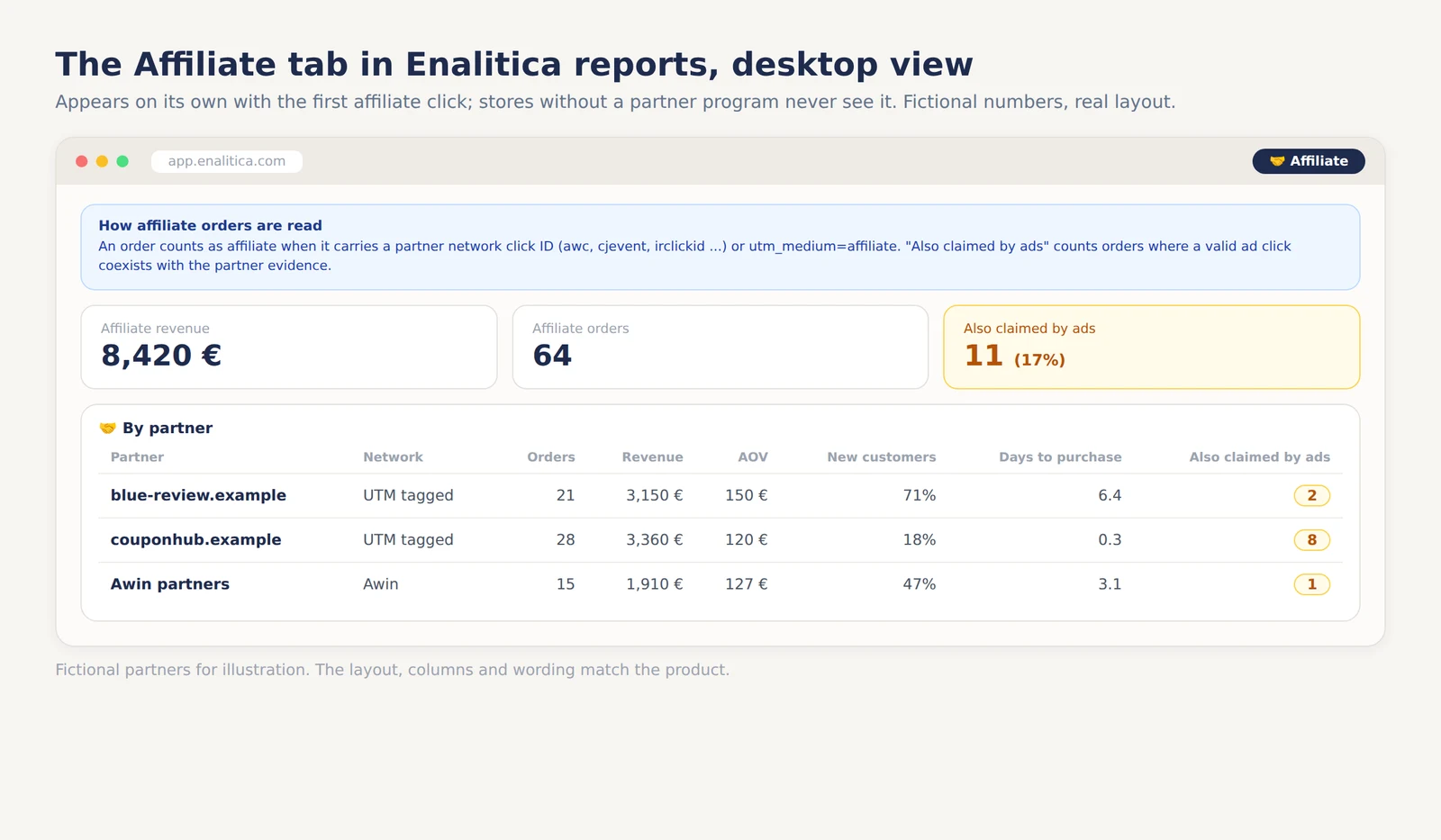
Affiliate is its own channel in the reports, and the tab has one deliberately unusual property: it appears on its own with the first affiliate click. Stores without a partner program never see it, and no configuration is involved.
The amber column is the reason the tab exists. It counts the orders where the partner's evidence coexists with a valid ad click, meaning the network's invoice and an ad platform's ROAS are both claiming that sale.
Enalitica does not decide who deserves the sale. It shows every claim written on one order, so commission conversations start from evidence instead of from reports that cannot see each other.
The view above is a real layout with fictional numbers. Nothing is deduplicated away silently: the order stays in its ad tab too, with a note that adding tabs together counts it twice.
Affiliate program measurement checklist
- [ ] Every partner link carries
utm_medium=affiliateand a partner-namingutm_source - [ ] Network click IDs land in a first-party cookie and are written onto orders
- [ ] Coupon codes are per-partner and not indexed on public coupon sites
- [ ] The network's monthly report is reconciled against your own orders by order ID
- [ ] Orders claimed by both a network and an ad platform are counted and known
- [ ] Cancelled and returned orders are removed before commissions are approved
- [ ] Brand-search orders claimed by partners are reviewed separately
- [ ] Each partner is ranked on new-customer share and days to purchase, not only revenue
Frequently Asked Questions
What is an affiliate click ID and which parameters should I capture?
An affiliate click ID is the identifier a network appends to your landing URL to tie a sale back to a partner click. The common ones are awc (Awin), cjevent (CJ), irclickid (impact.com), sscid (ShareASale), ranSiteID (Rakuten), rfsn (Refersion), ps_xid (PartnerStack) and sca_ref (UpPromote).
How do I see affiliate sales in GA4?
GA4 has a default "Affiliates" channel group, but its definition is medium = affiliate, so it only fills when links carry utm_medium=affiliate; network click IDs like irclickid are not recognised on their own, so untagged partner traffic lands in Referral. Consistent UTM tagging is what makes affiliate visible in GA4.
How do I stop affiliate networks and Meta from counting the same sale?
You cannot stop each system from counting in its own silo; you can only see the overlap on your own orders. Capture the network's click ID and the ad platform's click ID on the same order, count the orders carrying both, and use that number in commission and budget decisions.
How long do affiliate cookies last?
Most affiliate networks default to a cookie window of about 30 days (Awin calls it the industry standard), and each program can set its own. Whoever measures partner sales should know each program's window, because a click older than the window is not a valid commission claim.
Do coupon browser extensions steal affiliate attribution?
Often, yes. An extension popup clicked at checkout registers a fresh partner touch seconds before purchase, and last-click rules then route the commission to it. How often it happens differs by program, which is why the click-to-order gap per partner is worth watching.
Can I run affiliate measurement without an affiliate network?
Yes. Per-partner links tagged with utm_medium=affiliate plus per-partner coupon codes give you attribution and a payment basis without network fees. What a network adds is partner discovery, tracking infrastructure and trusted payouts; the measurement itself your own order data can carry.
Sources
The outside pages this article relies on. Links checked on 28 September 2026.
- the industry standard (help.awin.com)
- definition is medium = affiliate (support.google.com)
Figures marked "in Enalitica's data" are aggregates from the real orders of the stores we measure, with no names and no individual orders. How we measure.
See your real numbers
Import 30 days of orders or leads during a 5-minute onboarding. Works for e-commerce and service businesses.
See plans and pricing