
First Purchase Discounts: Do Those Customers Return?
First purchase discounts win the order, but do those customers ever pay full price again? The margin math, the research, and how to test it on your own cohorts.

Tilen Ledic
Written by
The welcome popup with a first purchase discount is on practically every store, and it works: the coupon converts a visitor who was about to leave. The question nobody's dashboard answers is what happens afterwards. Did the first purchase discount buy you a customer who returns at full price, or did you just sell one order below margin to a stranger you will never see again? The two outcomes look identical in the month's revenue and completely different a year later, and your own order history can tell them apart.
This guide runs the margin math, walks through what the research actually found, borrows a painful lesson from JCPenney, and shows how to measure discount-acquired customers on your own cohorts instead of guessing.
What a first purchase discount really costs
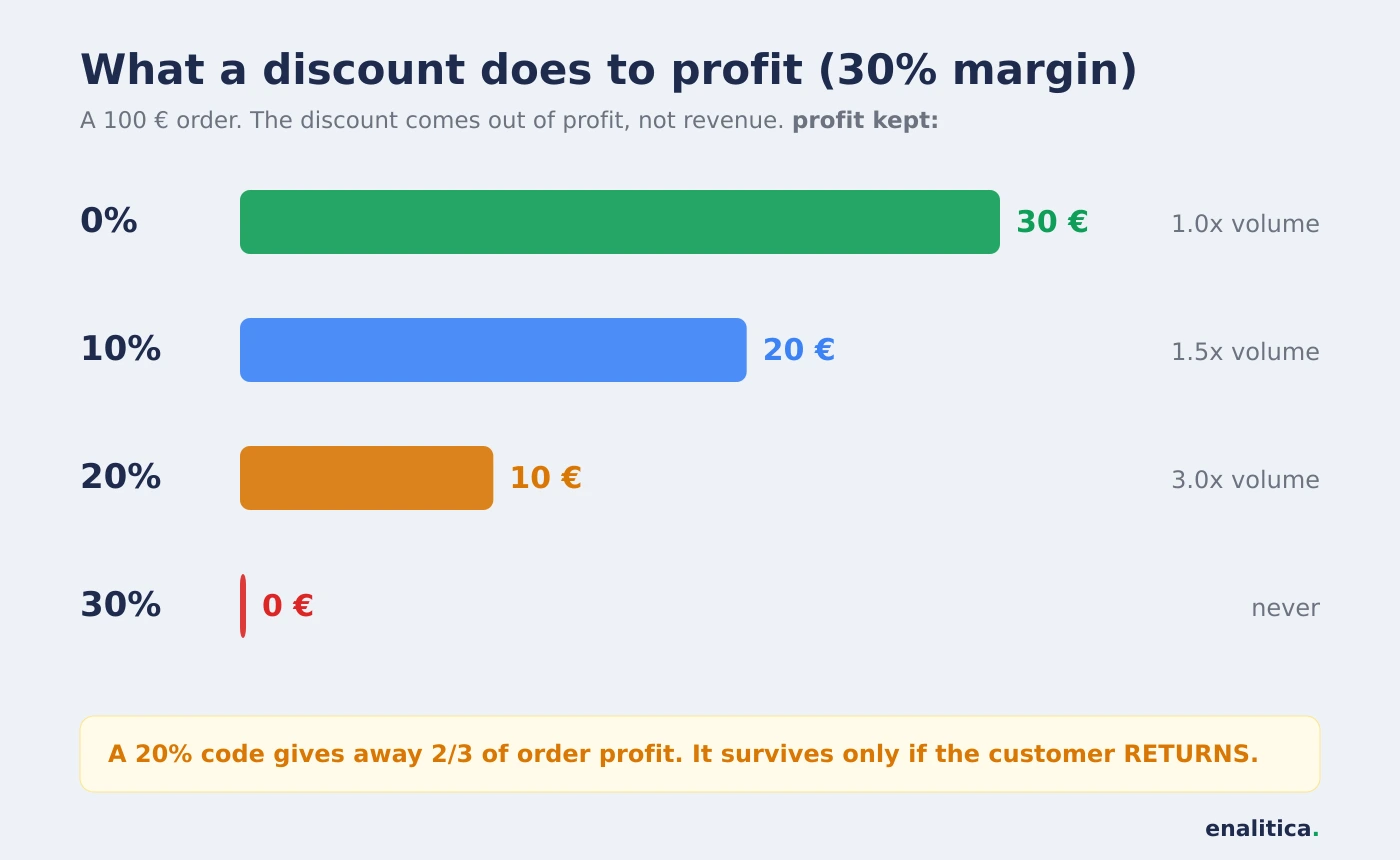
A discount comes out of profit, not revenue, which multiplies its true cost. At a typical 30% contribution margin, a 100 euro order carries 30 euros of profit; each discount tier eats a disproportionate share of it:
| Discount | Revenue kept | Profit kept | Orders needed to break even |
|---|---|---|---|
| 0% | 100 € | 30 € | 1.0x |
| 10% | 90 € | 20 € | 1.5x |
| 20% | 80 € | 10 € | 3.0x |
| 30% | 70 € | 0 € | ∞ |
A 20% welcome code at a 30% margin gives away two thirds of the order's profit, so the campaign around it must produce three times the volume just to stand still. That math is survivable exactly when the discounted first order buys a RETURNING customer, whose later full-price orders repay the introduction. Which is why the entire question collapses into one measurable thing: do they come back?
Do discount customers come back?
The research is more nuanced than the folklore. Peel's analysis across thousands of DTC brands found a sweet spot: first purchase discounts between roughly 5 and 20% acquire customers whose repurchase behavior is essentially normal, and there is little difference between a 10% and a 20% code in future customer value. Some datasets even show discount-first customers repurchasing slightly MORE often, because the discount reached people who were genuinely interested but hesitant.
The behavior breaks above that range: codes beyond 20% increasingly attract bargain hunters who rarely return at full price. And the stakes of getting a customer to purchase two is enormous in either case: returning buyers convert at around 26%, against roughly 2% for first-time visitors. The honest summary is that a moderate welcome discount is usually fine, an aggressive one usually buys traffic, and only your own cohort curves can say which side of the line your store is on. The same math at the year's biggest scale is Black Friday, where the average discount hits 29%.
How discounts train customers: the JCPenney lesson
Discounts do not only select which customers you attract; they teach the ones you keep. JCPenney is the canonical case: after a decade in which its average discount crept from 38% to 60%, the company scrapped coupons for honest everyday prices in 2012. Customers, trained for years to wait for the game, walked away: traffic fell about 10% and sales dropped 19%, and the CEO was out within eighteen months.
The ecommerce translation: a store whose newsletter is a coupon calendar is running a small JCPenney. Existing customers learn to park their cart until Sunday's code arrives, and every "welcome" discount that leaks to returning buyers converts full-price demand into discounted demand. The training effect cuts both ways, which is why the fix is measurement and discipline, not prohibition.
How do you measure discount customers in your store?
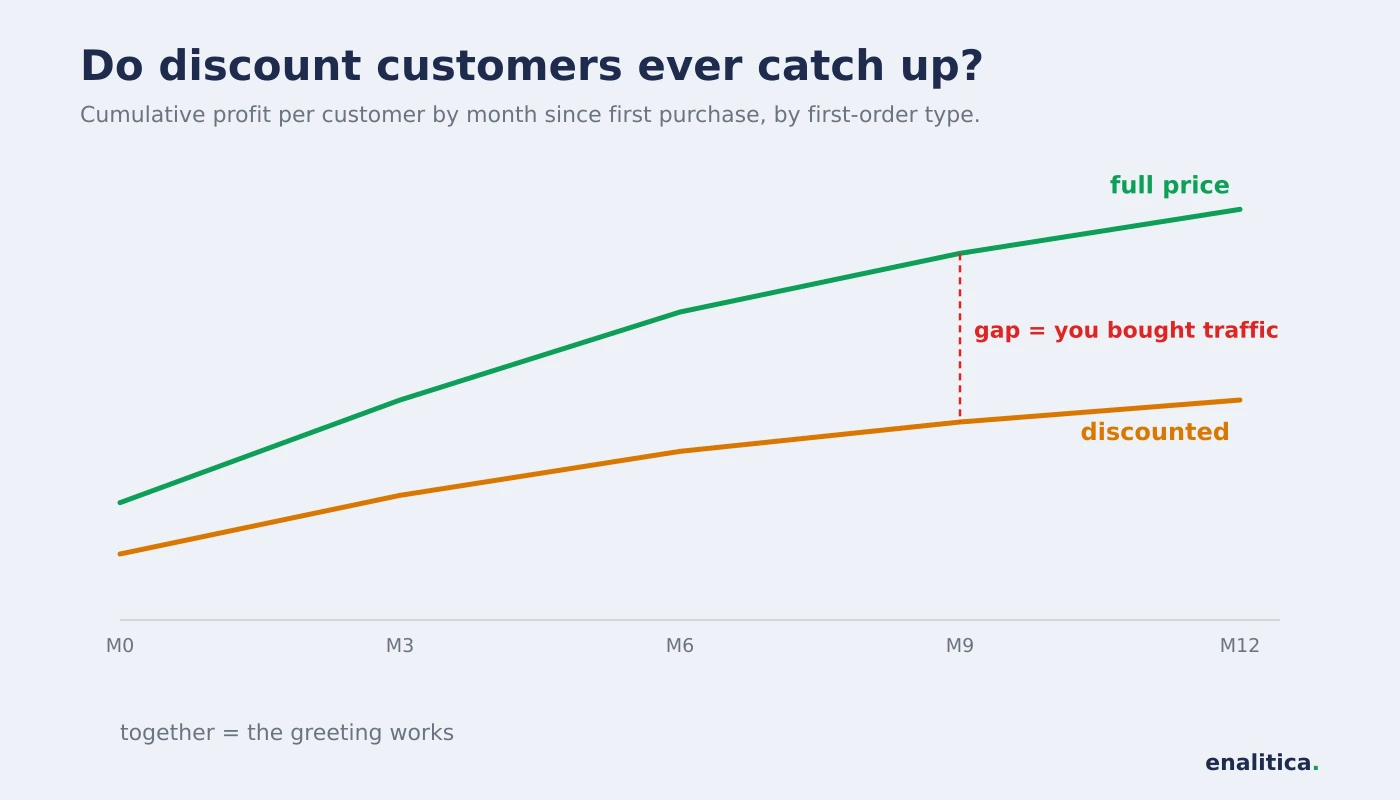
Split your customers by how their FIRST order was paid: with a discount or at full price, then compare the two groups' profit per customer over the following months. Every later purchase counts toward the group of the first order, so the curves answer the exact question the popup raises: do discount-acquired buyers catch up, or stay permanently cheaper?
Three details decide whether the comparison is honest:
- Count coupons, not just line discounts. Cart-level coupon codes are the most common discount and the easiest to miss when they are recorded separately from item prices; a comparison that skips them classifies most discounted orders as full price.
- Compare PROFIT per customer, not revenue. The discount already cut margin once on the first order; revenue curves hide that.
- Give the cohorts time. Judge at month 3 and month 6, not week 2, and read the repeat-purchase share next to the value curve.
A small gap between the curves means the welcome discount works as a greeting: pay it with confidence, and treat it as part of your customer acquisition cost. A large, persistent gap means you are buying one-time orders, and the discount budget deserves to move.
Discount rules that buy customers, not deal hunters
- Stay in the 5 to 20% band. Below 5% nobody moves; above 20% the bargain-hunter share climbs and the margin math turns brutal. If 10% converts nearly as well as 20%, and the data says it usually does, take the cheaper greeting.
- Charge it to acquisition, not to everyone. First order only, new emails only, excluded from sale items. A welcome code that returning customers can reuse is a price cut wearing a costume. The most common leak is an Advantage+ campaign without excluded existing customers, which shows the welcome offer to exactly those buyers.
- Do not let the newsletter become a coupon calendar. Existing buyers learn schedules fast; JCPenney's customers needed a decade to learn and never unlearned.
- Watch the discounted group's basket. If discount-first buyers also buy smaller baskets, the gap is wider than the code percentage suggests.
- Recheck twice a year. Audiences, products and competitors shift; the curves that justified the code last year may not this year.
How Enalitica shows whether discount customers stay
Enalitica answers the question from your orders: the cohort card groups customers by first order with a discount versus full price and draws profit per customer for both groups across the twelve months after the first purchase, repeat-purchase share included. Coupon orders are counted as discounted even when the coupon is recorded separately from the products, exactly the case most reports misclassify.
Because the curves are built on profit (product costs, shipping and fees subtracted, same engine as POAS), the comparison already contains the margin the discount consumed. One glance settles whether your welcome code is a greeting or a leak, and the same view shows what a new customer may cost for each group.
Book a demo and bring your coupon report; we will read your two curves together.
Frequently Asked Questions
What is the best first purchase discount percentage?
Research across thousands of DTC brands points to 5 to 20%, with surprisingly little difference between 10% and 20% in future customer value. Above 20% the share of one-time bargain hunters rises sharply. Start at 10%, measure your discount-versus-full-price cohorts, and only escalate if the curves stay together.
Do discounts lower customer lifetime value?
Moderate first purchase discounts usually do not: customers acquired with 5 to 20% codes repurchase at near-normal rates. Deep discounts do, by attracting deal hunters, and recurring sitewide promotions do, by training existing customers to wait. The clean test is profit per customer by first-order type, over months.
How do I keep bargain hunters away from my welcome code?
Constrain the code: first order only, one per email, excluded from already-discounted items, modest percentage. Deal hunters chase depth; a 10% greeting is unattractive to them and nearly free compared to the 25% codes that summon them.
Should returning customers ever get discount codes?
Sparingly, and for a reason: reactivation after a long pause or a service failure apology beats a scheduled monthly coupon. Every code a returning customer expects converts an order they would have placed at full price into a discounted one, which is pure margin loss.
See your real numbers
Import 30 days of orders or leads during a 5-minute onboarding. Works for e-commerce and service businesses.
See plans and pricing