
Black Friday Ads: Record ROAS, Vanishing Profit
Black Friday ads show the best ROAS of the year while profit disappears into discounts and returns. Margin math, new-customer share and bidding in the spike.

Tilen Ledic
Written by
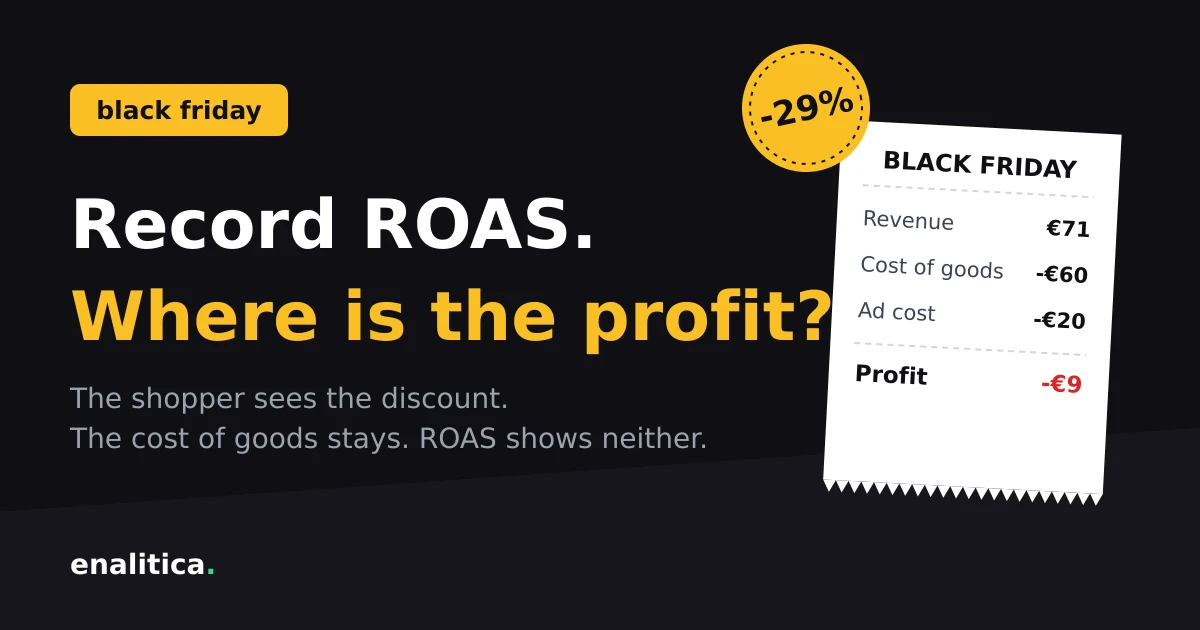
Black Friday ads produce the prettiest ROAS numbers of the year and, quite often, the worst profit of the quarter. The reason is simple: the discount lowers revenue per order while the cost of goods stays the same, so the same ROAS figure means far less money earned. This year Black Friday falls on November 27, and this guide walks through how discounts rewrite margin math, how many holiday buyers are actually new customers, what January returns do to November results, and whether to touch Smart Bidding during the spike. Facts verified on August 14, 2026; numbers from the 2025 season are cited with sources.
Why Black Friday Ads Need POAS, Not ROAS
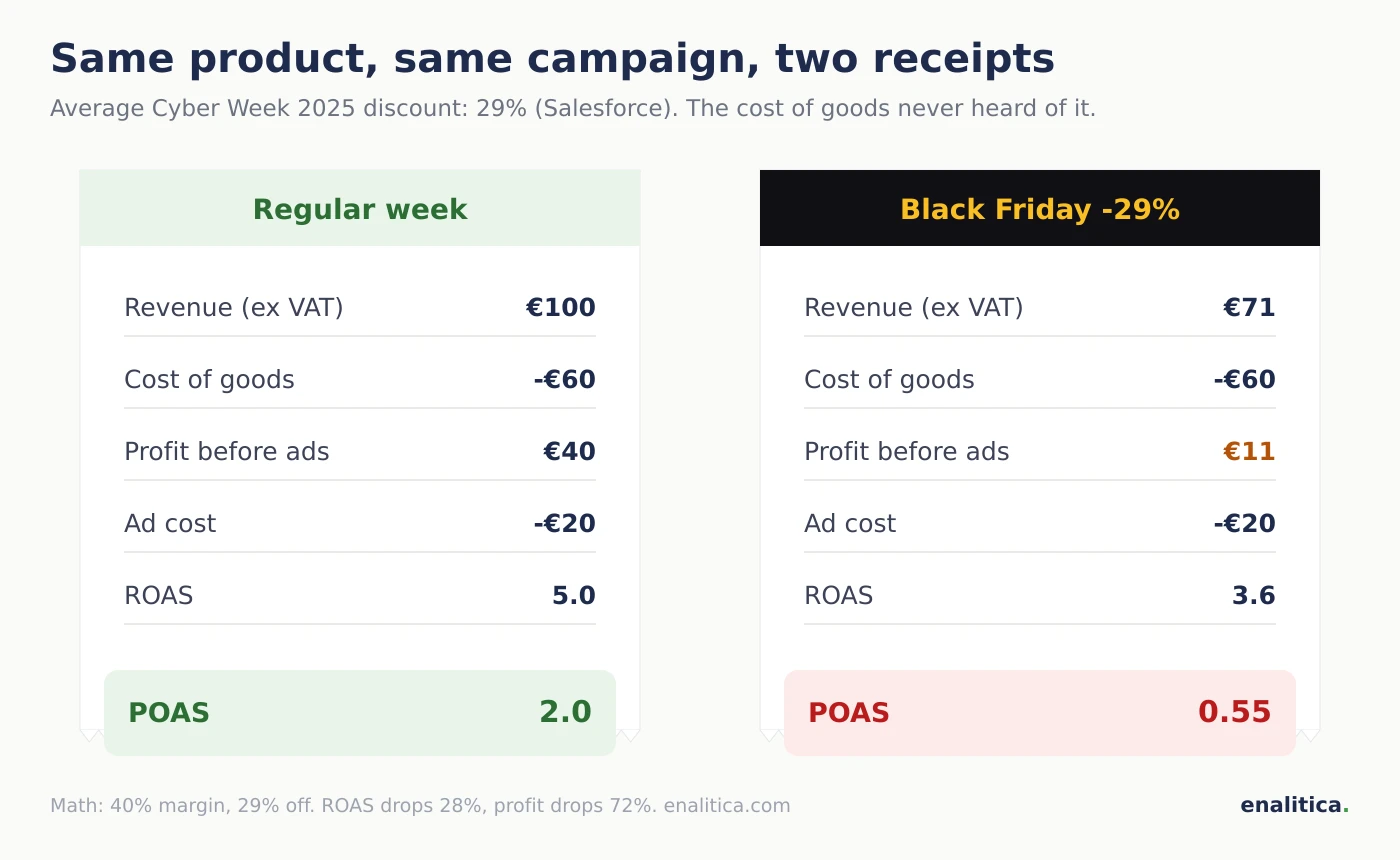
Black Friday ads have to be measured in profit on ad spend (POAS), because ROAS cannot see a discount. Salesforce measured an average discount of 29 percent during Cyber Week 2025; at a typical 40 percent margin, a discount that deep eats almost three quarters of the profit per order, while ROAS stays healthy-looking or even improves thanks to the higher conversion rate.
The concrete math for a product with €100 revenue excluding VAT and €60 cost of goods:
| Regular week | Black Friday (-29%) | |
|---|---|---|
| Revenue per order | €100 | €71 |
| Cost of goods | €60 | €60 |
| Profit before ad cost | €40 | €11 |
| ROAS at €20 ad spend | 5.0 | 3.6 |
| POAS at €20 ad spend | 2.0 | 0.55 |
ROAS drops 28 percent; profit drops 72. And because conversion rates rise during a sale, many campaigns show a HIGHER ROAS on Black Friday than in October while every order earns pennies or loses money. If you measure profit on ad spend (POAS), the transformation is visible immediately; if you only measure ROAS, you discover it on the annual balance sheet.
How Many Black Friday Buyers Are Actually New Customers?
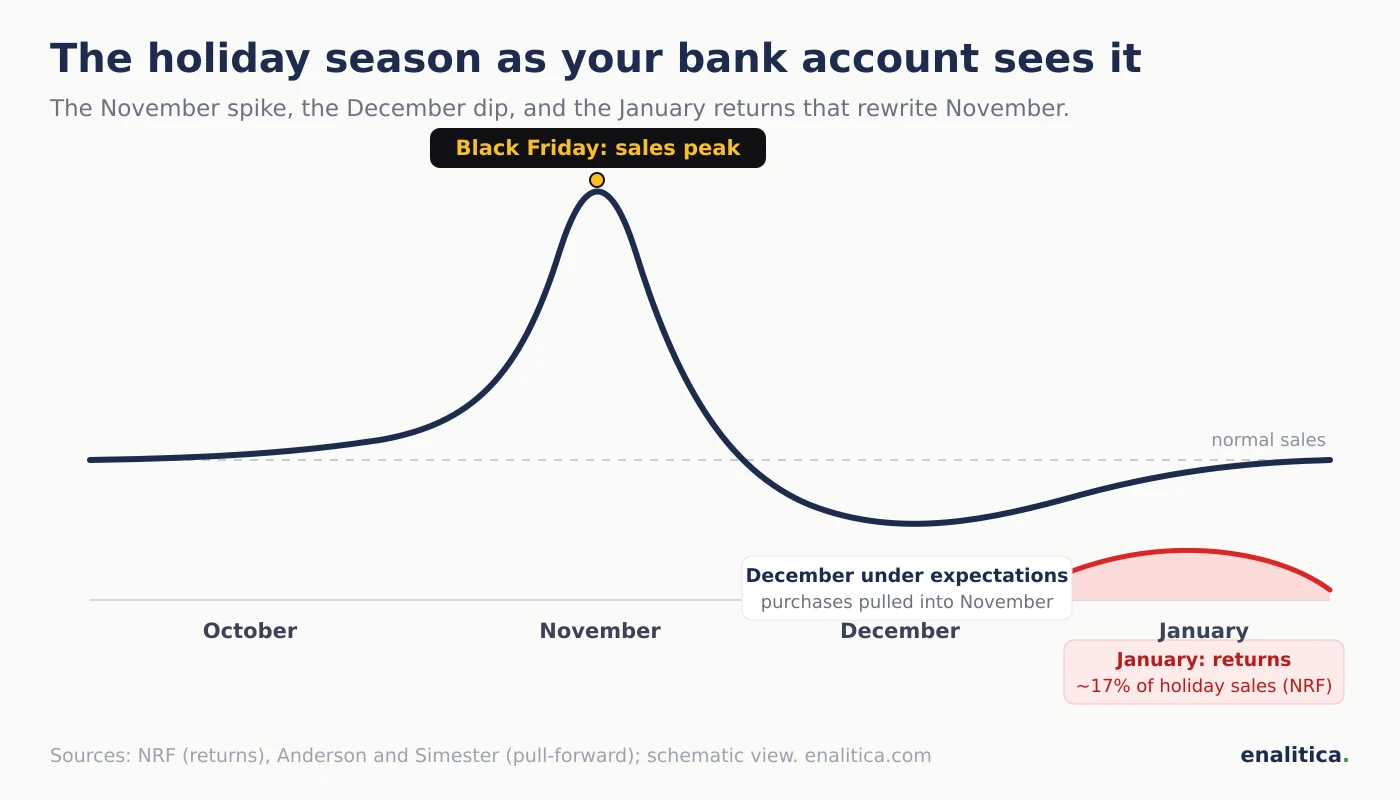
A sizable share of Black Friday sales comes from existing customers who would have bought anyway and simply waited for the sale. This is called pull-forward: the promotion moves December into November while the quarter's total barely moves. Three field studies (Anderson and Simester) found an even less pleasant long-run effect: deeper discounts increase future purchases by first-time customers but REDUCE future purchases by established customers, because the sale teaches them to wait for the next one.
For a store this means a discount given to an existing customer is the most expensive kind of discount: you pay for the ad, cut the margin, and convert future full-price purchases into sale purchases. The key question for every Black Friday campaign is therefore what share of its orders are first-time buyers. A campaign at 80 percent new customers builds a base you can sell to all year; a campaign at 80 percent existing customers is expensively harvesting your own base, much like bidding on your own brand name. How discount-acquired customers behave later is covered in detail in our guide to first purchase discounts.
How Much Holiday Revenue Comes Back as January Returns?
The US National Retail Federation estimates around 17 percent of holiday sales are returned, and online returns run around 19 percent annually, notably above the 15.8 percent all-channel average. November performance reports never see those numbers: ROAS is computed at purchase, and the return arrives in January, after the marketing team has already celebrated a record season.
Holiday returns run higher for predictable reasons: impulse purchases during sales, gifts that missed, and shoppers who order three sizes at 29 percent off and keep one. To judge the truth of a Black Friday campaign you need a number that can only be computed in mid-January: revenue AFTER returns, minus cost of goods, minus ad spend. Why returns reorder the ranking of your best campaigns is shown in our comparison of POAS vs ROAS when returns hit; put the January review in the calendar in November.
Smart Bidding During Black Friday: Adjust or Leave Alone?
For most stores the best Smart Bidding move during Black Friday is no move at all. Optmyzr compared advertisers who used seasonality bid adjustments with those who did not across three years of Black Friday data (up to 6,000 accounts per year): advertisers without adjustments were consistently more efficient, while those with adjustments paid roughly double the CPC inflation. Google's algorithm has seen years of Black Fridays; manually announcing "conversions will double" mostly just raises your bids in the most expensive hours of the year.
Seasonality adjustments keep one narrow legitimate use, which Google's own guidance describes: short sales of 1 to 7 days that the algorithm cannot know from history (a new store's first big sale, an unannounced flash sale). Even then, Optmyzr recommends sizing the adjustment from the CPC increase you need, not from the expected conversion jump. What not to do mid-spike: switching bidding strategies or making a large target ROAS change resets learning in the most expensive week of the year. Set budgets and targets before the season, let the algorithm work during it, and check that PMax or the AI Max expansion is not harvesting your brand searches during the spike, because Black Friday week is when more people search your name than ever.
How Enalitica Measures Black Friday in Profit, Not ROAS
Enalitica computes Black Friday the way your bank account feels it: from orders, after discounts, after VAT and after returns.
- POAS per campaign from real orders: revenue is net (after discount and VAT), product costs come from the store, price lists or an ERP, and returns reduce the order's revenue while its cost of goods stays counted. A campaign that "sells great" at ROAS 4 during the sale shows its true POAS while the season is still running.
- New-customer share per campaign: every campaign shows what share of its revenue comes from first-time buyers, computed over the entire order history. A sale harvesting the existing base separates from a sale building a new one at a glance.
- Returns reported back to Google: every refund amount is written onto its order and sent server-side to Google Ads as a conversion adjustment, so even Google's bidding learns in January what November actually earned.
- Seasonal context instead of panic: on an unusual week, the campaign card shows the same month last year's spend and return (with at least a year of history), and the weekly verdicts are computed from profit, not revenue.
If you want to see this year's Black Friday in profit for the first time, see plans and pricing or book a live demo; enter product costs once and POAS stays forever.
Checklist Before Black Friday
- Product costs entered for the products that carry most of your revenue; without them POAS does not exist.
- Compute in advance how much discount your margin can absorb: at a 40 percent margin, 29 percent off is nearly all of the profit.
- Set a stop line in profit (POAS, not ROAS) below which a campaign gets paused mid-sale.
- Run a conversion tracking audit in October, not on November 26.
- Protect your own brand: brand lists and negative keywords before the demand spike hands your name to PMax or AI Max.
- Set budgets and target ROAS before the season; do not switch bidding strategies mid-spike.
- Verify returns are syncing from your store, or January will silently rewrite November.
- Put a mid-January review in the calendar: revenue after returns, profit after product costs, new-customer share.
Frequently Asked Questions
When is Black Friday this year?
Black Friday falls on November 27, 2026 (always the Friday after US Thanksgiving), with Cyber Monday on November 30. In practice sales start earlier: a large share of stores open discounts in early November, and Cyber Week from Thanksgiving through Monday remains the peak of the season.
Should I raise campaign budgets for Black Friday?
Raise budgets before the season and gradually, not overnight on the day of the sale. Smart Bidding needs a few days to adapt to a new spend level, and large overnight changes reset learning in the most expensive week of the year. More important than the budget level is deciding the profit stop line in advance, below which you cut spend.
Should I use a seasonality bid adjustment for Black Friday?
Mostly no: Optmyzr's three-year analysis found advertisers without seasonality adjustments were more efficient, while those with adjustments paid higher CPCs. An adjustment makes sense for short sales the algorithm cannot know from history, and even then sized from the CPC increase you need rather than the expected conversion jump.
How much discount can my margin absorb?
Compute profit per order at full price (revenue excluding VAT minus cost of goods) and subtract the discount amount from it. At a 40 percent margin, 20 percent off takes half the profit and 29 percent off takes three quarters. A discount deeper than the margin means every order loses money before the ad cost; that can be a deliberate customer-acquisition decision, but it should never be a surprise.
How do I measure whether Black Friday paid off?
In mid-January, sum Black Friday order revenue after returns, subtract product costs and ad spend, and check the share of first-time buyers. It paid off if profit is positive, or if you knowingly paid a loss for new customers who come back; it did not pay off if the sale sold at a loss to existing customers who would have bought without the discount.
See your real numbers
Import 30 days of orders or leads during a 5-minute onboarding. Works for e-commerce and service businesses.
See plans and pricing