
POAS vs ROAS: How Returns Quietly Flip the Right Decision
POAS vs ROAS: two campaigns with identical ROAS can deserve opposite decisions once returns enter the math. How POAS counts refunds and corrects Google Ads.

Tilen Ledic
Written by
Two campaigns. Same spend, same revenue, same ROAS of 5.0 in Google Ads. One sells a product that customers keep. The other sells a product where every third package comes back.
Ads Manager cannot tell them apart, because ROAS is measured at the moment of purchase and never updated. The refund three weeks later changes your bank account, but not the number you make decisions on. If you scale by ROAS, you scale both campaigns equally, and one of them is quietly burning the profit the other one earns. That is the POAS vs ROAS difference in one sentence: ROAS stops counting at checkout, POAS (profit on ad spend) keeps counting when the package comes back. Nowhere does this hit harder than after the holidays: January returns rewrite Black Friday's November after the fact.
Why ROAS cannot see returns
ROAS answers one question: how much gross revenue did a click generate on the day it converted. Everything that happens afterwards is invisible to it, and "afterwards" is not rare. The NRF and Happy Returns estimate that 19.3% of online sales will be returned in 2025 ($849.9 billion across US retail). Fashion return rates run higher still: roughly a quarter of online purchases go back, shoes more. And in the EU the floor is legal: the 14-day right of withdrawal ships with every order.
Returns also concentrate in specific customers. When Boozt blocked 42,000 serial returners, they were under 2% of its customers but around a quarter of all return volume. By conversion data, those were the best customers in the account. By kept revenue, they were the worst.
POAS: the metric that sees what comes back
POAS (profit on ad spend) divides profit, not revenue, by ad spend: revenue minus returns, minus the cost of goods sold (COGS), shipping and payment fees. Returns hit it twice, which is exactly right:
- the refunded revenue leaves the numerator, and
- the costs stay: you paid shipping both ways, and returned goods often cannot be restocked or resold at full value.
One distinction matters before you trust any returns number: a cancellation is not a return. An order where the card failed or the customer cancelled before dispatch never cost you fulfilment. An order that was delivered and came back did. A dashboard that lumps them together makes careful shops (the ones that manually verify payments) look like returns disasters, and hides the real ones.
The same ROAS, the opposite decision
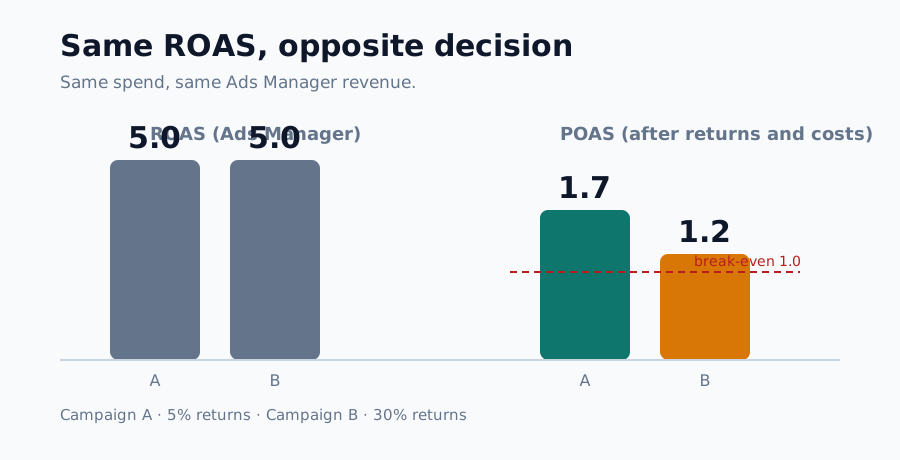
Same spend, same Ads Manager revenue, one difference: the return rate.
| Campaign A | Campaign B | |
|---|---|---|
| Ad spend | 1,000 € | 1,000 € |
| Revenue (Ads Manager) | 5,000 € | 5,000 € |
| ROAS | 5.0 | 5.0 |
| Returns | 5% | 30% |
| Kept revenue | 4,750 € | 3,500 € |
| Gross profit (35% margin) | 1,663 € | 1,225 € |
| POAS | 1.7 | 1.2 |
And that still flatters campaign B, because the two-way shipping on its returned orders is not in the table; add a few euros per returned package and B drifts toward POAS 1.0, which is break-even: its entire gross profit goes to paying for its own ads.
By ROAS these campaigns are twins. By POAS, A funds your growth and B works for the courier. The budget you move on this decision is the most expensive number your dashboard shows you.
The decisions returns actually change
A returns-adjusted view of the same campaigns changes four concrete decisions.
- Scaling: rank campaigns by POAS, not ROAS, before moving budget. High-ROAS high-return campaigns are the classic trap.
- Target setting: if you bid to a target ROAS, derive the target from returns-adjusted revenue (what you actually keep). A 30% return rate means your true break-even tROAS is over 40% higher than the one computed from gross margin.
- Products and keywords: return rates differ far more by product than by audience. Knowing which products, and even which search keywords, bring the orders that come back turns "our returns are high" into "these three items need better size charts".
- Policy: free returns are a marketing cost. Price them like one, per product, not as a store-wide average.
How to Teach Google Ads About Returns: Conversion Adjustments
Returns-adjusted POAS fixes your own decisions. One more leak remains: Google's Smart Bidding optimizes on gross conversions, so it keeps hunting for more of the buyers who return. Practitioners describe it bluntly: Google sees the checkout, never the refund.
Google's own remedy has existed for years and almost nobody ships it: conversion adjustments. A retraction removes a conversion (cancelled or fully returned order), a restatement lowers its value (partial refund); where adjustments sit among Google's other server-side tools is in our Google conversions API guide. The constraints, per Google's documentation: the adjustment must arrive within about 54 days of the conversion, should be uploaded at least 24 hours after it, and a retraction is final. The catch is that adjustments only enter via the API or scheduled sheet uploads keyed to order IDs; there is no button in the interface. Which is why bidding at a typical store runs on gross revenue forever, and why the Nordic profit-tracking tools built entire businesses on closing this one gap.
How Enalitica Adjusts POAS and Google Ads for Returns
- You never choose between the metrics. Every campaign row shows ROAS and POAS side by side, each in two flavors: direct (last paid click) and multi-touch (every campaign that took part in the journey). Volume, truth, and path contribution in one table, so the A-vs-B comparison above is simply what your dashboard shows every day.
- POAS is returns-adjusted by default. Full returns leave revenue entirely, partial refunds shrink it by the refunded share, and cancellations are counted separately so they never pollute your return rates. The Dobiček dashboard shows a "Returns included" chip with the exact amount, so you see the adjustment instead of trusting it.
- Returns are visible where decisions happen: campaigns carry a return-share warning chip, and a dedicated table shows the keywords whose orders come back most.
- Capture is automatic from WooCommerce and Shopify; stores that manage orders inside Enalitica record a return with one click (full or partial, amount and date included).
- Google gets corrected every night: Enalitica uploads retractions and restatements for the orders that changed, automatically, inside the 54-day window. Smart Bidding learns from the revenue you kept, not the revenue you invoiced.
Book a demo and bring your return rate; we will show you which of your campaigns flips.
Frequently Asked Questions
Is ROAS useless then?
No. ROAS is a fine volume signal and the only common language with Ads Manager. The mistake is making scaling decisions on it alone. Read them as a pair: ROAS tells you the machine is turning, POAS tells you whether it produces anything.
What is a good POAS?
POAS 1.0 means gross profit exactly covers ad spend: break-even on advertising, before your fixed costs. How far above 1.0 you need to be depends on those fixed costs; the useful comparison is between your own campaigns, where returns-adjusted POAS ranks them by what they actually contribute.
Does Meta support return corrections like Google?
No. Meta's Conversions API has no retraction mechanism, so Meta-reported ROAS always stays gross. One more reason to judge Meta campaigns against your own returns-adjusted numbers.
How far back can Google conversions be corrected?
About 54 days from the conversion. That comfortably covers EU 14-day withdrawals and normal return processing, which is why a daily automated pass catches essentially everything and a quarterly manual cleanup does not.
Sources
The outside pages this article relies on. Links checked on 25 July 2026.
- NRF and Happy Returns estimate (nrf.com)
- roughly a quarter of online purchases go back (statista.com)
- blocked 42,000 serial returners (euronews.com)
- Practitioners describe it bluntly (seresa.io)
- conversion adjustments (support.google.com)
See your real numbers
Import 30 days of orders or leads during a 5-minute onboarding. Works for e-commerce and service businesses.
See plans and pricing