
Bidding on Your Own Brand Name: What the Data Says
Bidding on your own brand name flatters ROAS while organic absorbs most clicks. Data from 225 geo tests, when brand bidding pays off, and how to test it.

Tilen Ledic
Written by
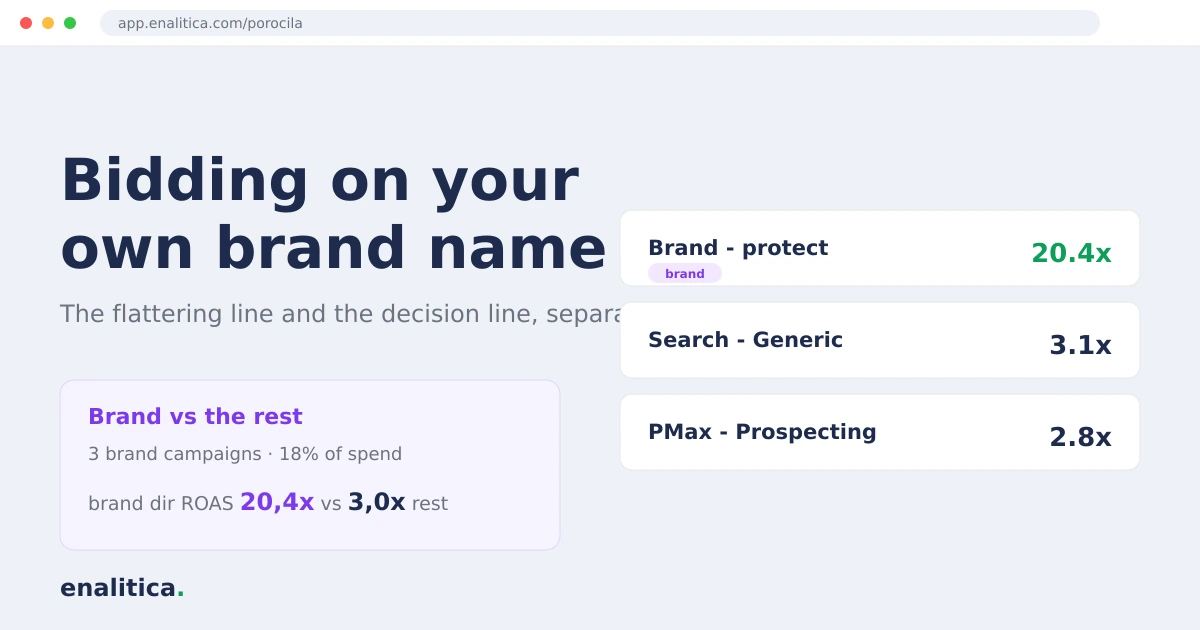
Brand clicks are the cheapest clicks in any Google Ads account, they convert two to three times better than generic terms, and they make every report look wonderful. That is exactly why bidding on your own brand name is the most quietly contested budget line in paid search: the customer typing your store's name into Google had already decided to visit you. The open question is whether the ad changed anything, and it is one of the few questions in marketing where hard experiments exist on both sides.
This guide walks through that evidence: what brand campaigns do to your ROAS reporting, what incrementality tests actually found, the cases where defending your brand is clearly worth the money, and a test you can run with nothing but your orders and Search Console.
What bidding on your own brand name actually buys
Bidding on your own brand name means paying for the top ad slot on searches like "acme store" or "acme.com", queries with navigational intent, typed by people who already know you. The click usually costs a fraction of a generic click, and the resulting conversion rate is the best in the account, because the searcher finished most of the journey before they saw the ad.
What the money buys is position insurance: your ad sits above everything, including your own #1 organic result. Whether that insurance pays depends entirely on what would have happened without it, and that is not visible in any platform dashboard. Google Ads reports every one of those sales as ad-driven revenue, at a spectacular return, regardless of whether the ad earned it.
Brand campaigns flatter every ROAS report
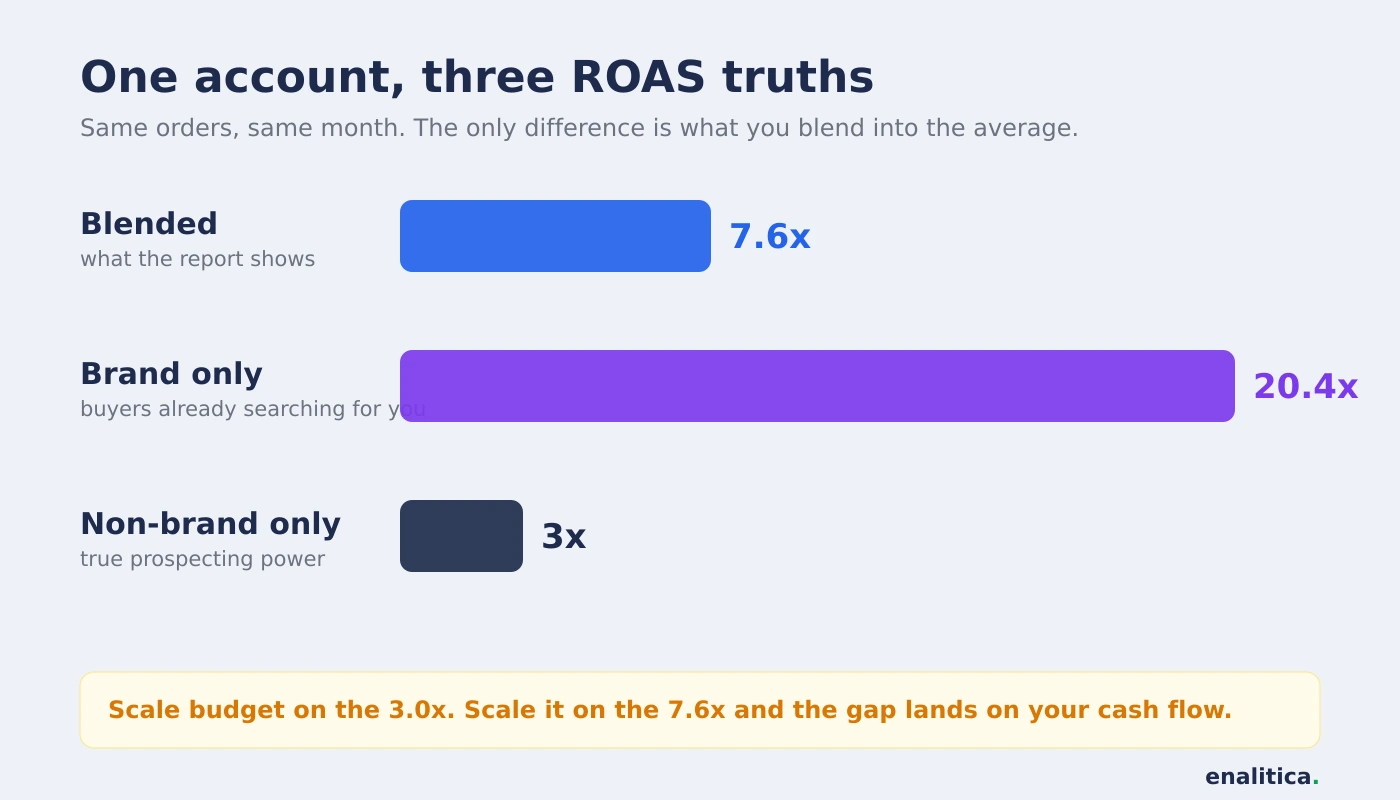
Mixing brand and non-brand into one blended number is the oldest trick in performance reporting, and often not even a deliberate one. Brand traffic converts so well that a modest brand campaign can lift a mediocre account into a heroic-looking average: an account showing a blended 7.6x ROAS can hide a 3x non-brand reality behind a 20x brand campaign. Scale the budget expecting 7.6x and the gap lands on your cash flow, because new budget buys non-brand clicks, not more people searching your name.
The fix is structural, not moral: read brand and non-brand as separate lines, always. Brand ROAS measures how many people already wanted you. Non-brand ROAS measures whether your marketing wins new demand, and it is the only number that should drive scaling decisions. The same logic applies one level up, in blended ROAS and MER: every mixed number needs its components visible before it can support a decision.
Does brand bidding bring incremental sales?
Mostly no, for most stores, and the experiments are unusually consistent. When eBay switched off its brand search ads for a landmark 2015 study, total traffic barely moved: the organic listing directly below the ad absorbed almost all of the clicks the ads had been collecting. A decade later, Stella's 2025 benchmark of 225 geo-holdout tests across DTC brands measured a median incremental ROAS of 0.70x for branded search, the lowest of any channel tested and below break-even, precisely because organic cannibalization eats most of the reported return.
The honest counterweight comes from Google's own research, which found that on average 89% of ad clicks are incremental, and that even a #1 organic ranking recovers only about half of the clicks a paused ad was getting. That study is worth knowing and worth qualifying: it dates to 2011, averages across all queries rather than brand queries alone, and was published by the company selling the clicks. The experiments run by advertisers on their own brand terms keep landing much closer to eBay's result than to Google's.
When is bidding on brand keywords worth it?
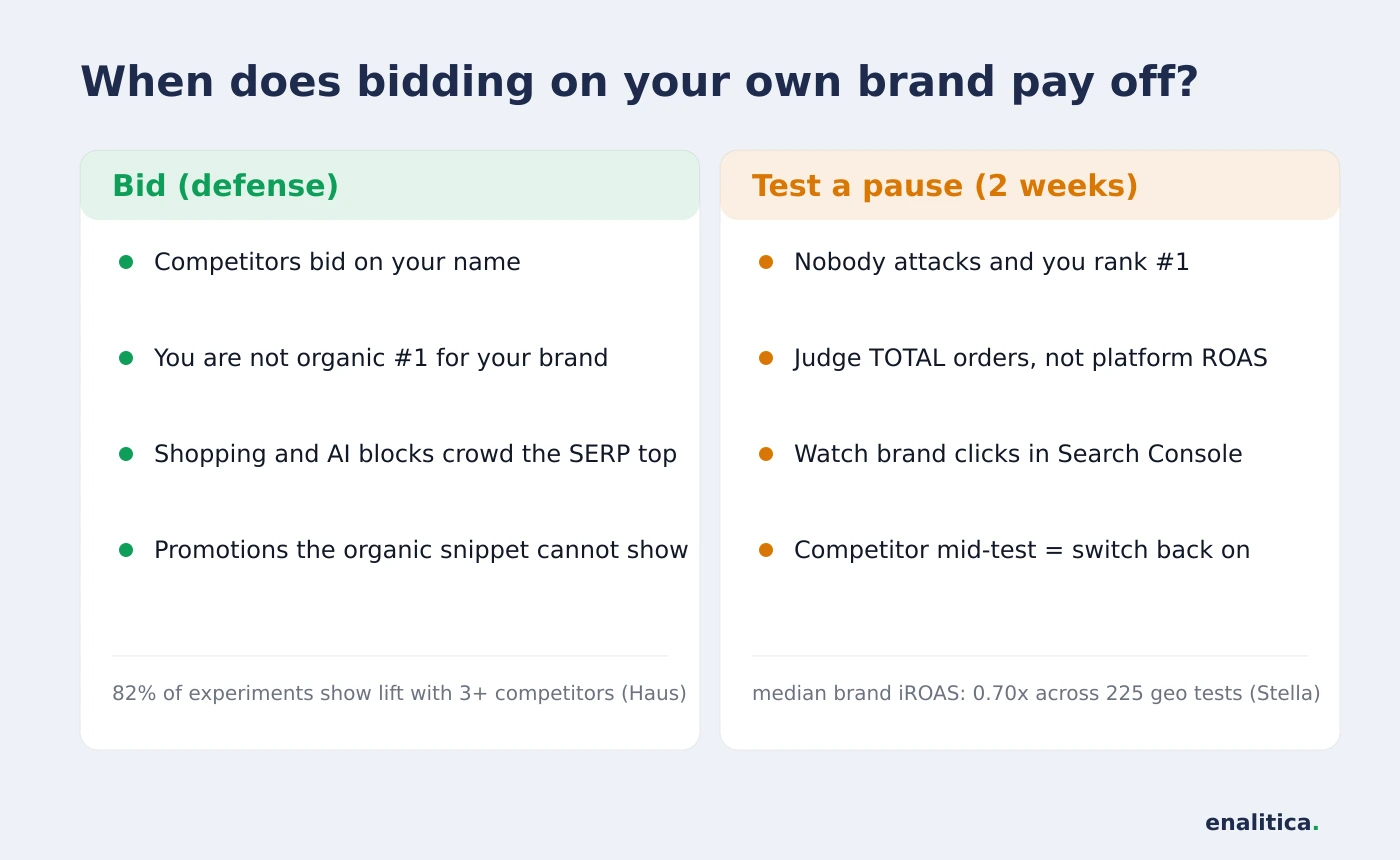
Brand bidding earns its budget when someone else is standing in your doorway. Haus, which runs incrementality experiments for a living, found that 82% of brands facing three or more competitors on their own brand terms measured significant lift from brand ads, against only 35% of brands with little auction competition; the contested group also saw meaningfully higher incremental returns despite paying more per click. Competition on your name is the single strongest predictor that defense pays.
The practical checklist, in order of weight:
- Competitors bid on your name. Their ad above your organic result costs you real sales; a defensive campaign with high impression share makes conquesting expensive for them.
- You do not rank #1 organically for your own brand, or the SERP above you is crowded with shopping units, maps and AI answers that push your listing below the fold.
- You are running a promotion the organic snippet cannot show: launch, seasonal sale, changed shipping terms. The peak of this category is Black Friday week, when searches for your name hit their annual maximum.
- Nobody attacks and you own the SERP. This is the case for testing a pause rather than paying indefinitely, and where negative keywords for your brand terms keep generic campaigns honest at the same time.
Performance Max quietly buys your brand traffic
Performance Max gravitates toward branded queries because they convert best, and by default nothing stops it. Industry analyses put brand traffic at 10 to 15% of PMax conversions on typical accounts, with documented cases above 40%. The result is a campaign type that reports a beautiful ROAS built partly on sales that were coming anyway, while your dedicated brand campaign loses impression share and your blended report shows nothing wrong.
Google now allows brand exclusions on PMax: lists of brand terms the campaign must not serve on. Use them if you want PMax to report true prospecting performance, and fund a standard brand search campaign first if you still want the brand SERP covered, because an exclusion without a catcher simply hands the slot to whoever bids next. The full setup and how to verify PMax on your orders is covered in our guide to Performance Max campaigns. From September 2026 the same trap reaches Search campaigns too: AI Max search term expansion without brand protection is just as happy to harvest your brand searches.
How to test brand bidding with orders and Search Console
You do not need geo-testing software to get a usable answer; you need two weeks and the discipline to read the right numbers. Pause the brand campaign (and add brand exclusions to PMax so it cannot silently take over the traffic) and then judge the period on totals, never on platform ROAS:
- Total orders and revenue for the period versus a comparable one. This is the number the eBay economists watched, and the only one that decides.
- Organic brand clicks and average position in Search Console. If organic absorbs the paused traffic, you will see brand clicks rise almost one-for-one.
- Watch for the tripwire. If a competitor moves onto your name mid-test (their ad above your organic result), the defense case is proven; switch the campaign back on and treat the spend as insurance.
Expect platform-reported conversions to drop; that is bookkeeping, not lost sales. The test fails only if total orders sag while organic brand clicks fail to make up the paused ad clicks. Either way you exit with a measured number where an opinion used to be, and the budget conversation about which ads actually drive sales gets much shorter.
New customers reveal what brand campaigns really do
A brand campaign's dirty secret is not the ROAS; it is who is clicking. People searching your name are disproportionately returning customers, newsletter subscribers and people your other marketing already won. When you split any campaign's orders into first-time and returning buyers, brand campaigns typically skew heavily toward customers you had already acquired, which means part of that spectacular ROAS is you paying a toll on your own customer base.
Two numbers make the pattern impossible to miss: the share of a campaign's orders that come from first-ever buyers, and the cost of a new customer computed against real orders rather than platform conversions. A generic campaign with a modest ROAS but a high new-buyer share is doing the work brand campaigns get credit for. That is the same logic that makes assisted conversions worth checking before any pause, applied to acquisition instead of attribution.
How Enalitica separates brand campaigns from the rest
Enalitica does the brand split from your orders, without regex or spreadsheet surgery. You type the words of your brand into report settings (store name, domain, common misspellings) and every Google Ads report gains a brand-versus-rest reading: how many campaigns matched, what share of spend they take, and the direct ROAS of brand campaigns next to the rest of the account, so the flattering line and the decision line never blend again.
Because every number is computed from orders, the same reports show direct and multi-touch revenue per campaign, the share of orders where a campaign only assisted, and new-versus-returning buyers detected from actual order history rather than a platform flag. Search Console reports carry a branded filter for the organic side of the test above. The split that agencies argue about becomes a line you glance at monthly.
Book a demo and bring your Google Ads account; we will read your brand share together in fifteen minutes.
Frequently Asked Questions
Should I bid on my brand name if I rank #1 organically?
Ranking #1 makes brand bidding least likely to be incremental: eBay's experiment and most published geo tests show the organic listing absorbs nearly all paused ad clicks. Bid anyway when competitors appear on your name or the SERP crowds your listing out; otherwise a two-week pause test settles it cheaply.
How much cheaper are brand clicks than non-brand clicks?
Brand CPCs typically run at a small fraction of generic CPCs because quality scores on your own name are near-perfect and competition is usually thin. That is exactly why brand campaigns report outsized ROAS and why the number cannot be compared against non-brand campaigns in the same table.
Do competitors bidding on my brand name change the math?
Completely. With three or more bidders on your name, Haus measured significant lift from brand ads in 82% of experiments, versus 35% with little competition. Auction pressure is the strongest single predictor that a defensive brand campaign earns its budget.
Does pausing brand ads hurt the rest of the Google Ads account?
No. Campaigns do not share a karma score; Quality Score is computed per keyword and ad. What a pause does change is reporting: platform conversions fall while orders hold, which is the cannibalization gap becoming visible. Judge the test on total orders and organic brand clicks, not on the platform's own count.
How do I find out who is bidding on my brand name?
Open Auction insights in Google Ads for your brand campaign (or for the brand keywords in a mixed campaign): it lists every domain that appeared in the same auctions, with impression share, overlap rate and how often each one outranked you. Search your own name in an incognito window from your main market a few times a day for a week to see the actual ads, since resellers and marketplaces often bid only at certain hours. When a competitor shows up consistently, that is the case where brand ads earn their budget; without competitors, the Auction insights table is your evidence that a pause test is safe.
See your real numbers
Import 30 days of orders or leads during a 5-minute onboarding. Works for e-commerce and service businesses.
See plans and pricing