Are ChatGPT Ads Worth It for an Online Store?
What ChatGPT ads cost in 2026, the most a click may cost at your margin, how big a test must be, and how to judge it from your own orders.
 Tilen Ledic Written by
On this page
- What do ChatGPT ads cost in 2026?
- The real question: how much may one click cost you?
- How big must a ChatGPT ads test be before you believe it?
- Why OpenAI's number will be higher than your orders
- What a ChatGPT ads test looks like in your orders
- When do ChatGPT ads make sense for a store?
- What we do not know yet
- How Enalitica measures a ChatGPT ads test
- Checklist before you launch a ChatGPT ads test
An email from OpenAI lands on Tuesday: ChatGPT ads are open in your country, 15 euros a day gets you started. Your Google Ads rep says the early movers win. A competitor posts a screenshot of a ChatGPT answer with their sofa under it, labelled Sponsored. You have 450 euros you could spend on a month-long test, and one question: is this worth it for my store, or is it the next thing that eats a budget and leaves a report nobody can check?
Nobody can answer that with a benchmark yet. OpenAI says so itself: its own FAQ states that ChatGPT Ads "does not yet have performance benchmarks across advertisers, industries, or campaign types" (October 2026). What you can answer before spending a cent is whether the numbers could work at your order value and margin, and whether the test you are about to pay for is big enough to tell you anything. Both are arithmetic, and both are in the calculator below.
What do ChatGPT ads cost in 2026?
ChatGPT ads are sponsored placements shown at the bottom of ChatGPT answers, separated from the answer and labelled. OpenAI announced them on 16 January 2026 with three rules worth knowing as an advertiser: ads appear only for people on the Free and Go plans (Plus, Pro, Business and Enterprise stay ad-free), never for users under 18, and never next to health, mental health or political topics. OpenAI also states that ads do not influence the answers.
After a pilot from February to April, self-serve buying through Ads Manager and cost-per-click bidding arrived on 5 May 2026. On 31 August self-serve opened in 31 European markets, and Slovenia and Croatia are on OpenAI's list of available countries. What matters is where the company that is billed is registered, not where the shop sells.
| What you pay and control | ChatGPT ads (October 2026) |
|---|---|
| Ways to buy | Views (per 1,000 impressions), Clicks (per click), Conversions (still billed per click or per 1,000 impressions, never per conversion) |
| Minimum daily budget | 15 EUR or 25 USD |
| Overspend | Up to 2× the daily budget on a day, up to 7× over a week |
| Targeting | Context hints describing the conversations the ad belongs in, not exact-match keywords; country and region; iOS, Android or web |
| Custom audiences in the EU | Avoid them: ads personalisation is not available in the EEA and Switzerland |
| Benchmarks from OpenAI | None published |
Budget, objective and targeting rules from OpenAI's campaign help page and targeting docs, checked 31 October 2026.
Prices are a moving target. Digiday reported in April that CPMs fell from about 60 dollars at launch to as low as 25. Search Engine Journal reported in September that cost per click ranged from 3 to 22 dollars across advertisers, with one agency averaging 9.89 dollars (5.10 in the UK, 10.62 in the US). These are reports from early advertisers, not price lists. Your auction, your category and your copy decide your price.
The real question: how much may one click cost you?
A CPC of 3 dollars sounds cheap next to a 22 dollar one. Neither number means anything until you put it next to what one click is worth to your shop. That worth has a simple formula:
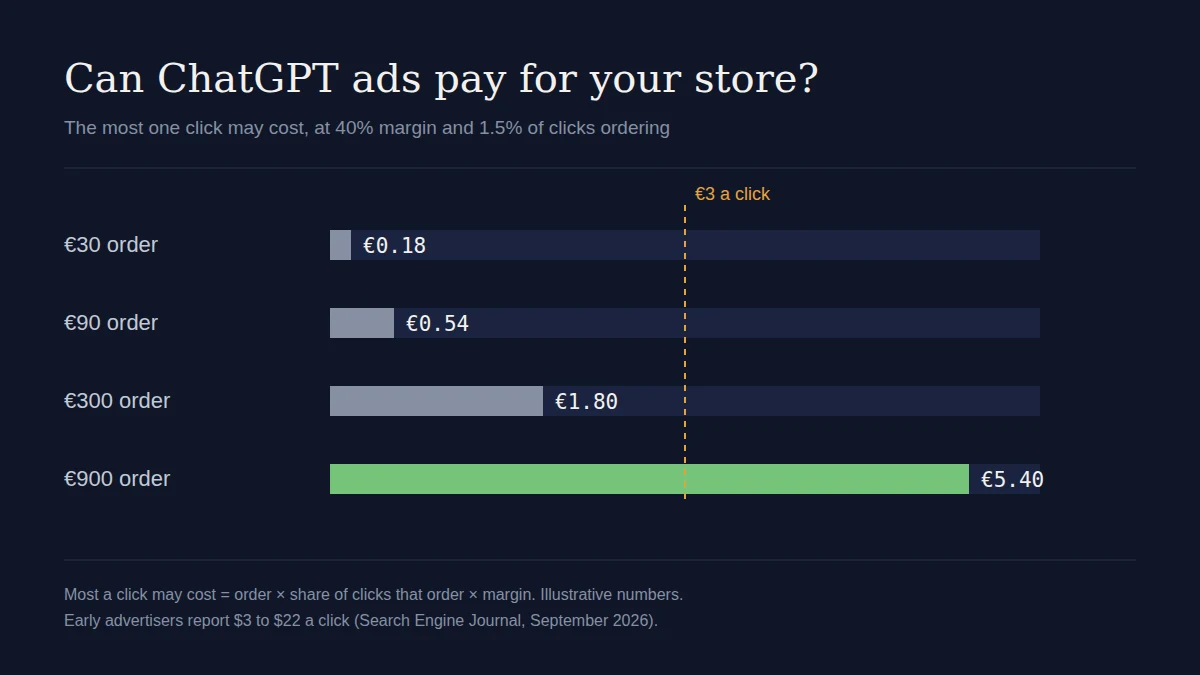
Most a click may cost = average order × share of clicks that order × margin
Margin here is what is left of a sale after the product, shipping and payment fees. Take a shop with a 90 euro average order, a 40% margin and 1.5% of ad clicks turning into an order. One click is worth 90 × 0.015 × 0.40 = 0.54 euros of gross profit. Pay less, and each click leaves something. Pay 3 euros, and each click costs you 2.46.
Here is the same formula for four kinds of shop, at 40% margin and 1.5% of clicks ordering:
| Average order | Most a click may cost | At €3 a click | At €9 a click |
|---|---|---|---|
| €30 (gifts, cosmetics) | €0.18 | ✗ | ✗ |
| €90 (coffee gear, fashion) | €0.54 | ✗ | ✗ |
| €300 (small appliances) | €1.80 | ✗ | ✗ |
| €900 (furniture, bikes) | €5.40 | ✓ | ✗ |
The pattern: at the prices early advertisers report, ChatGPT ads pay for themselves on clicks alone mainly where orders are large, or where the share of clicks that order is far above 1.5%. That share is the number nobody knows for your store yet. Your Google Ads rate is a reasonable first guess, and probably an optimistic one, because someone clicking from inside a conversation is often still deciding what they want.
Can ChatGPT ads pay for your store?
Enter your average order, your margin, how many clicks become an order and what a click costs. The calculator tells you the most a click may cost, and how many orders a test would bring before you can trust it.
OpenAI also counts orders after an ad was seen but not clicked, and reports them separately. This calculator works from clicks only, because only a click leaves a trace in your store. Read the share of clicks that order from your own orders, not from the platform report.
The calculator is also on its own page as the ChatGPT ads calculator.
How big must a ChatGPT ads test be before you believe it?
This is where most first tests go wrong. At the 15 euro minimum, a month costs 450 euros. At 3 euros a click that buys 150 clicks. At 1.5% of clicks ordering, that is about 2 orders.
Two orders cannot tell you anything. One bigger order or one quiet weekend changes the result by half, and you end the month with a feeling, not a verdict. To get about 10 orders at the same rates you need around 670 clicks, which is roughly 2,000 euros at 3 euros a click.
So decide before you start what the test is for:
- A real profit test needs a budget that brings at least 10 orders at your expected rates. The calculator shows the expected orders for your budget and warns below 10.
- A cheap learning test at the minimum budget can tell you the CPC you actually get, the click-through rate and whether the visitors behave like buyers (product views, carts, checkouts). Judge it on those, not on profit.
Either is fine. Spending 450 euros and then judging it on profit is the mistake.
Why OpenAI's number will be higher than your orders
When the month ends, Ads Manager will show conversions, and your shop will show orders. They will not match, and that is expected.
OpenAI's pixel reads a click id called oppref from the landing page address and keeps it in a first-party cookie for 30 days. A purchase inside the click window (up to 30 days) counts as a click-through conversion. On top of that, OpenAI counts view-through conversions: a purchase within one day after someone saw the ad without clicking. OpenAI reports these separately from click-through conversions, and when both apply, the click wins (conversion tracking docs).
Your shop only knows about the clicks. An order that carries the oppref click id provably came through a ChatGPT ad. A purchase after a view without a click leaves no trace in the shop at all. So OpenAI's number is the ceiling and your order count is the floor, and the truth for the decision usually sits closer to the floor. Our view-through conversions article explains why the same gap shows up on Meta and Google.
The second trap is in Google Analytics. A paid ChatGPT click and a free ChatGPT recommendation arrive from the same site, chatgpt.com, with the same referrer. Unless something reads the oppref parameter, GA4 files both under the same source. The ad spend goes into one bucket and the orders land in another, which makes the free channel look better and the ads look like they sold nothing. The ChatGPT ads attribution guide goes through this in detail.
What a ChatGPT ads test looks like in your orders
Here is the ChatGPT Ads view in Enalitica on our demo shop, a coffee equipment store, over three months:
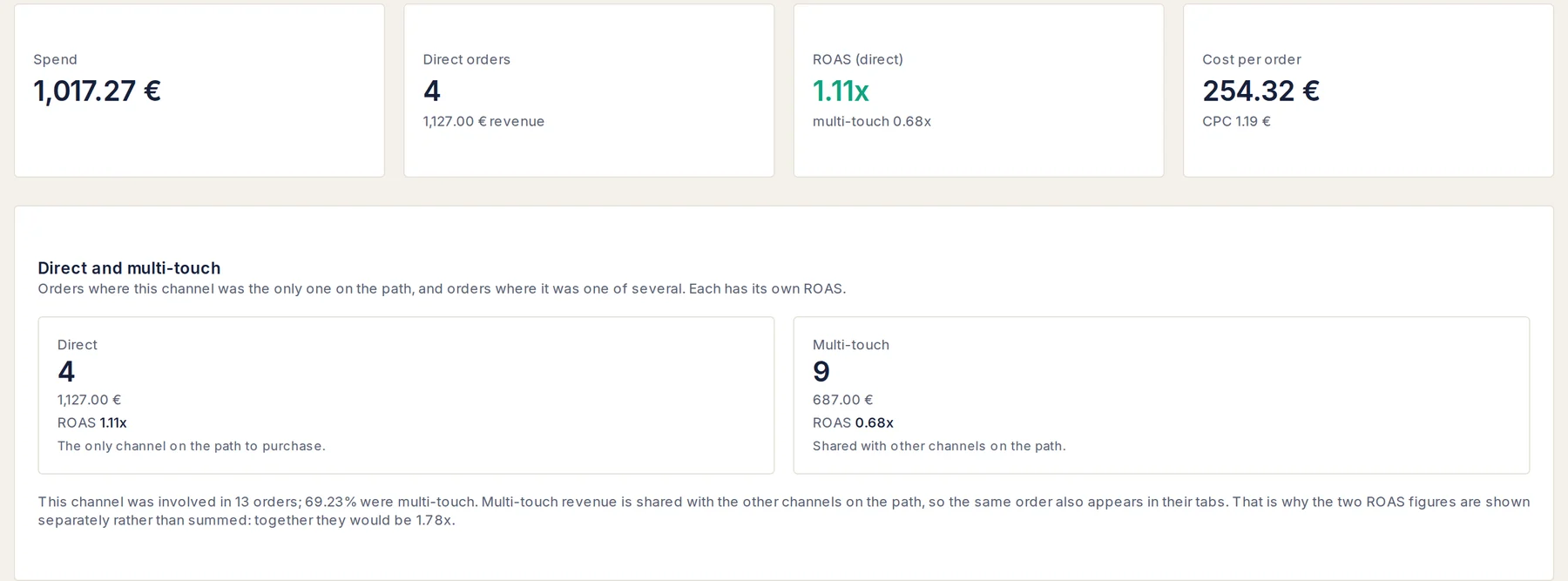
- 1€1,017 spent. The test costs what your own clicks cost, here €1.19 a click.
- 24 orders only ChatGPT brought. €1,127, a direct ROAS of 1.11. The number you can prove and budget on.
- 39 orders it shared. Another channel was on the path too, so the credit is shared and shown apart.
- 4Never added together. Summed they would read 1.78×, which would count the same orders twice.
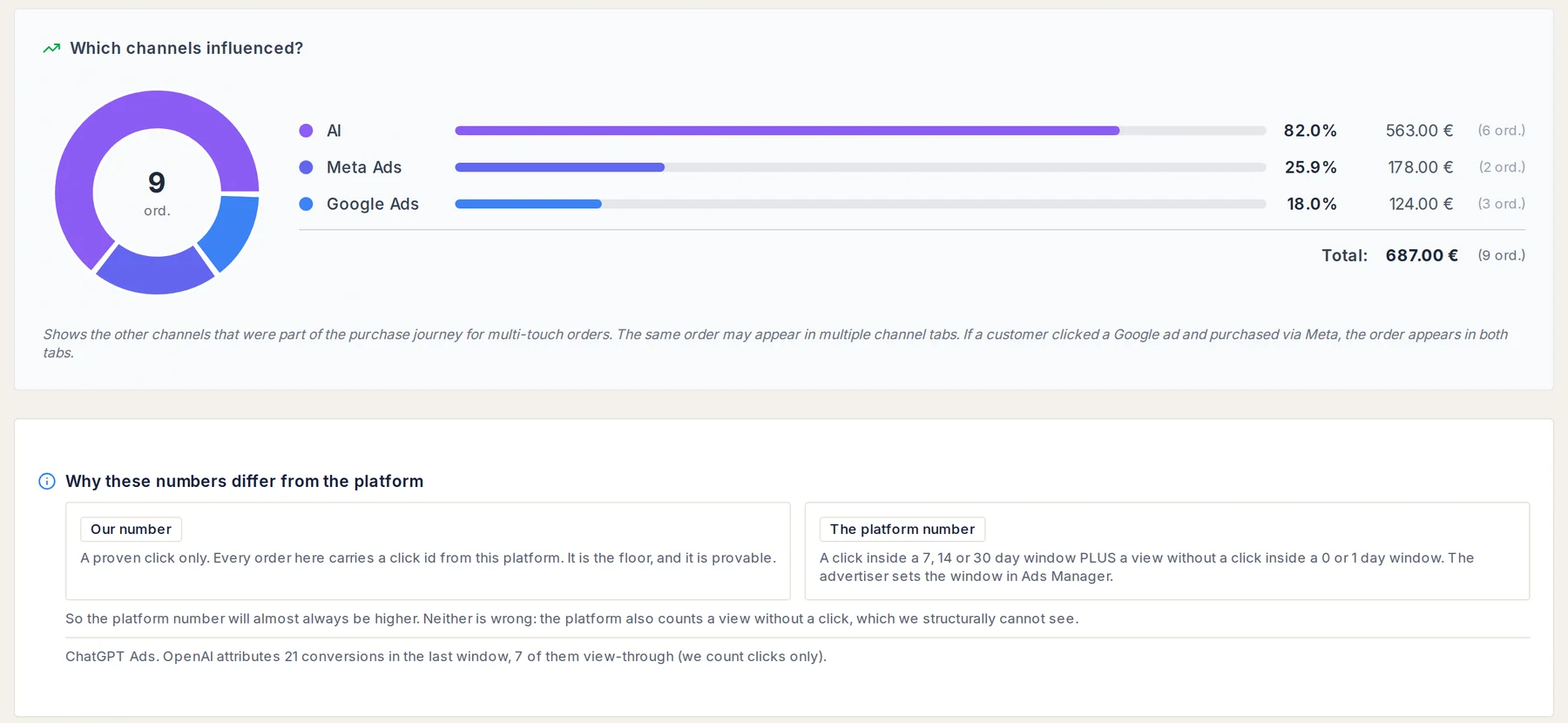
- 1Who else was on the path. The 9 shared orders and the channels that shared them.
- 282% free AI answers. The same buyer also came from an unpaid ChatGPT or Perplexity answer. The paid ad was not the only reason.
- 3Why OpenAI shows more. Its count includes people who saw the ad and never clicked. We count clicks only.
- 421 conversions, 7 from views. OpenAI's own number sits under ours, so the gap is explained.
Read it top to bottom, the way you would read your own test:
- 1,017 euros spent, 855 clicks, 1.19 euros a click. The demo shop's clicks are cheaper than the reports above, which is the point: your own CPC is the only one that counts.
- 4 orders where a ChatGPT ad was the only channel on the path, 1,127 euros of revenue, a direct ROAS of 1.11. At a 40% margin the break-even ROAS is 2.5, so on direct orders alone this test loses money.
- 9 more orders where the ChatGPT ad was one of several channels. In 82% of that revenue, the other channel was free AI traffic: the same customer also arrived from an unpaid AI assistant answer. Credit for those orders is shared, so they are shown separately and never added to the direct number.
- OpenAI's own count sits underneath, with the view-through share named, so the gap is explained instead of argued about.
Those are demo numbers, not a benchmark. What the view gives you is the method: spend against orders you can prove, the shared orders kept apart, and the platform's claim beside them.
For scale, in Enalitica's data across the shops we measure (90 days to 28 September 2026), visits from AI assistants were about 0.5% of orders and 0.5% of analytics sessions, and 1.6% of leads for service businesses. Free AI traffic is real and growing, but it is still a small share of what most shops sell. A paid channel built on top of it starts from a small base.
When do ChatGPT ads make sense for a store?
| Your situation | Worth testing now |
|---|---|
| Average order above €500 and a decent margin | ✓ |
| Products people research by asking (furniture, appliances, bikes, B2B equipment) | ✓ |
| You already see orders from free ChatGPT traffic | ✓ |
| You can fund a test that brings 10+ orders | ✓ |
| Average order under €50 | ✗ |
| Impulse products bought straight from a social feed | ✗ |
| Your Google Ads and Meta are not yet profitable | ✗ |
| You cannot tell paid ChatGPT clicks from free ones | ✗ |
The last row is the one we would fix first. Testing a new channel you cannot measure is paying for an opinion.
What we do not know yet
- Real conversion rates. OpenAI publishes no benchmarks, and early reports mix B2B and ecommerce. Your first test sets your own baseline.
- How prices settle. CPMs dropped by more than half in the first months. Prices in a young auction move faster than in Google's.
- What a view is worth. A one-day view-through window counts some people who would have bought anyway. Nobody outside OpenAI can measure how many.
- Targeting in Europe. Without personalisation and custom audiences in the EEA, the only lever is context hints. That keeps the ads tied to the conversation, and it also means fewer ways to steer.
- Small-test noise. Below 10 orders, any verdict is luck. This one is not about ChatGPT, it is about arithmetic.
How Enalitica measures a ChatGPT ads test
Enalitica starts from the order, not from the ad platform. When a customer clicks a ChatGPT ad, the oppref click id is in the landing address. Our tracking script stores it in a first-party cookie for 90 days and writes it onto the order at checkout, the same way it handles gclid from Google and fbclid from Meta. If the customer comes back on another device and logs in or leaves the same email, the click is still matched for 30 days. A view without a click is never counted, because a view leaves nothing on the order.
That one id solves the paid-or-free problem. A visit from chatgpt.com with oppref is a ChatGPT ad. The same visit without it is free AI traffic and goes to the AI channel. The spend and the orders stay in the same row.
You connect ChatGPT Ads Manager with an API key you create in Ads Manager. Enalitica uses it only to read spend, impressions and clicks; it never changes your ads. Every night Enalitica pulls spend, clicks and impressions per campaign, and OpenAI's own conversion count with its view-through share. If you also add a Conversions API key, Enalitica sends every order that carries the oppref click id back to OpenAI from our server, so its bidding learns from real sales even when the pixel was blocked. In the ChatGPT Ads tab you then see, for any period:
| What you see | |
|---|---|
| Spend, clicks, CPC | From OpenAI, per campaign |
| Direct orders and ROAS | Orders where the ChatGPT ad was the only channel on the path |
| Multi-touch orders and ROAS | Orders shared with Google, Meta, email or free AI traffic, shown separately |
| Which channels shared the order | The other channels on those paths, with their share |
| OpenAI's claim | Their conversions, with the view-through part named |
The same view exists for Google Ads, Meta and Microsoft Ads, so you can compare ChatGPT's cost per order with what you already pay elsewhere, on the same orders. If you have connected Enalitica to ChatGPT or Claude through our MCP access, you can also ask in plain words: "Did the ChatGPT ads pay off last month?"
The useful part starts before the test. Connect the shop and your current ad accounts first, and in a few minutes you see your real share of clicks that order per channel and your margin. That is the number the calculator needs and the one most owners guess. Start a 14-day trial before you launch the campaign, so the ChatGPT result has a real baseline to be compared with.
Checklist before you launch a ChatGPT ads test
- Work out the most a click may cost with your own order value, margin and order rate, using the calculator above.
- Size the budget for at least 10 expected orders, or decide up front that the test is for learning, not profit.
- Make sure paid and free ChatGPT visits are told apart, by a tool that reads
opprefonto the order. Otherwise GA4 will mix them. - Write context hints that sound like questions your customers ask, not like keyword lists. "Which espresso machine for a small kitchen" works better than "espresso machine cheap".
- Turn the campaign off by hand at the end of the test. When we ran Enalitica's own campaign in September 2026, Ads Manager had no end date field, so a capped test ended only when we paused it.
- Judge on orders, not on Ads Manager. Compare direct orders and cost per order with Google and Meta on the same orders.
Frequently Asked Questions
Can a shop in Slovenia or Croatia run ChatGPT ads?
Yes. Since 31 August 2026 self-serve Ads Manager is open in 31 European markets, and both Slovenia and Croatia are on OpenAI's availability list. Eligibility depends on where the legal entity that pays is registered. Some new accounts can first advertise only in their home country, and other countries unlock after verification and some spend at home.
Is there a minimum spend for ChatGPT ads?
The minimum daily budget is 15 euros or 25 dollars. Daily spend can reach twice the budget on a busy day, but never more than seven times the daily budget over a week. There is no per-campaign minimum total in OpenAI's table, so a 30-day test at the floor is about 450 euros.
Are ChatGPT ads cheaper than Google Ads?
Per thousand impressions they started far above Google and have been falling. Per click, early reports range from 3 to 22 dollars, which is more than most ecommerce search clicks on Google. The fairer comparison is cost per order you can prove, on your own orders, which only a test answers.
Do ChatGPT ads change what ChatGPT recommends?
OpenAI states that ads do not influence ChatGPT's answers and are always separate and labelled. Being recommended in a free answer and appearing in an ad are two different things. A shop that is already recommended for free should measure that traffic first, because it is the cheaper of the two.
Should I install OpenAI's pixel if I use Enalitica?
If you run Conversions campaigns, yes: OpenAI's bidding learns only from the conversions it receives, through its pixel or its Conversions API. Enalitica now also feeds that signal: with a Conversions API key in the ChatGPT Ads connection, every order that carries a ChatGPT ad click is sent to OpenAI's Conversions API from our server, with the stored oppref click id and the real order value. OpenAI's Conversions API does not capture oppref by itself, which is why the stored click id matters. Keep the pixel for page views and add-to-cart, and leave the purchase to the server send: OpenAI merges a pixel purchase and a server purchase only when both carry the same event id, so two sources with different ids count one sale twice (Enalitica's id is your shop's order id plus _purchase, which a pixel can repeat). The Conversions API guide explains the rule. Your own independent count stays in Enalitica.
How long until I know if ChatGPT ads work?
Count in orders, not weeks. With a 30-day click window, wait at least a few days after the last click before you close the books, and only call it on profit once the test has brought 10 or more orders. Before that, read the CPC, the click-through rate and the carts.
Sources
The outside pages this article relies on. Links checked on 1 November 2026.
- "does not yet have performance benchmarks across advertisers, industries, or campaign types" (help.openai.com)
- announced them on 16 January 2026 (openai.com)
- self-serve buying through Ads Manager and cost-per-click bidding (openai.com)
- self-serve opened in 31 European markets (openai.com)
- list of available countries (help.openai.com)
- campaign help page (help.openai.com)
- targeting docs (developers.openai.com)
- reported in April (digiday.com)
- reported in September (searchenginejournal.com)
- 30 days (developers.openai.com)
- conversion tracking docs (developers.openai.com)
Figures marked "in Enalitica's data" are aggregates from the real orders of the stores we measure, with no names and no individual orders. How we measure.

Run the ChatGPT test on your own orders, not on OpenAI's report.
Free for 14 days, nothing charged before day 15, connected in about five minutes. Your Google and Meta orders show up first, so the ChatGPT result has something real to be compared with.
Start the free trial