
How View-Through Conversions Inflate ROAS
Meta counts view-through conversions: people who saw an ad and never clicked. Where they hide in Meta and Google reports, and how to measure ROAS without them.

Tilen Ledic
Written by

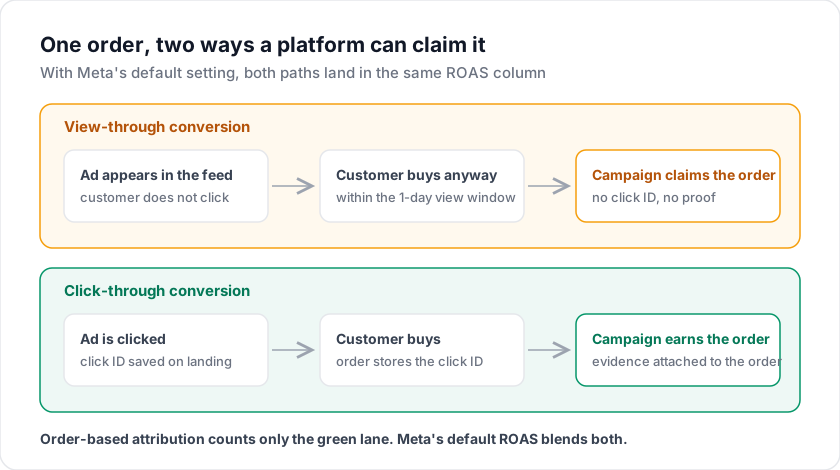
Your Meta dashboard says ROAS 8. Your store's order list says the month was decent, not spectacular. Part of that gap has a name most store owners have never inspected: view-through conversions. These are orders Meta credits to your campaign because the customer saw an ad, scrolled past it, never clicked, and then bought within a day.
The customer may have bought because of the ad. Or they may have been on their way to buy anyway, and your ad simply appeared in the feed of someone who already knew your brand. Meta cannot tell the difference, but it counts the order either way.
What Is a View-Through Conversion?
A view-through conversion (also called a post-view conversion) is credited when someone is shown your ad, does not click it, and later completes a purchase within the platform's view-through window. No visit from the ad, no click, just an impression followed by an order: impression-based attribution in its purest form.
And "shown" means very little. Meta's own definition of an impression is "the number of times an instance of an ad is on screen for the first time", with no minimum duration, and a video ad "is not required to start playing for the impression to be counted". One frame in a fast scroll qualifies.
The windows are short but the volume is not. Meta's attribution setting now defaults to a triple stack: 7-day click, 1-day engage-through and 1-day view. Any purchase within 24 hours of an impression gets attributed to the campaign. Meta removed the 28-day windows in January 2021 when iOS 14 arrived, and 2026 reshuffled the buckets twice more: since January the reporting API no longer returns the long view windows at all, and since March "click" means a link click only. Likes, comments, shares and short video views all moved into the renamed engage-through bucket, which still lands in your default results. A purchase after a like, with no visit to your store, now counts in the headline number the same way a view-through does.
Google Ads has the same concept for its visual formats. Its view-through conversions apply to Display, Video, App, and Demand Gen campaigns, with a default view window of 1 day, adjustable from 1 to 30 days. Search ads have no view-through; you cannot "view" a text ad you did not click.
Where View-Through Hides in Meta and Google Reports
This is the part that actually costs money, because the two platforms report it in opposite ways.
| Meta Ads | Google Ads | |
|---|---|---|
| View-through counted | ✓ (1-day view default) | ✓ (Display, Video, App, Demand Gen) |
| Shown inside main Results / Conversions column | ✓ | ✗ (separate "View-through conv." column) |
| Included in headline ROAS | ✓ | ✗ (with exceptions) |
| Separable in reporting | ✓ (Compare attribution settings) | ✓ (already separate) |
Meta blends view-through into the numbers you look at daily. Results, cost per result, and ROAS all include view-through conversions by default. There is no asterisk in the interface. Unless you deliberately split the columns, you are reading clicks and impressions as one number.
Google keeps them apart, mostly. View-through conversions sit in their own column and stay out of "Conversions" and out of Smart Bidding targets. But there are exceptions that behave like Meta: engaged-view conversions (someone watches at least 10 seconds of your skippable YouTube ad, or 5 seconds of an in-feed or Shorts ad, then converts within the engaged-view window, 3 days by default for website conversions) do land in the main Conversions column. Demand Gen campaigns can also opt view-through into bidding. So "Google does not count views" is only true until you run video.
GA4, for its part, is click-based. Its data-driven attribution does not see Meta impressions at all, which is one reason your GA4 and Meta numbers will never reconcile. The single nuance: GA4 does treat YouTube engaged views (30+ seconds) as a touchpoint.
How the 1-Day View Window Inflates Retargeting ROAS
Take a €100 order from a returning visitor. She bought from you twice before. Yesterday she scrolled past your retargeting ad on Instagram without slowing down. Today she typed your store name into her browser and ordered.
Under Meta's default attribution window, that is a view-through conversion: €100 of revenue attributed to the retargeting campaign. Multiply across a month and your retargeting ROAS looks heroic, precisely because retargeting (remarketing) reaches the people most likely to buy anyway. The same mechanic is why Advantage+ campaigns without exclusions spend a large share of their budget on existing customers.
This is not a hypothetical bias. The largest controlled study on the question, 15 randomized Facebook experiments covering 1.6 billion impressions published in Marketing Science in 2019, found that observational attribution methods routinely overstate advertising's true effect compared to randomized lift tests. More recently, Seer Interactive tested Meta's own incrementality setting on $1.05M of ad spend and found Meta's default attribution claimed a meaningfully higher share of conversions than a GA4 cross-reference supported: 87% claimed as incremental versus 67% implied.
Two Haus datasets sharpen where the inflation lives. In Haus's analysis of DTC brands, under 7-day click Meta actually generated about $115 of incremental revenue for every $100 it reported, so prospecting is under-credited rather than over-credited. In its review of 640 incrementality experiments, the ratio of incremental to platform-reported conversions was lowest for conversion-optimized lower-funnel campaigns and rose to 1.3 times that for mid-funnel, 2.4 times for traffic and 6 times for reach campaigns. The warmer the audience a campaign is optimized towards, the more of its reported number was going to happen anyway.
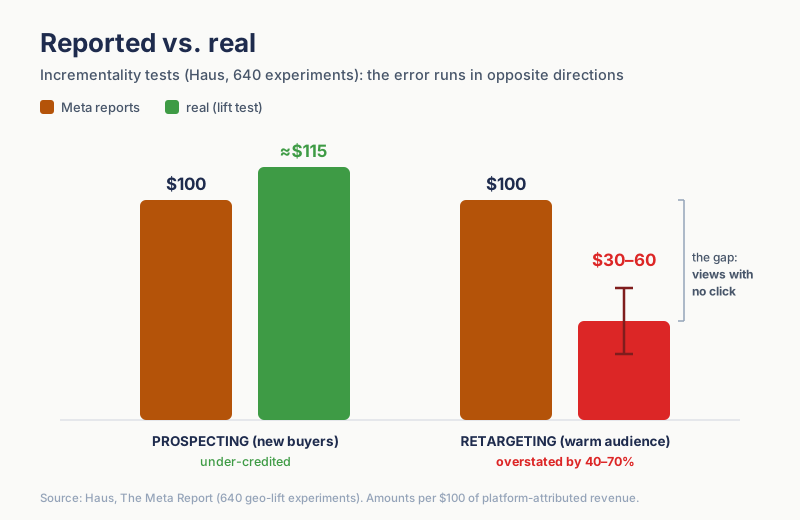
The honest take: view-through is not fake. Some of those people genuinely bought because the ad reminded them, and only incrementality testing can tell you how many. The platform grading its own homework has no incentive to separate them for you, and the correlation runs the wrong way.
The warmer the audience, the more view-through conversions, and the less the ad actually changed.
How to See Your View-Through Share
View-through credit is one of four mechanisms that widen the gap between platform dashboards and store revenue; the others, modeling included, are laid out in modeled conversions vs real orders.
You do not have to guess your view-through share. Both platforms let you split the number in a few clicks.
In Meta (3 minutes, reporting only, bidding untouched):
- Open Ads Manager with your campaigns in view.
- Click Columns above the table, then Compare attribution settings (in Ads Reporting the same option sits under Customize, Options, Select attribution settings).
- Tick 7-day click and 1-day view separately and apply.
- Each conversion metric now shows extra columns. The 1-day view column is the share of results Meta credits to a mere impression, no click.
- Read your retargeting campaigns first; that is where the inflation concentrates.
Bonus check: Breakdown → By attribution setting splits every reported result into its click, engage and view components in one view.
In Google Ads: add the "View-through conv." column to any Display, Video, or Demand Gen report. It is already excluded from your Conversions column, so here the check is the reverse: make sure nobody on your team is quoting "All conversions" (which includes view-through) as if it were "Conversions."
Then do one more comparison that no platform column can do for you: put platform-reported revenue next to your actual orders. If Meta plus Google claim more revenue than your store recorded, the surplus has to come from somewhere, and view-through plus double-counting between platforms are the two usual suspects. Your blended ROAS is the ceiling check: total real revenue over total spend cannot be argued with.
Start with the orders that carried a Meta click ID in Enalitica's data (stores with Meta and Google Ads connected, more than 10,000 orders, over €700,000 revenue, last 90 days to 28 September 2026): Meta reported 4.6 times that many conversions. Add Google, and the two platforms' conversions matched the stores' total order count, email, organic and direct included, at a value close to three quarters of all revenue. Only 1.4% of orders touched two ad platforms with a click, so click-on-click double counting explains little of that gap; view-through and modeled conversions have to carry most of it.
How Enalitica Measures ROAS From Click-Backed Orders
Enalitica does not count view-through conversions, by design. Attribution starts from the confirmed order in your WooCommerce or Shopify store, and an order is only tied to a campaign when there is a captured click behind it: a gclid, fbclid, gbraid or another click ID stored with that specific order.
An impression cannot produce a click ID, so an impression can never claim an order.
In practice you see three numbers side by side for the same campaign: what Meta claims (clicks plus views), what Google claims, and the revenue from orders that carry an actual click from that campaign. And because the split matters, the Meta column in Enalitica's campaign table now carries a small tag showing what share of Meta's claimed purchases had no click at all (its 1-day view window), campaign by campaign, so the inflation is visible right on the number that contains it. The first time store owners see this, the reaction is usually the same: the Meta number shrinks, the "Direct" bucket shrinks, and the sum finally matches the bank statement. Your ROAS will look lower than Meta's. It is also the one you can defend in a spreadsheet with order numbers in it.
One thing we keep seeing across our clients deserves saying here, because last-click numbers put Meta in a harsher light than it earns: when a store invests seriously in Meta, its organic and direct traffic rise with it, brand searches multiply, and orders arrive days later through channels Meta never gets credit for. We can see the lift; we cannot measure how much of it is Meta's, and neither can anyone honestly. Read the Meta row as a floor, not a verdict; the Meta halo guide explains what we see and why nobody can size it.
That does not make view-through useless. It is a soft signal for prospecting reach, and if you want Meta's algorithm to keep learning from view events, you should keep sending them. The rule is narrower: never let a view-through number decide where next month's budget goes. Book a demo and we will pull up your own campaigns and show you the click-backed revenue next to the platform-claimed revenue.
Frequently Asked Questions
Should I change my Meta attribution setting to 7-day click only?
Changing the ad set attribution setting changes what the delivery algorithm optimizes for, not just reporting, so treat it as a media decision rather than a reporting fix. The safer first step is to use the Compare attribution settings columns for honest reporting while leaving optimization untouched. If a campaign's results turn out to be mostly 1-day view, fix the strategy, not just the column.
Are engaged-view conversions the same as view-through conversions?
No, and the difference matters for reporting. Engaged-view requires real engagement (at least 10 seconds of a skippable video ad, or the full ad if shorter) and Google counts it in the main Conversions column with a 3-day default window for website conversions (1 day for video action campaigns). View-through requires nothing but the impression and stays in its own column. Meta's newer engage-through window is the same idea on the Meta side.
Do view-through conversions show up in GA4?
No. GA4 only attributes across clicks (plus YouTube engaged views on Google's own inventory), so a Meta view-through conversion appears in GA4 under whatever channel the buyer actually arrived from, often Direct or Organic. This mismatch alone can explain a large share of the Meta-versus-GA4 gap.
What is a normal view-through share for a store?
There is no published benchmark worth citing, and the share varies mostly with audience temperature: cold prospecting tends to show a low view-through share, retargeting a high one. That variance is the point. Measure your own split with the comparison columns before assuming your ROAS is click-earned.
What about Meta's incremental attribution setting?
Since April 2025 Meta offers an optional "Incremental attribution" setting: you pick "Incremental conversions" as the performance goal and Meta bids and reports on estimated incremental lift instead of raw attributed conversions. It is a genuine step toward honesty, with two caveats: the lift estimate still comes from Meta's own models (Haus's independent read has it beating standard attribution for DTC brands and roughly level for omnichannel ones, after trailing it a year earlier), and selecting it locks the normal attribution settings. Worth testing on one campaign; not a substitute for checking claims against your own orders.
Does turning off view-through events break Meta's optimization?
You cannot fully "turn off" impressions being used for attribution without changing the attribution setting, but you can and should keep sending complete conversion events (including server-side ones) to Meta regardless of how you report internally. Signal for the algorithm and truth for the budget meeting are two different jobs. Use both.
Sources
The outside pages this article relies on. Links checked on 28 September 2026.
- definition of an impression (facebook.com)
- attribution setting (facebook.com)
- removed the 28-day windows in January 2021 (en-gb.facebook.com)
- no longer returns the long view windows at all (ppc.land)
- "click" means a link click only (facebook.com)
- view-through conversions (support.google.com)
- default view window of 1 day (support.google.com)
- engaged-view conversions (support.google.com)
- data-driven attribution (support.google.com)
- 15 randomized Facebook experiments covering 1.6 billion impressions (pubsonline.informs.org)
- Seer Interactive tested Meta's own incrementality setting on $1.05M of ad spend (seerinteractive.com)
- analysis of DTC brands (haus.io)
- review of 640 incrementality experiments (haus.io)
- Select attribution settings (facebook.com)
- "Incremental attribution" (facebook.com)
- independent read (haus.io)
Figures marked "in Enalitica's data" are aggregates from the real orders of the stores we measure, with no names and no individual orders. How we measure.
See your real numbers
Import 30 days of orders or leads during a 5-minute onboarding. Works for e-commerce and service businesses.
See plans and pricing