ChatGPT Sales in 2026: What the Last 100,000+ Store Orders Show
We analysed the most recent 100,000+ real online store orders: how much ChatGPT really sells, who buys, and why GA4 misses most of it.
 Tilen Ledic Written by
On this page
I'm Tilen, founder of Enalitica. We build order-based attribution for online stores, which means we spend our days working out which click, ad or channel actually brought each order. Attribution is literally what we do for a living.
Lately almost every store owner I talk to asks me the same question: is ChatGPT actually selling anything for us? So we went and checked. Not traffic estimates, not GA4 sessions. We took the most recent 100,000+ real orders from the stores we measure and looked at every single one: did this buyer come from ChatGPT or another AI assistant, or not?
What we found is more interesting than the headlines you have probably seen. One report says AI visitors convert 90% better, the next says they convert worse than almost every channel, and your own GA4 shows an AI line so thin you wonder whether to care. Most of that confusion goes away once you count orders instead of visits.
Key numbers from 100,000+ real orders
- 100,000+
- most recent real online store orders analysed
- ~4×
- AI's share of orders vs the same months a year earlier, same stores
- 95 of 100
- AI-referred orders that came from ChatGPT
- ~9 in 10
- AI-referred orders placed by first-time customers (7 in 10 overall)
- Under half
- of AI-referred orders that GA4 files under its AI channel
- Same basket
- AI orders spend about what other orders spend
Source: Enalitica, first-party data from the most recent 100,000+ orders of the online stores we measure.
Method in one paragraph. The base is the most recent 100,000+ orders from the online stores Enalitica measures, up to 7 November 2026. An order counts as AI-referred when its own landing referrer or utm_source points to an AI assistant (chatgpt.com, perplexity.ai, gemini.google.com, copilot.microsoft.com, claude.ai and other AI assistant hosts). Paid ChatGPT ad clicks are excluded, and so are test, cancelled and failed orders. Shares are computed per store, and "the typical store" means the median. Year-on-year comparisons use only stores present in both periods, and new versus returning is decided by the store's own email address history. The dataset itself is described on our methodology page.
The Short Answer
ChatGPT sells, and its share of orders is growing fast. In our data the AI share of orders between August and November 2026 was about four times what the same stores saw a year earlier, and it rose in almost every store we measure between the first half of 2026 and this autumn. At the typical store, AI assistants are already close to 1 in 100 orders, up from a fraction of that a year ago.
Three more things hold across the data. ChatGPT brings almost all of it. AI buyers are overwhelmingly new customers who spend about what everyone else spends. And GA4 puts fewer than half of these orders in its AI channel, so the AI line in your analytics is smaller than what your shop actually sells.
Key findings (free to quote with a link)
- Enalitica's analysis of more than 100,000 online store orders shows that AI assistants' share of orders roughly quadrupled in a year (August to November 2026 against the same months of 2025, same stores).
- Enalitica's analysis of more than 100,000 online store orders shows that ChatGPT accounts for about 95 of every 100 orders referred by AI assistants.
- Enalitica's analysis of more than 100,000 online store orders shows that nearly 9 in 10 AI-referred orders come from first-time customers, against about 7 in 10 of all orders.
- Enalitica's analysis of more than 100,000 online store orders shows that orders from AI assistants have about the same basket size as other orders.
- Enalitica's analysis of more than 100,000 online store orders shows that GA4 files fewer than half of AI-referred orders under its AI channel; the rest appear as Referral, Organic Search, Unassigned or Direct.
- Enalitica's analysis of more than 100,000 online store orders shows that at the typical store, AI assistants are already close to 1 in 100 orders.
Why Session Studies Disagree
The big public numbers count visits, and each one is honest about what it measures. Adobe reported that in September 2026 AI-referred visits to US retail sites converted 90% better than other traffic and earned 83% more revenue per visit. BrightEdge found that ChatGPT sent 95.1% of all AI-referred website traffic in August 2026.
Then there is the academic view. Maximilian Kaiser and Christian Schulze studied 973 e-commerce sites with more than $20 billion in revenue between August 2024 and July 2025, published in Marketing Science. Their finding: ChatGPT referrals converted better than paid social but worse than every other established channel, with conversion rising over time.
Both are right about their own sample and window. A visit-based number depends on how well the visit was classified, and as you will see below, a large share of AI visits are not classified as AI at all. An order-based number starts at the other end: the order exists, and the only question is which source it carried.
How Fast the AI Share of Orders Grew
The curve stayed flat for most of 2025 and then bent upwards in the second half of 2026. By quarter, on the same scale, it looks like this:
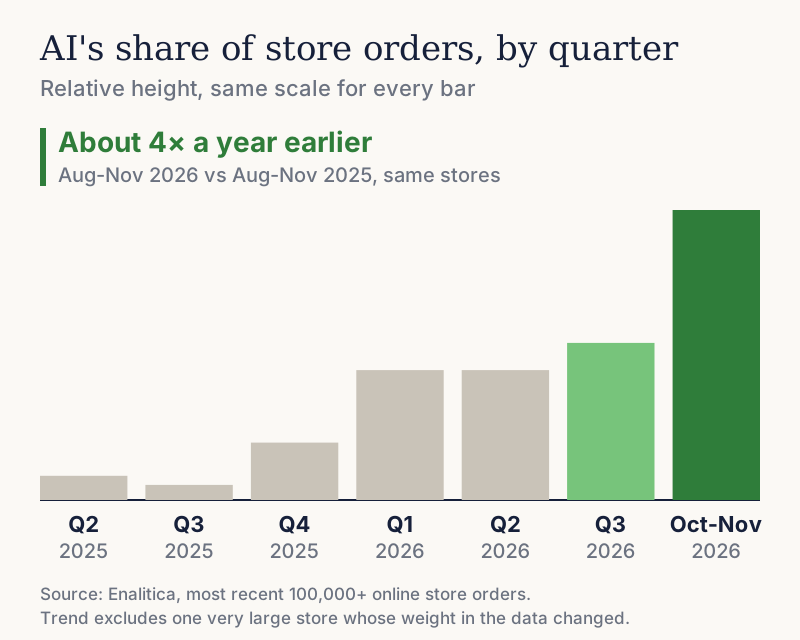
The growth is broad, which matters more than the size of the multiple. It rose in almost every store we measure between the first half of 2026 and the autumn, so this is not one shop whose product happened to be recommended. For the trend line we left out one very large store whose weight in the data changed over the period, because otherwise its mix would move the line more than AI did.
The typical store now sits close to 1 order in 100 from AI assistants. A year ago it was a fraction of that. If your store sells something people research before buying, assume you are on the same curve, and check rather than guess.
ChatGPT Sells, the Others Barely Register
About 95 of every 100 AI-referred orders came from ChatGPT. Perplexity, Gemini, Copilot and Claude share the remainder between them. That matches what BrightEdge sees in traffic, so the share holds at the order stage too.
For a store owner this simplifies the work. If you want to know how your products show up in AI answers, start with ChatGPT and treat the others as a later check. Google's AI Mode and AI Overviews are a separate case: Google reports their clicks inside the normal Search Console "Web" numbers, so they arrive at your store as ordinary Google organic visits, and no order-level method can split them out from the referrer.
New Customers, Same Basket
Nearly 9 in 10 AI-referred orders came from first-time customers, judged by whether the email address had ever ordered from that store before. Across all orders the figure is about 7 in 10.
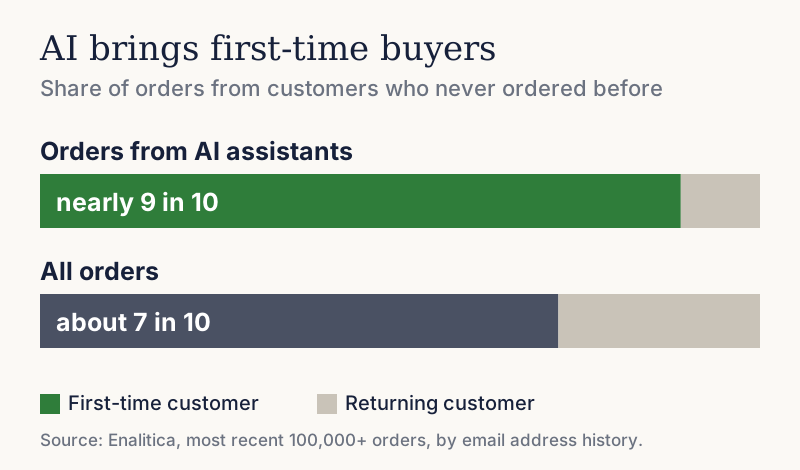
That makes sense when you think about how people use ChatGPT: they ask "which sofa bed is best for a small flat" because they do not yet have a shop in mind. AI answers work like a discovery channel. Your returning customers come back through email, a bookmark or your brand name on Google instead.
The basket is where the hype does not hold. You will read that AI shoppers spend more. In our data, once each order is compared with its own store's average, AI orders are about the same size as other orders. They are not bigger. A store that sells €800 furniture gets €800 orders from ChatGPT and a store that sells €40 cosmetics gets €40 ones.
Conversion is the other half of the story. Comparing AI orders with AI visits in GA4, an AI visit converts better than the site average in most stores we measure. One likely reason: the shopper arrives after a conversation that already narrowed the choice, so fewer of these visits are idle browsing.
GA4 Files Fewer Than Half Under AI
This is the main reason to count orders. We took every AI-referred order from stores with GA4 connected and looked up the GA4 session behind it. Only 41% sat in GA4's AI Assistant channel.
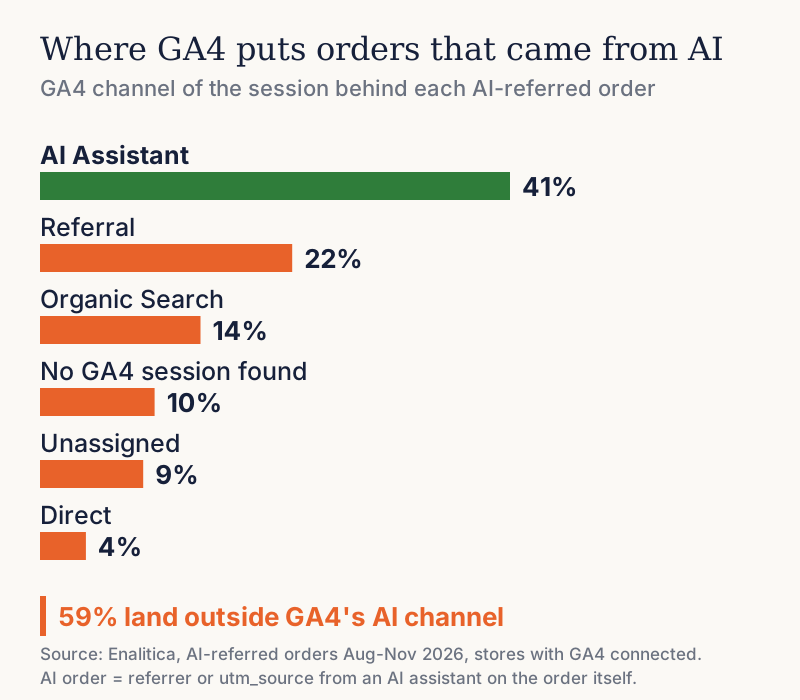
The rest scatter. Referral takes the biggest piece, usually because the visit came from an AI host GA4's rule does not recognise yet. Organic Search and Unassigned take most of the remainder, and for about one order in ten GA4 has no matching session at all, typically because the buyer declined analytics cookies.
So when GA4 says the AI channel is small, it is small partly because GA4 is looking at a slice. We covered the GA4 setup that recovers some of it, a custom channel group and a referrer filter, in how to track AI traffic in GA4.
The Orders Nobody Can See
Counting orders closes the gap GA4 leaves, but it cannot recover a source that never reached the store, and three leaks are worth knowing:
- Apps and copy-paste. A link opened from the ChatGPT desktop or phone app, or copied from an answer into a new tab, often arrives with no referrer. The visit lands in Direct, in GA4 and in any order-level tool.
- The tag is not on every link. OpenAI adds
utm_source=chatgpt.comto many outbound links, which is what lets a store recognise ChatGPT when the referrer is missing. Many links still go out without it. - The October gap. Between 8 and 15 October 2026 ChatGPT reportedly stopped adding the tag, according to an Adobe analyst who said OpenAI confirmed a bug. OpenAI has not commented publicly. Our October bars include that week, so if anything they undercount.
Every number in this post is therefore a floor. The real AI share of orders is higher, and nobody can say by how much from the order alone. A post-purchase "how did you hear about us" question is the only way we know to catch the rest.
What Changed With Buying Inside ChatGPT
In 2025 the worry was that ChatGPT would keep the sale for itself. OpenAI launched Instant Checkout so people could pay without leaving the chat. In March 2026 OpenAI moved away from it towards apps that retailers build inside ChatGPT, after limited adoption, and Shopify said it would not build one.
For most stores that means the buyer clicks through and pays on the store's own site again, where the order system records it with its source. That is a large part of why the growth above is visible at all: the sale happens where it can be counted.
What a Store Owner Should Do
You do not need a new strategy for AI assistants yet. You need to know your own number, and to stop judging the channel by a GA4 line that holds less than half of it.
- Count AI on orders, not sessions. Check which orders carried a ChatGPT referrer or
utm_source=chatgpt.com. That is your floor. - Treat it as acquisition. Nearly all of these buyers are new to you, so judge the channel against your new-customer goals, not against email.
- Look at which pages AI sends people to. The landing pages tell you which products and guides ChatGPT already cites.
- Annotate 8 to 15 October 2026 in your reports, so a dip that week is not mistaken for a trend.
- Ask buyers. One optional question at checkout catches the app and copy-paste orders no tool sees.
Enalitica does step 1 for you. Every order keeps the source it arrived with, and the AI / LLM report splits AI orders by assistant, shows revenue, conversion and landing pages, and keeps orders where AI started the journey but another channel closed it in a separate multi-touch column.
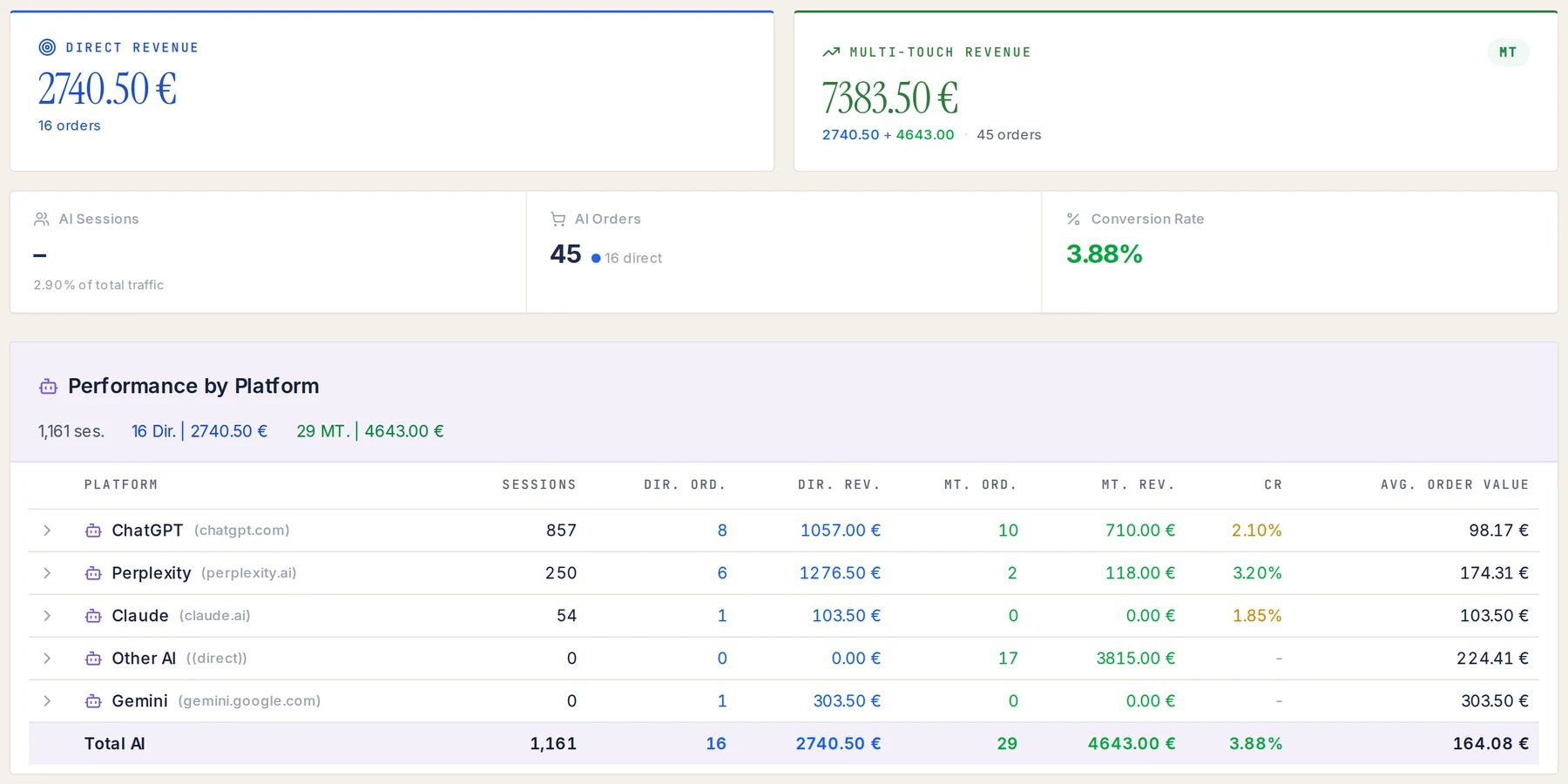
- 1AI on the path. Orders where an AI answer started the journey and another channel closed it, kept apart from direct AI orders.
- 2Counted on the order. Each AI order carries its referrer or utm_source, whatever GA4 called the session.
- 3Per assistant. ChatGPT, Perplexity, Claude, Gemini and other AI hosts, with revenue and average order value.
You can also ask about it in plain language. With Enalitica MCP connected, ChatGPT or Claude can answer "how many orders did AI assistants bring last month, and were they new customers?" from your own order data, read-only and without customer personal data.
If you are thinking of paying for ChatGPT on top of the free answers, read are ChatGPT ads worth it and how ChatGPT ads attribution works first. Paid clicks carry their own click ID, which is why they are kept out of every number above.
Frequently Asked Questions
How many online store orders come from ChatGPT and AI assistants in 2026?
At the typical store in Enalitica's data, close to 1 order in 100 now arrives from an AI assistant, and that is a floor because app and copy-paste visits lose their source. The share differs a lot by what you sell: stores with considered purchases, where people ask for comparisons, see more than stores selling impulse or repeat items. The more useful figure is your own trend, because the share of AI-referred orders roughly quadrupled in a year.
Why does Google Analytics show less ChatGPT traffic than my shop actually gets?
GA4 classifies sessions by rules, and its AI Assistant channel only catches visits whose source matches its list. In our data fewer than half of AI-referred orders sat in that channel. Visits from AI hosts it does not recognise land in Referral, visits whose source was lost land in Direct or Unassigned, and buyers who declined analytics cookies have no session at all. Your shop's order records keep the referrer and UTM tags of the order itself, so they show more.
Do shoppers from ChatGPT convert better than shoppers from Google?
On average, an AI visit converts better than the site average in most stores we measure, but that compares AI with every visit, including casual browsing. Against high-intent Google traffic such as brand searches, the academic study of 973 sites found ChatGPT behind. A fair comparison for your store is AI orders divided by AI visits next to Google organic orders divided by Google organic visits, both counted from orders.
How to cite this data: Source: Enalitica, analysis of the most recent 100,000+ online store orders, enalitica.com/blog/chatgpt-ecommerce-sales
Sources
The outside pages this article relies on. Links checked on 7 November 2026.
- Adobe reported (business.adobe.com)
- BrightEdge found (thenextweb.com)
- 973 e-commerce sites with more than $20 billion in revenue (frankfurt-school.de)
- Marketing Science (pubsonline.informs.org)
- reports their clicks (developers.google.com)
- an Adobe analyst who said OpenAI confirmed a bug (relevantaudience.com)
- OpenAI moved away from it (shopifreaks.com)
Figures marked "in Enalitica's data" are aggregates from the real orders of the stores we measure, with no names and no individual orders. How we measure.

See your real numbers
Import 30 days of orders or leads during a 5-minute onboarding. Works for e-commerce and service businesses.
See plans and pricing