
When to Pause a Google Ads Campaign: Rules, Not Gut Feel
When to pause a Google Ads campaign, decided by rules: clean weeks, break-even POAS, four verdicts with thresholds, and a countdown instead of panic.

Tilen Ledic
Written by
When to pause a Google Ads campaign is a question most store owners answer with their stomach, usually at 11 pm, looking at three bad days. We think it deserves arithmetic instead. This article lays out the decision rules we run in production every week: how many weeks of data a verdict needs, where the profit threshold sits, and what has to be true before pausing is even on the table.
None of it requires our software. The rules are numbers, and you can apply every one of them in a spreadsheet. What they require is discipline about two things most ad accounts never define: what counts as evidence, and what counts as losing money.
One honest disclaimer up front, because a wrong pause loses momentum that a wrong budget tweak does not:
Pausing is the most expensive button in the ad account. That is exactly why it should be the most rule-bound decision in it.
The learning phase: the first week is not evidence
Google's Smart Bidding needs time to calibrate before a campaign's numbers mean anything: Google puts the learning period at a few conversion cycles, typically one to two, and its guide to measuring Smart Bidding recommends judging over a month or at least 50 conversions. During that learning period, delivery is deliberately exploratory: costs run higher and results swing, because the system is testing who to show the ads to. Judging a campaign inside this window is the most common expensive mistake in self-managed accounts.
What you can read during the first week is direction, not level. A cost per result that improves day over day says the algorithm is converging, even if the absolute number is still ugly. A flat or worsening trend after the first week is the earliest signal worth writing down.
The learning phase also restarts more easily than most people expect. Google lists the triggers of a Learning status as a new or reactivated bid strategy, a changed strategy setting, and campaigns, ad groups or keywords added to or removed from the strategy, which is why every rule below treats settings changes as evidence-destroying events.
How long should a campaign run before you judge it?
A campaign has earned a judgement after four clean weeks, and a week only counts as clean when two things hold: the sample was big enough to mean something, and nobody touched the settings. We compute verdicts on the last four clean weeks and read trends on eight, and the clean-week filter is the single most important idea in this article.
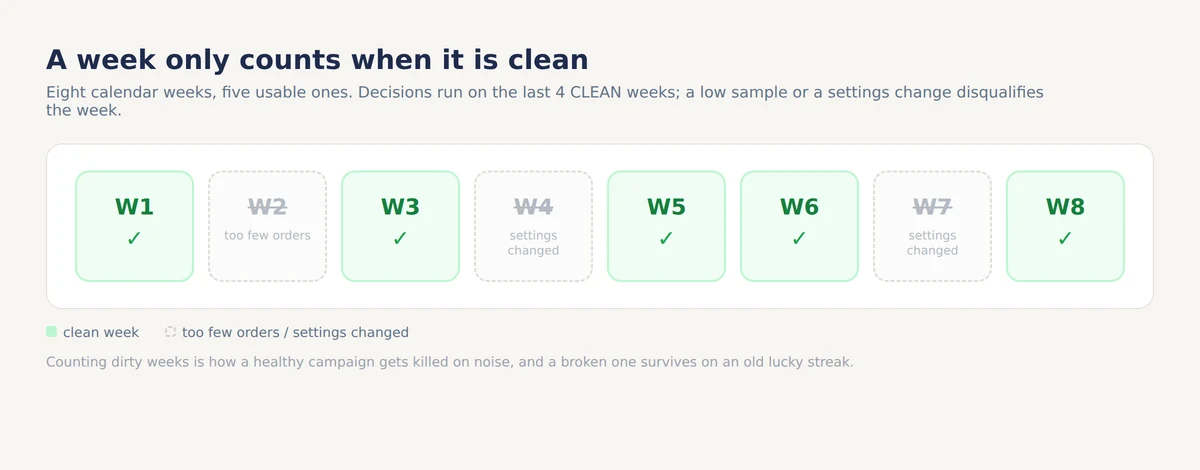
Why disqualify weeks at all? Because a week with three orders is a coin flip, and a week where the budget doubled on Wednesday measures the change, not the campaign. Counting dirty weeks is how a healthy campaign gets killed on noise, and how a broken one survives on an old lucky streak.
The practical consequence is humbling: a campaign you adjust every few days never accumulates clean weeks, so it never earns a verdict at all.
Constant tinkering does not just reset Google's learning; it resets yours.
Break-even ROAS and POAS: the line between profit and loss
Break-even is where an ad euro brings back exactly one euro of profit, and it is the line every pause decision should be measured against. On revenue metrics, break-even ROAS equals one divided by your margin: a store with a 40 percent margin breaks even at ROAS 2.5, not at ROAS 1. The blended ROAS and MER guide walks the formula.
POAS makes the same line simpler by moving costs into the metric itself. POAS is profit divided by ad spend, after purchase prices, shipping, fees and returns, so its break-even is always 1.0 for every store and every campaign. What POAS is and how to compute it is covered in our POAS guide.
The difference is not academic. The fictional campaign on the card further down runs ROAS 1.82, which looks respectable, and POAS 0.72, which means it loses 28 cents on every ad euro. Same campaign, same weeks, opposite decision, and only one of the two numbers knows about your purchase prices.
When to pause a Google Ads campaign: the four verdicts
When to pause a Google Ads campaign stops being a judgement call once every campaign gets one of four verdicts from the same measurable inputs: profit per ad euro over the last four clean weeks, the number of clean weeks, the spend, and the trend. These are the exact rules our verdict engine applies every Monday, thresholds included.
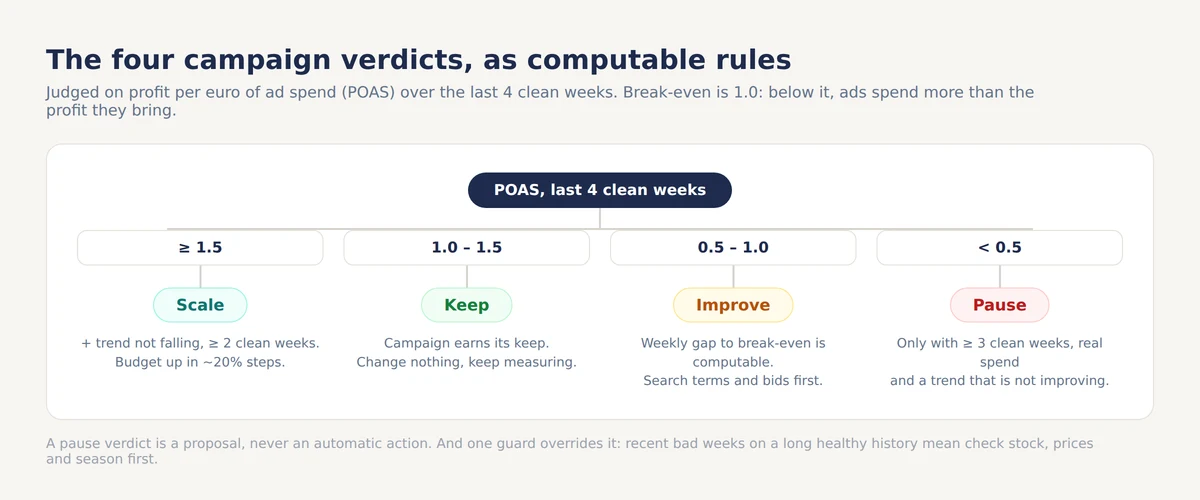
Scale requires POAS at or above 1.5, at least two clean weeks, and a trend that is not falling. Even then the budget moves in steps of about 20 percent per week, because bigger jumps move delivery faster than the evidence can follow (Google's own Demand Gen performance guide suggests raising a constrained budget by at most 15 percent) and because efficiency usually decays as spend grows. The full scaling playbook is in how to scale ads without scaling losses.
Keep is POAS at or above 1.0: the campaign earns its keep, so the correct action is the hardest one, which is nothing. Improve is POAS below 1.0, and its virtue is that the problem has a size: at 310 euros of weekly spend and POAS 0.72, the campaign is about 87 euros of weekly profit short of break-even. The first places to recover that gap are usually the search terms that spend without selling and the bid targets.
Pause demands four conditions at once: POAS well below break-even (our threshold is 0.5), at least three clean weeks of evidence, real spend behind the numbers (at least 100 euros over the four weeks), and a trend that is not improving. Miss any one condition and the verdict stays improve. And a pause verdict is a proposal to a human, never an automatic action, and never a deletion.
The stop countdown: a predictable decision instead of panic
A countdown replaces the worst property of pause decisions, which is that they usually happen suddenly, in a bad mood, on a bad day. When a campaign's profit sits below the pause threshold but the other conditions are not yet met, the right output is not a red alert; it is a date: if nothing changes, the pause proposal fires after two more clean weeks.
The countdown also names what is holding the proposal back. Spend still under the floor: the campaign is too small to judge. Trend improving: the campaign is earning its stay of execution. Fewer than three clean weeks: the evidence is not in yet. Each blocker is a fact you can check, not a feeling you can argue with.
The effect on the owner is the point, and it is a calmer and measurably better position to make decisions from:
A countdown turns "should I panic today?" into "I have two weeks to fix the search terms before this becomes a pause decision".
When should you NOT pause an underperforming campaign?
An underperforming campaign should survive the pause decision in three situations: when its long history contradicts its recent weeks, when it assists sales that finish elsewhere, and when its traffic is disproportionately new customers or brand searches. Each of the three has a concrete test.
A long healthy history overrides a bad month. When the last four weeks sit below break-even but the campaign has at least eight healthy measurable weeks behind them, the verdict in our engine is deliberately not "pause" but "check first". A campaign that earned for two quarters and stumbled for one month usually has an external cause: stock ran out, a price changed, the season turned. Pausing it treats a supply problem as a marketing problem.
Assists are invisible in last-click columns. A campaign can look unprofitable on its own attributed orders while feeding buyers who convert through brand search or direct visits days later. Before pausing anything, look at the orders where the campaign was part of the path but not the last click; the how-to is in assisted conversions: check them before you pause.
In Enalitica's data (more than 6,500 order journeys, last 90 days to 28 September 2026), 26.7% of the orders that touched Google Ads were closed by another channel, so about one Google-touched order in four is invisible to a last-click report.
Composition changes the verdict's meaning. A campaign whose orders are largely first-time customers is buying growth even at POAS just under 1.0, because those customers come back; one that mostly harvests searches for your own brand name is claiming sales that were coming anyway.
Brand is rarely a small slice: in the same data, keywords containing the store's own name drove 40% of the Google Ads orders with a known keyword, and about 3 in 10 in the median store. Both shares are measurable, and both belong in the decision; the reasoning is unpacked in advertising incrementality.
What pausing actually costs: assists and re-learning
Pausing has two costs that never show in the campaign column. The first is the assisted revenue above: orders the campaign touched but did not close disappear a week or two after the campaign does, in someone else's column, which is why the drop is so easy to misattribute. In Enalitica's data over the same 90 days, 29.5% of orders with a paid ad click were placed more than a day after that click and 9.3% more than a week after, so the gap a pause leaves shows up late.
The second is re-learning. A reactivated bid strategy is on Google's own list of Learning triggers, so a campaign that returns from a long pause can spend another few conversion cycles recalibrating, with the same swings it had at launch. Short pauses are close to free; long ones mean paying the learning tax twice.
Both costs together make one honest test worth the price: if you genuinely doubt a campaign causes anything, pause it deliberately for 14 days and watch the store's total revenue, not the campaign's column. Announce the dates in advance, change nothing else, and account for season. That is a pause as an experiment, not a pause as a mood.
How Enalitica turns these rules into weekly campaign verdicts
Enalitica runs every rule in this article as code, every Monday morning, over each connected store's Google Ads campaigns. The engine reads the same order-based profit data as the rest of the platform, computes the four-week evidence, and assigns each campaign one verdict with the numbers attached: keep, scale, improve or pause, plus the check-first guard when a long history contradicts a bad month.
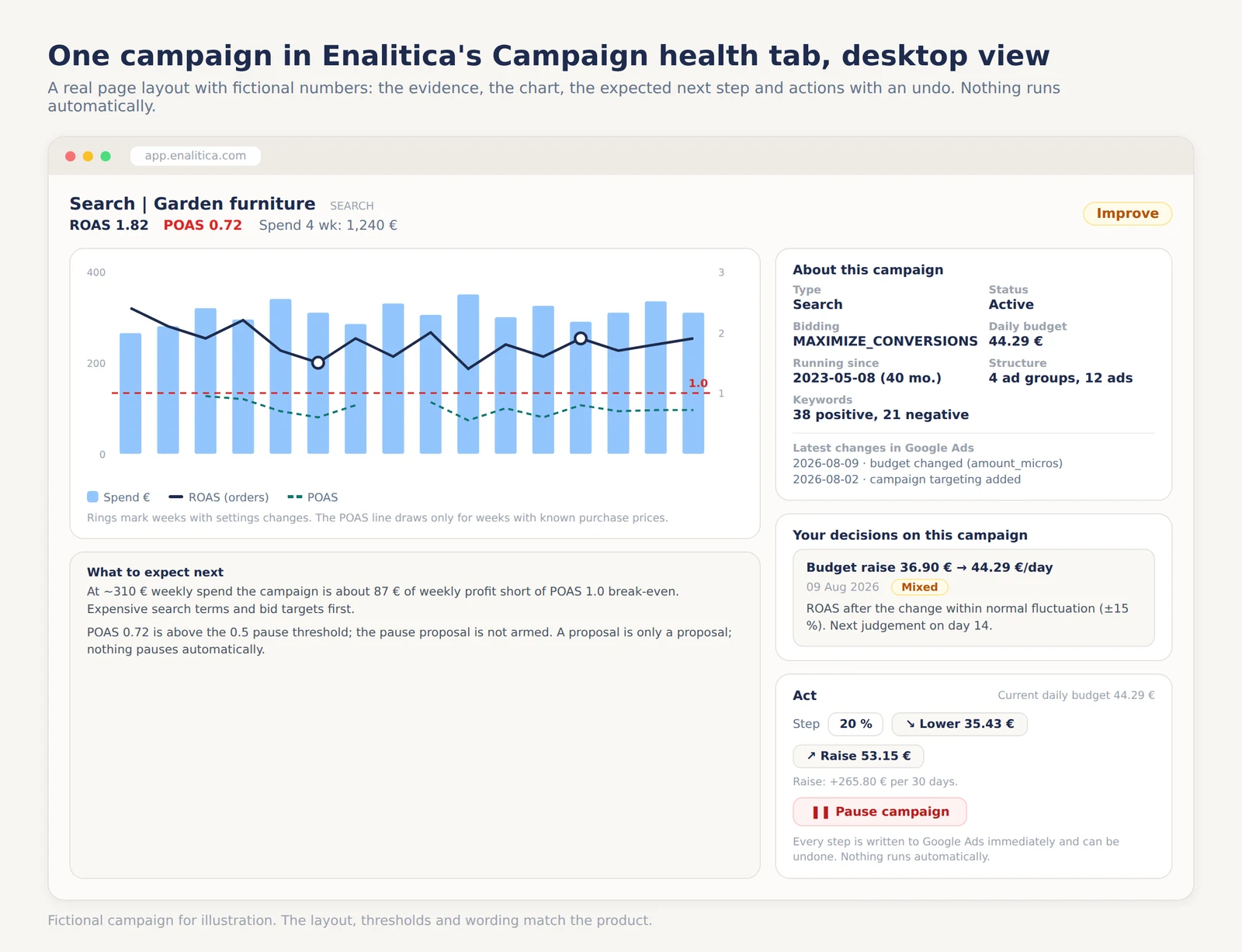
The view above is the real desktop layout with fictional numbers. Three design choices matter more than the layout. Every verdict ships with its evidence, so you can disagree with the rule rather than guess at it. The expected next step is computed, not narrated: an improve verdict states the weekly gap to break-even in euros. And nothing ever pauses automatically: the engine writes proposals, the owner clicks buttons.
Clean weeks are detected, not declared. The engine reads the campaign's change history straight from Google Ads, so a Wednesday budget edit disqualifies that week automatically, and the chart marks changed weeks with rings on the trend line. The POAS line draws only for weeks with known purchase prices, so missing cost data never fakes a profit.
Your own decisions are judged by the same standard. Every budget step made in the app is written to Google Ads immediately and stays reversible with one click. About two weeks later the engine compares performance before and after the change, with a ±15 percent band separating a real effect from normal fluctuation.
We built it this way after watching the alternative fail: dashboards that show twenty metrics and no verdict produce either paralysis or 11 pm gut decisions. Rules with visible numbers produce arguments about the rules, which is exactly the argument worth having.
Campaign pause decision checklist
- [ ] The campaign is out of the learning phase (one to two conversion cycles, then a month or ~50 conversions of evidence)
- [ ] You are judging clean weeks only: sufficient orders, no settings changes mid-week
- [ ] You have at least three clean weeks of evidence, four for comfort
- [ ] You are measuring against break-even (POAS 1.0, or ROAS = 1/margin), not against zero
- [ ] Spend in the window is large enough that the percentages mean anything
- [ ] The trend is flat or falling, not improving
- [ ] Assisted orders were checked, not only last-click ones
- [ ] New-customer share and brand share were checked
- [ ] A long healthy history was ruled out as a "check stock, prices, season" case
- [ ] The pause has an owner, a date and a plan for what gets measured after
Frequently Asked Questions
How long should a Google Ads campaign run before judging results?
Wait out the learning phase first (Google says one to two conversion cycles and recommends judging over a month or at least 50 conversions), then judge on at least three to four clean weeks: weeks with a sufficient sample and no settings changes. For most small stores that means about a month of untouched running before a pause-level decision is honest.
What is break-even ROAS and how do I calculate it?
Break-even ROAS is one divided by your profit margin: at a 40 percent margin, ROAS 2.5 is the point where ads stop losing money. On POAS, which already includes costs, break-even is always 1.0. Campaigns between break-even and zero profit are improve cases, not pause cases.
Are two weeks of bad results enough to pause a campaign?
Usually not. Two weeks is below the evidence floor unless spend is high: our own rule requires at least three clean weeks, real spend behind the numbers and a non-improving trend before a pause proposal fires. Two bad weeks after months of profit is a check-first case, not a pause case.
Does pausing a Google Ads campaign reset its learning?
In practice a short pause of a few days usually resumes close to where it left off. Longer pauses carry more risk, because Google lists a reactivated bid strategy among the triggers of a Learning status, and recalibration takes a few conversion cycles. Budget the re-learning cost into any pause decision.
Should I pause campaigns during a seasonal dip?
Distinguish the campaign from the calendar first: if the whole store is down and the campaign's share of it is stable, the campaign is not the problem. Cutting budget through a dip is often cheaper than pausing, because it preserves the campaign's history and avoids the re-learning tax when the season returns.
What if ROAS looks fine but POAS is below 1.0?
Then the campaign sells products that lose money after purchase prices, shipping, fees and returns, and the revenue metric is hiding it. Check which products the campaign actually sells and their margins before touching the campaign itself; sometimes the fix is the product mix or the price, not the ads.
Sources
The outside pages this article relies on. Links checked on 28 September 2026.
- learning period at a few conversion cycles, typically one to two (support.google.com)
- guide to measuring Smart Bidding (support.google.com)
- Demand Gen performance guide (support.google.com)
Figures marked "in Enalitica's data" are aggregates from the real orders of the stores we measure, with no names and no individual orders. How we measure.
See your real numbers
Import 30 days of orders or leads during a 5-minute onboarding. Works for e-commerce and service businesses.
See plans and pricing