
TrueROAS vs Enalitica: Pricing, Journeys and MCP Compared
TrueROAS vs Enalitica, checked on TrueROAS's site, September 2026: revenue-based pricing, journey per order, MCP for your own AI, EU hosting. Where each wins.

Tilen Ledic
Written by
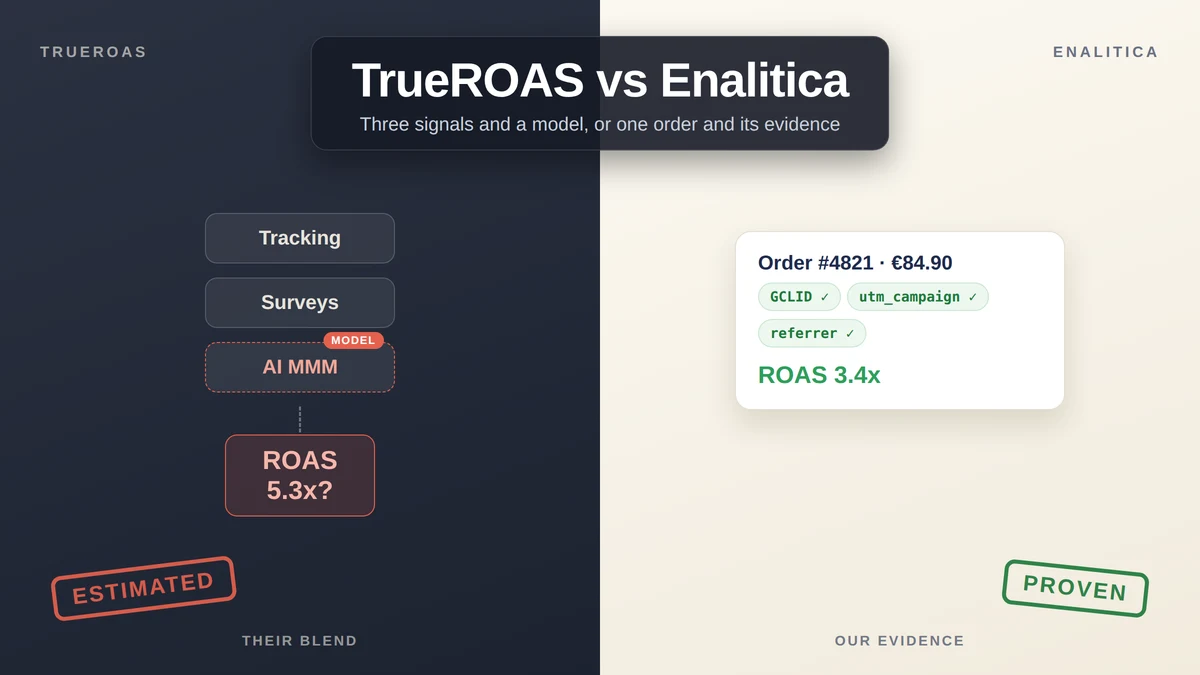
This comparison started in September 2026, when TrueROAS briefly advertised on the Enalitica brand name and published a comparison page about us. The ads have since stopped; the comparison page is still up, so here is our side, checked against their own pages on 25 September 2026.
Updated 25 September 2026: since the first version Enalitica added customer journeys for every order and enquiry and a read-only MCP connection for your own AI assistant, so two rows in the table below changed.
Enalitica wrote this page, so read the factual rows, not the adjectives; where TrueROAS is stronger, the page says so, as in our attribution software guide.
TrueROAS and Enalitica agree on the starting point: a sale counts only when a real order exists behind it. They part ways one step later. TrueROAS's homepage promises three signals, tracking, surveys and an AI media mix model, "triangulated into one answer"; on its pricing page that blend is the True Horizon plan from $449 a month, while Basic and Pro are order-verified pixel tracking. Enalitica never models: an order with no evidence stays in a visible Unknown row. This TrueROAS vs Enalitica comparison is about that difference, plus price, journeys, AI access and where the data lives.
Short answer. TrueROAS fits a Shopify store that spends mostly on Meta, wants ads managed and creative reports inside one tool, and may grow into True Horizon (MMM, surveys, incrementality) from $449 a month. Enalitica fits a WooCommerce, Shopify or Shopamine store in the EU that wants every number traceable to an order, a journey for every order and every enquiry from the Growth plan up, POAS after real costs, and a flat price by order volume from €49. Both verify sales against orders; they differ on what happens to sales no click proves, on price as revenue grows, and on where the data lives.
TrueROAS vs Enalitica, Feature by Feature
The table answers what a store evaluating both actually asks: how each tool counts a sale, whether a journey exists per order, whether your own AI can read the data, profit, hosting and price. Rows TrueROAS wins are left standing.
| TrueROAS | Enalitica | |
|---|---|---|
| Attribution basis | Order-verified pixel; survey and AI MMM on True Horizon | Order plus evidence, no modelling |
| Sales no click proves | Basic and Pro: not counted; True Horizon: allocated by model | Visible Unknown row |
| Journey per order and per enquiry | ✓ per order, Pro plan | ✓ per order and per enquiry, Growth+ |
| Your own AI over MCP | ✓ Pro plan: Claude, ChatGPT, Cursor, plus its own Trew AI agent | ✓ Growth and up: Claude, ChatGPT, Grok by OAuth, Gemini and others by API key; read-only, no customer personal data, no built-in agent |
| Profit per campaign (POAS) | Profit dashboard and product margins listed; POAS per campaign not documented; profit bidding sends gross profit to Meta and Google | ✓ direct and multi-touch, from real purchase prices, shipping, fees and refunds |
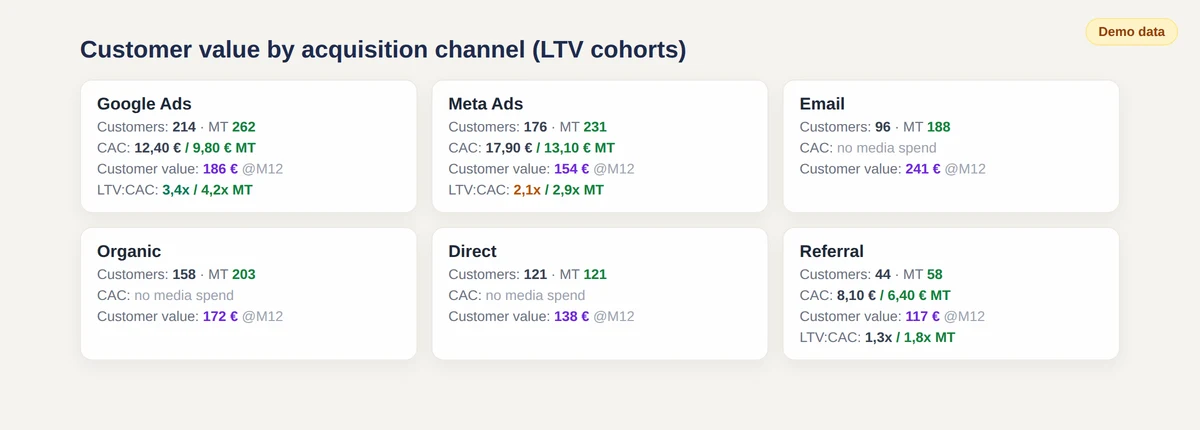
| LTV per acquisition channel | ✓ Pro plan | ✓ |
| Platform numbers shown next to orders | Not stated | ✓ |
| Manage ads inside the tool | ✓ Meta, Google, TikTok, Snapchat, Pinterest, Microsoft | Partly (negative keywords, AI campaign drafts) |
| Creative-level analysis | ✓ Creative Lab | ✗ |
| Snapchat, Pinterest, TikTok spend | ✓ | ✗ |
| MMM and incrementality reports | ✓ True Horizon | ✗ |
| Service businesses and enquiries | Not a documented focus (GoHighLevel listed as a custom integration) | ✓ enquiries with journey, outcome and deal value |
| Platforms | Shopify, WooCommerce; BigCommerce, GoHighLevel and custom builds by integration, up to 7 days | Shopify, WooCommerce, Shopamine, custom shops (order webhook) |
| Hosting stated | AWS / Google Cloud, region not stated | Hetzner servers in the EU |
| Pricing (September 2026) | Free under $10k monthly revenue, card required; above that scales with revenue: Pro $39 just above $10k, $299 at $100k, $1,349 at $1.5M; True Horizon from $449 | Free up to 100 orders a month, no card; Starter €49, Growth €149, Agency €349 (6,000 orders, then €25 per 1,000); 14-day trial with card |
Every TrueROAS fact above was read on trueroas.com on 25 September 2026 (pricing, comparison page, features, privacy policy); Enalitica plan facts are from the pricing page.
TrueROAS is priced by your revenue and says so plainly: free under $10k a month, then a bill that rises as sales rise, with the rate per dollar falling. Enalitica is priced by order volume, in euros, so a good month costs the same as a bad one inside the plan's order allowance.
What TrueROAS Does, in TrueROAS's Own Words
TrueROAS describes its method on its homepage: "Others track. We triangulate," with three signals listed side by side, Tracking, Surveys, AI MMM. The pixel records clicks and orders server-side, the survey asks the buyer on the thank-you page how they heard about the store, and the media mix model allocates the sales the first two signals missed. The blend is presented as "one source of truth" and sent back to Meta and Google.
The pricing page sorts those signals into plans. Basic and Pro are "Order-Verified Tracking: every conversion is matched to a real Shopify order", with the post-purchase survey included. Machine learning with MMM, incrementality reports and a budget scenario planner sit in True Horizon, from $449 a month, "popular for $100k+". So a store on Pro gets a tracked, order-verified number; the triangulated blend is a separate product.
Can a Modeled Sale Be a Verified Sale?
No. An observed sale and a modelled sale answer different questions, and one ROAS figure that mixes them hides which is which. TrueROAS's features page describes machine learning that matches "cookies, browsers, IP, and much more"; its comparison page calls the pixel "True Fingerprinting" and promises "no consent popups needed"; its annual plans carry a 17 percent ROAS improvement guarantee. Those are claims about recovering sales, not about which sales were observed, and only True Horizon adds the modelled share.
A sale confirmed by a click ID is a measurement. A sale assigned by a media mix model is an estimate with confidence intervals. True Horizon puts both in one column.
Both vendors start from the order for the same reason. Enalitica's data for the 90 days to 25 September 2026 (more than 10,000 orders, over €700,000 of revenue) has the two ad platforms claiming roughly one conversion for every order the stores received, and that order count already includes email, organic and direct. The caveat: Google's Conversions column can include non-purchase actions, Meta counts view-through and engaged-view conversions, and click capture misses visitors who decline consent. Any tool that starts from platform numbers inherits that inflation; a tool that starts from orders cannot.
In Enalitica's data, Meta and Google Ads together reported as many conversions as the stores had orders in total, email, organic and direct included.
Enalitica keeps the two worlds apart. Orders without evidence are never estimated into channels; they sit in a visible Unknown row, and the platforms' own reported numbers are shown alongside, clearly labelled, so you can compare the modelled world and the measured one yourself.
Fact-Checking the TrueROAS Comparison Table About Enalitica
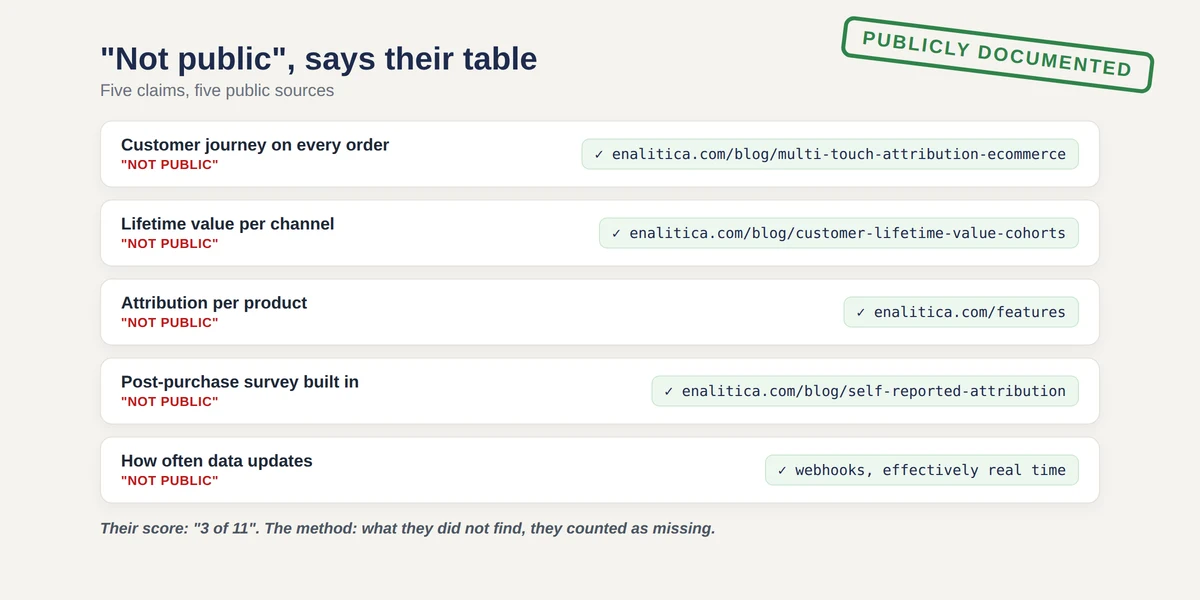
The TrueROAS comparison page, currently headed "Enalitica Is New. TrueROAS Has a Track Record.", scores Enalitica "3 of 11" features and labels us "early stage". The footnote explains the method: "'Not public' means the vendor does not document that feature, and it does not count as included." Eight rows carry that label for Enalitica; here is where each one stands, with the public source:
| Their table says | Reality, with the public source |
|---|---|
| Customer journey on every order: "Not public" | Every order and every enquiry carries its full journey from the Growth plan up; documented in the customer journey tracking guide and the multi-touch attribution guide |
| Lifetime value per channel: "Not public" | LTV cohorts by acquisition channel, with CAC payback; in the customer lifetime value guide |
| Attribution per product: "Not public" | Product-level revenue by channel ships in reports and AI report insights |
| Post-purchase survey built in: "Not public" | The declared-source question, with rules for when the customer's answer wins; documented in the self-reported attribution guide |
| Works with Claude, ChatGPT, Cursor (MCP): "Not public" | Read-only MCP on Growth and up, for Claude, ChatGPT and Grok by OAuth and Gemini and others by API key; setup guide |
| AI assistant on your data: "Not public" | Fair: Enalitica has AI-written reports and analysis but no agent of its own; you bring your own assistant over MCP |
| Shows if an ad really added sales: "Not public" | Correct: Enalitica has no incrementality experiments; the halo we show is the change in brand searches, not a lift test |
| How often data updates: "Not public" | Orders arrive by webhook, effectively in real time; ad spend and platform figures sync daily |
Both tools count a sale only when an order exists; the difference is what each does with the sales no click proves.
Two rows of their table deserve credit for accuracy. "Where its numbers come from: Server-side order and click-ID matching" is a precise description of Enalitica. And "Price for a store doing $100k/mo: Enalitica $149, TrueROAS $299, est. -50% vs TrueROAS" is their own arithmetic.
How Enalitica Attributes One Order, Step by Step
Enalitica starts from the confirmed order and works backwards, which is the opposite direction from a pixel-first stack. When the order lands, it already carries whatever evidence arrived with the buyer's visits: a Google or Meta click ID captured at click time, UTM parameters, a referrer, or a witnessed consented visit. The classifier files the order by that evidence, the full journey stays attached, and clicking any report number opens the actual orders behind it.
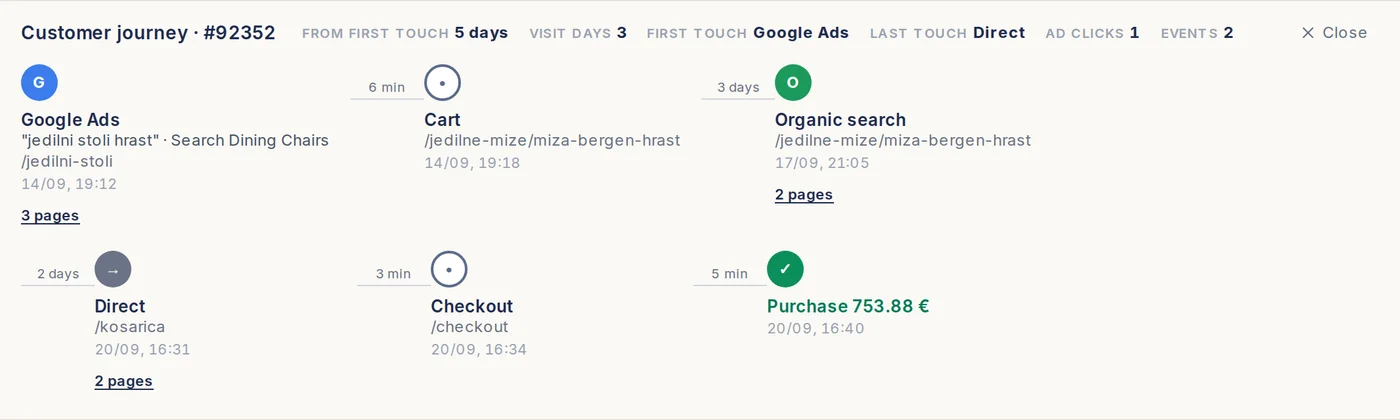
A journey for every order and every enquiry. From the Growth plan up Enalitica stores the path behind each order: the ad click with its campaign and keyword, organic and email visits, cart and checkout, and the time between them; for a service business the same timeline ends in an enquiry and the deal it turned into. In Enalitica's data, of more than 6,000 order journeys in the 90 days to 25 September 2026, 42 percent contained a paid ad click, one in four touched two or more channels, and 26.5 percent closed more than a day after the first touch. Full walkthrough: customer journey tracking.
Bring your own AI. On Growth and above, the Claude, ChatGPT or Grok you already pay for reads your Enalitica reports and journeys through a read-only MCP connection (OAuth for those three, an API key for Gemini and others), with no customer personal data. TrueROAS ships its own Trew AI agent and an MCP endpoint on Pro; Enalitica ships no agent and nothing can be changed through the connection. Setup: connect ChatGPT to your store data.
The same evidence feeds Meta CAPI and Google enhanced conversions from our side, the feedback loop TrueROAS also advertises, with one difference in what gets sent: only observed conversions, never a model's allocation, so the ad platforms train on things that happened.
POAS: Profit Sent to Platforms, or Profit Shown to You
TrueROAS understands profit well; its profit bidding article is a good read. It computes gross profit as revenue minus product cost, shipping, payment fees and discounts, and sends that figure to Meta and Google as the conversion value, so the platforms' bidding algorithms optimise toward it. Its comparison page also lists a shareable profit dashboard and product margins; a POAS column per campaign is not documented in the materials we opened.
Enalitica puts profit where the budget decision is made: in front of the owner, as a first-class report. POAS per campaign, direct and multi-touch, sits next to ROAS in every campaign table, with cost prices imported from your store or ERP down to the delivery-note level and refunds subtracted. Profit bidding hands the number to the machines; a POAS column hands it to the person paying the bills.
There is a practical catch the TrueROAS article itself concedes: profit bidding changes nothing when margins barely vary, and many stores have no cost price on every SKU, only an average margin. Enalitica shows which products still lack cost prices and computes from what is known.
What Does TrueROAS Tracking Mean for EU Consent?
Any store selling in the EU should ask one question of any vendor whose algorithm matches cookies, browsers and IP across visits: which of those signals are read with the visitor's consent, and what happens to the sale when consent is refused? We ask it of every tool in our privacy-safe attribution guide.
TrueROAS is Perm Solutions AB in Stockholm, so EU law applies to the vendor. Its privacy policy names AWS and Google Cloud as infrastructure and covers transfers outside the EEA with standard contractual clauses, and its GDPR article describes tokenised first-party data without personal identifiers. The line to ask about is on its own comparison page: "no consent popups needed" next to "True Fingerprinting".
Enalitica runs on Hetzner servers in the EU, captures visits only after consent, reads the click IDs and UTMs that arrive with the order, and files the rest as Unknown instead of re-identifying anyone. Transactional email and the optional AI report writer are US subprocessors under standard contractual clauses, on aggregated data.
Which Tool Should Your Store Choose?
Choose TrueROAS if you run a Shopify store on Meta-heavy spend, want creative-level analytics and ads managed inside the tool, and expect to grow into MMM and incrementality reports on True Horizon. Choose Enalitica if you want every attributed euro traceable to a real order, a journey for every order and enquiry, profit per campaign after real costs, EU hosting and a price by order volume. If you sell services or leads alongside products, the choice makes itself, because a pixel-first ecommerce tool has no answer for a phone call.
When the two dashboards disagree, the deciding question from our modeled conversions guide still applies: which one can show you the orders?
Where TrueROAS Is Ahead of Enalitica
Credit belongs in both columns. TrueROAS's creative-level analysis, which ad and which creative rather than which campaign, goes deeper than Enalitica's Meta reporting, which stops at campaign and ad set. TrueROAS ingests Snapchat, Pinterest and TikTok spend, three channels Enalitica does not sync. It ships an AI agent of its own, Trew AI, where Enalitica only opens a read-only door for the assistant you already have. And on True Horizon it offers MMM with incrementality reports, which Enalitica does not offer at all.
Those are fair reasons to pick TrueROAS; the one item we will not copy is the modelled fill, because the honest Unknown row is the point of Enalitica.
Frequently Asked Questions
Is TrueROAS accurate?
TrueROAS is accurate for the sales its pixel observes and verifies against an order, like any competent server-side tracker. On True Horizon a media mix model adds sales no system observed, and that share is not labelled per row; treat the tracked part as measurement and the modelled part as an estimate.
Does TrueROAS offer POAS or profit per campaign?
TrueROAS lists a shareable profit dashboard and product margins, and its profit-bidding article computes gross profit as revenue minus product cost, shipping, payment fees and discounts and sends that to Meta and Google as the conversion value. A POAS column per campaign in its own reporting is not documented. Enalitica shows POAS per campaign directly, direct and multi-touch, from real purchase costs, shipping, fees and refunds.
Does Enalitica work with ChatGPT, Claude or Grok?
Yes, on Growth and above. Enalitica exposes a read-only MCP connection: Claude, ChatGPT and Grok connect by OAuth, Gemini and other assistants by API key. The assistant can read reports, campaign figures, order and enquiry journeys and lead quality, never customer personal data, and cannot change anything. TrueROAS offers MCP on its Pro plan for Claude, ChatGPT and Cursor.
Sources
The outside pages this article relies on. Links checked on 25 September 2026.
- pricing (trueroas.com)
- comparison page (trueroas.com)
- features (trueroas.com)
- privacy policy (trueroas.com)
- homepage (trueroas.com)
- profit bidding article (trueroas.com)
- GDPR article (trueroas.com)
Figures marked "in Enalitica's data" are aggregates from the real orders of the stores we measure, with no names and no individual orders. How we measure.
See your real numbers
Import 30 days of orders or leads during a 5-minute onboarding. Works for e-commerce and service businesses.
See plans and pricing