
Klaviyo Attribution: Real Orders, Generous Credit
Klaviyo attribution counts real orders but shares credit generously: 5-day window, opens and MPP. How the model works, what to change, what email really sold.

Tilen Ledic
Written by
Klaviyo attribution is unusual among marketing platforms: it does not invent orders, because it syncs them server-side straight from your store, but it hands out credit for them very generously. By default, Klaviyo claims every order placed within five days of a customer merely OPENING an email, and an open today is often not a human act but an Apple server. This guide explains how Klaviyo's model actually works, why its numbers never match GA4 or your store, which settings tame the inflation, and how to check what email really sold. Checked against Klaviyo's help center in September 2026.
How Klaviyo Attribution Actually Works
Klaviyo attribution stands on two legs. The first is solid: Klaviyo connects to Shopify, WooCommerce and other platforms server-side and syncs every order as a "Placed Order" event, amount and products included. Every euro in Klaviyo's reports therefore belongs to a real order from your store admin; the modeled and double-counted orders familiar from ad platforms do not exist here.
The second leg is softer: the rule for WHICH orders email may claim. By default the window is 5 days, and the conversion goes to the last message the recipient opened OR clicked within it, as described in Klaviyo's message attribution guide.
The model is last-touch, but only among Klaviyo's own channels: if a customer opened an email and clicked an SMS a day later, the SMS gets the credit; if they clicked a Google ad in between, Klaviyo never sees it and hands nothing over. New accounts get 5 days for email clicks and opens, 5 days for SMS clicks and 24 hours for push opens. The windows can be changed in account settings (up to 90 days), and according to Klaviyo's attribution settings guide a change is applied to historical conversions as well as future ones.
Why Does Klaviyo Claim More Revenue Than GA4?
Klaviyo claims more revenue than GA4 for three stacking reasons. First, opens: GA4 requires a click (a session), while Klaviyo by default also counts orders that follow a mere open, without a single visit from the email.
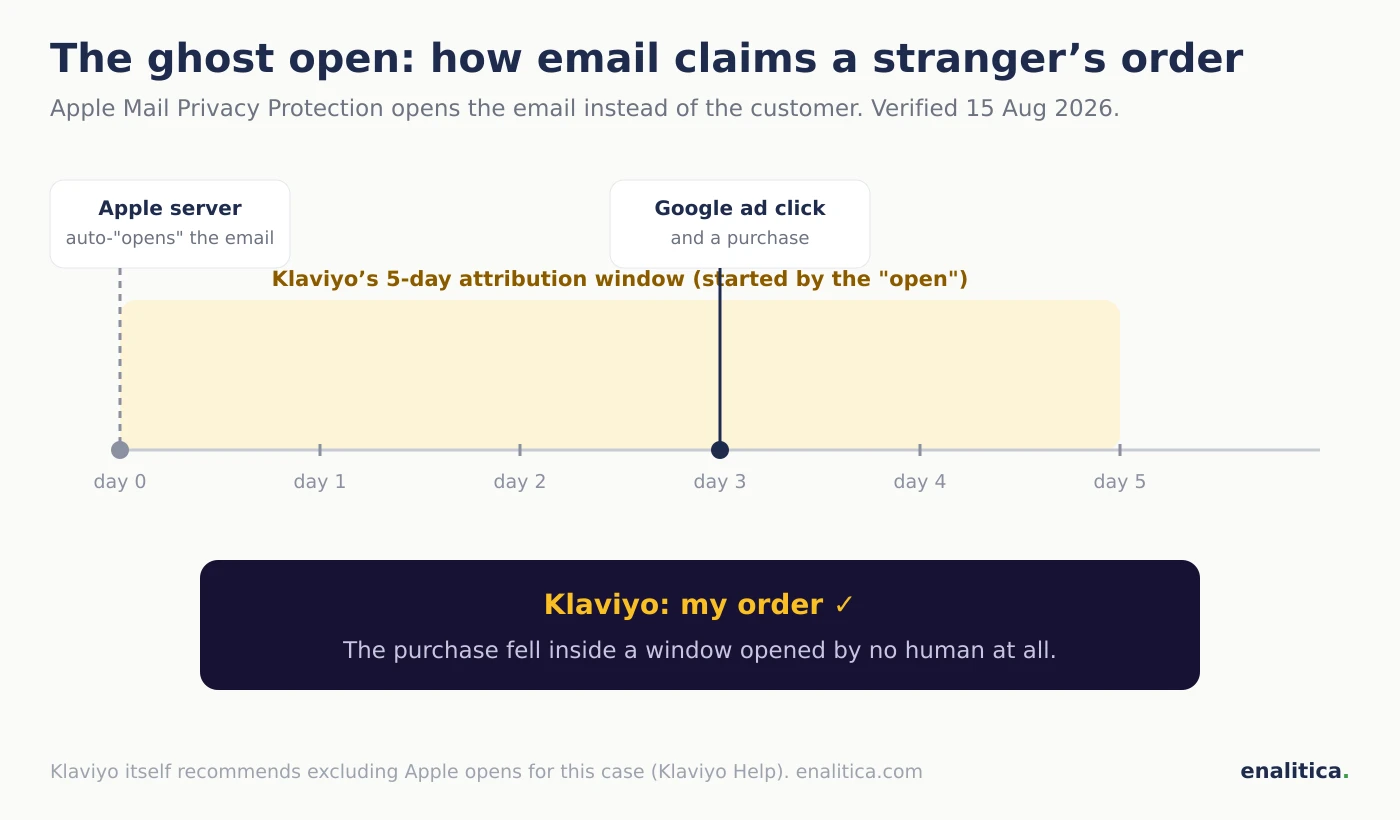
Second, Apple Mail Privacy Protection. When an Apple Mail user turns on Protect Mail Activity, Apple downloads remote content privately in the background when the message arrives, not when it is read, which registers an "open" no human performed. Every such ghost open starts the 5-day window, and a purchase that had nothing to do with the email lands in Klaviyo's column. Klaviyo's conversion tracking guide states plainly that conversions are tracked when Apple MPP automatically opens the email, and offers a setting to remove those opens, covered below.
Third, there is no deduplication across platforms. A customer clicks a Meta ad, opens your newsletter two days later, and buys: Meta counts a conversion, Klaviyo counts a conversion, and GA4 assigns the order to the last click. Three platforms, three "truths", one order; the sum of their claims can run far past the store's revenue, which we broke down in our comparison of how Meta, Google and Enalitica count conversions.
Klaviyo measures "influence" (a message was near the purchase), GA4 measures "the last step". Neither definition answers which orders would not exist without email.
In Enalitica's data (more than 6,500 order journeys, last 90 days to 28 September 2026), email was the last touch on only 3.3% of orders, yet on 35.6% of the orders it touched it appeared earlier in the journey without being the last touch. That is the highest assist rate of any channel, ahead of Google Ads (26.7%) and Meta Ads (16.3%), so a last-click report undersells email while an open-based report oversells it.
Does Klaviyo Make Its Numbers Up?
No. Klaviyo's orders are real, synced from the store; only the explanation of why they happened is generous. That is an important difference from ad platforms: Meta can report more purchases than the store even has (view-through and modeled conversions), while Klaviyo's total can never exceed the store's true sales; it can only overstate email's share of them. Mailchimp, Brevo, Omnisend and the other ESPs work on the same logic: real orders from the store, their own window, their own credit rules.
Klaviyo's reports are excellent for comparisons WITHIN email (which campaign, which flow, which subject line performs better), but they are not a measure of how much of your sales email drives.
For the first question Klaviyo's model is consistent and useful; for the second you need a number that demands a proven click and does not double-count against ads.
Which Klaviyo Settings Tame the Inflated Credit
Three settings in Klaviyo separate an honest report from a cheering one, all under Settings:
- Attribute on clicks, excluding Apple opens. Klaviyo lets you remove Apple Mail Privacy Protection opens (and bot clicks) from attribution. Stricter and cleaner still is clicks only: a click is the one action the customer indisputably performed themselves.
- A shorter window. Five days means Tuesday's newsletter claims Saturday's purchase. For stores with an impulsive buying cycle, 1 to 3 days is far more credible; set the same window for email and SMS, or the channels steal credit from each other under different rules.
- UTM parameters on ALL messages, flows included. Klaviyo can append UTM tags automatically, but UTM tracking is switched on separately: a toggle per campaign, a checkbox per flow message. Flows are the classic hole: the welcome series, abandoned cart and win-back send untagged, and their clicks land in analytics under gmail, direct or referral. In Enalitica's data, flow orders often arrive with
utm_sourceandutm_mediumbut noutm_campaign, while campaign sends carry one, so any report keyed onutm_campaignshows those flows at zero revenue. How to tag properly is covered in our guide to UTM parameters for email.
After these three changes Klaviyo's number still measures influence by its own window, but at least without machine opens and with traceable clicks.
How Enalitica Measures What Email Really Sold
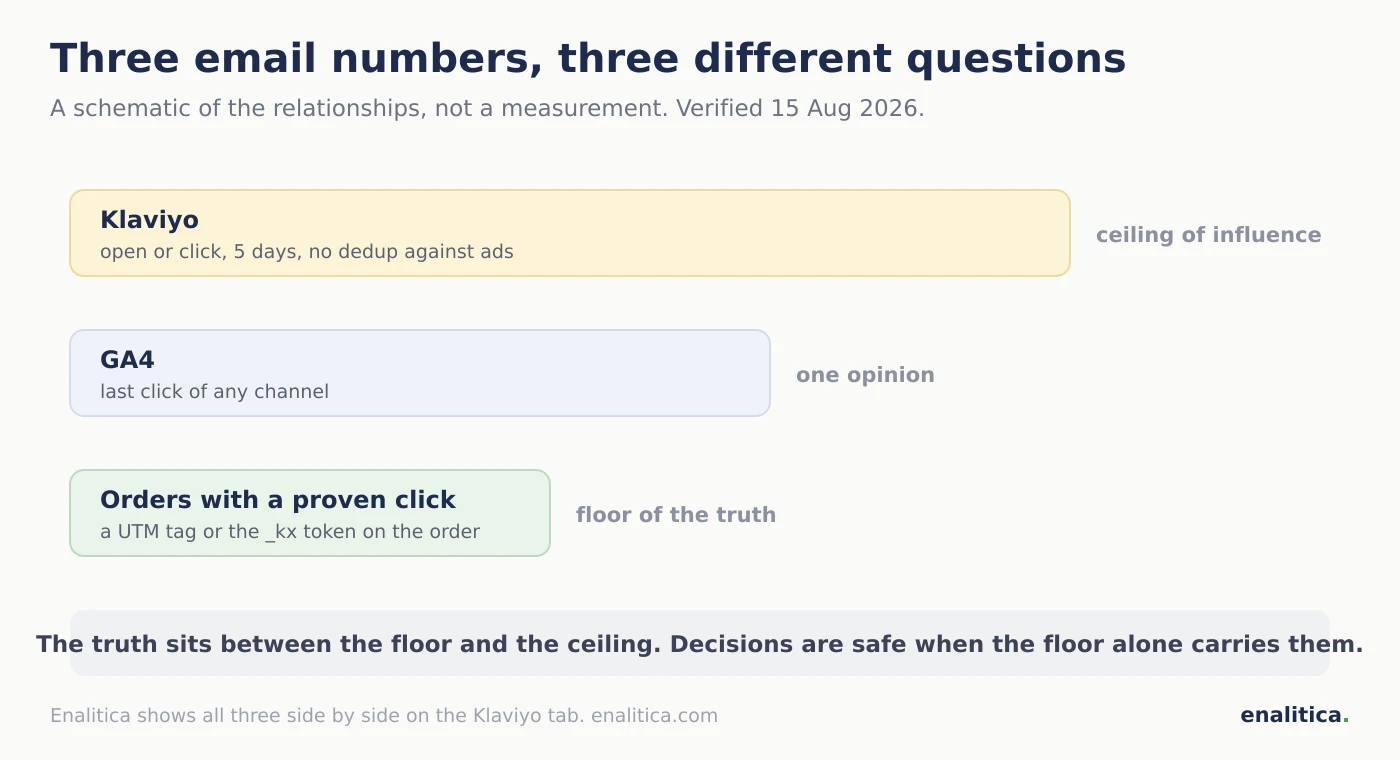
Enalitica answers "how much did email sell" with three numbers side by side, because each answers its own question:
- Klaviyo's number (synced through the Klaviyo connection; Brevo and Mailchimp likewise): its campaigns and flows with its credit rules. Useful for comparisons within email.
- Our number from orders: orders that carry a proven email signal (a UTM tag or a click). This is the floor of the truth, and the tab says so honestly when it really is only a floor: if most orders in the period carry no attribution signal at all (script not installed yet, history from before the connection, a fresh migration), a note explains that the comparison understates email, rather than implying Klaviyo invents revenue.
- Escaped clicks: orders whose landing URL carries Klaviyo's
_kxclick token but which were not attributed to email. That is the signature of flows sending without UTMs, and Enalitica now goes one step further: the_kxtoken by itself names the email channel, so even an untagged flow gets its orders, on Shopify, WooCommerce and Shopamine stores alike. The token is read purely as proof of a click and is never sent anywhere.
The usual rules apply as for every channel: the order is the source of truth, email orders are not double-counted against ads (one order, one primary channel, with a multi-touch view for assists), and the Shopify specifics are already handled in the import. To see all three numbers for your own store, see plans and pricing or book a live demo.
Email is not the only channel that grades its own homework: affiliate networks measure the sales they invoice commissions for, which is the same conflict with real money attached; see affiliate attribution without double counting.
Honest Email Attribution Checklist
- Check Klaviyo's attribution setting: clicks (or at least excluding Apple opens) and a 1 to 3 day window.
- Turn on automatic UTM tags for campaigns AND flows; flows are the classic hole.
- Unify the window between email and SMS, so the channels do not cut credit by different rules.
- Once a month compare three numbers: Klaviyo, GA4, and orders with a proven click; the ratio matters more than the absolute amounts.
- Check orders carrying the
_kxtoken without email attribution; every one of them is a flow sending untagged. - Judge campaigns on profit, not just revenue: an email with a discount code happily sells at a margin that is not there.
Frequently Asked Questions
What attribution window does Klaviyo use?
By default 5 days for email clicks and opens (new accounts also get 5 days for SMS clicks and 24 hours for push opens), counted from the last open or click. The window can be changed in account settings up to 90 days, and Klaviyo applies a change to historical conversions as well as future ones. Within the window, last-touch applies among Klaviyo's channels only, with no view of ads or search.
Does Klaviyo count email opens as conversions?
By default yes: an order inside the window after an open is attributed to email even without a click. Because Apple Mail Privacy Protection creates automatic opens for Apple Mail users who turn it on, Klaviyo offers a setting that removes Apple privacy opens from attribution, and you can go stricter and count clicks only; for honest measurement we recommend the latter.
Why do Klaviyo and GA4 email numbers not match?
Because they measure different things: Klaviyo assigns an order to the last open or click of its own message within its own window, GA4 to the last click of any channel. An order after a Meta ad and an opened newsletter counts as email in Klaviyo and as the ad in GA4. They will never match; what matters is knowing which question each number answers.
Are Klaviyo's orders real?
Yes. Klaviyo syncs orders server-side from the store (Shopify, WooCommerce and others), so every amount in its reports belongs to a real order. The question is not whether the orders happened but whether email earned them; that is decided by the attribution window and the opens rule.
How do I check how much email really sold?
Count the orders with a proven email signal: a UTM tag from an email campaign or Klaviyo's click token in the landing URL. That is the floor you can trust; Klaviyo's number is the ceiling of influence. The truth sits between them, and budget decisions are safe when the floor alone already justifies them.
Sources
The outside pages this article relies on. Links checked on 28 September 2026.
- Klaviyo's message attribution guide (help.klaviyo.com)
- Klaviyo's attribution settings guide (help.klaviyo.com)
- Apple downloads remote content privately in the background when the message arrives (support.apple.com)
- Klaviyo's conversion tracking guide (help.klaviyo.com)
- UTM tracking is switched on separately (help.klaviyo.com)
Figures marked "in Enalitica's data" are aggregates from the real orders of the stores we measure, with no names and no individual orders. How we measure.
See your real numbers
Import 30 days of orders or leads during a 5-minute onboarding. Works for e-commerce and service businesses.
See plans and pricing