
Email UTM Tracking: Why Your Newsletter Gets Less Credit Than It Deserves
Email UTM tracking done right: a 5-row convention for Klaviyo and Mailchimp, the mistakes that send newsletter revenue to Direct, and the repeat-purchase.

Tilen Ledic
Written by
Email is the only marketing channel you actually own. No auction, no algorithm change, no cost per click. And in many GA4 properties it is also one of the most undercounted channels in the report, because its revenue quietly leaks into Direct, Referral and Unassigned.
Email UTM tracking is the difference between a channel that gets credit and a channel that looks like a hobby. This guide covers the mechanics of the leak, the 5-row UTM convention that stops it, the mistakes that break it anyway, and what order-based attribution adds on top, including the part almost nobody measures: what email customers are worth after the first purchase.
Where does untagged email revenue go in GA4?
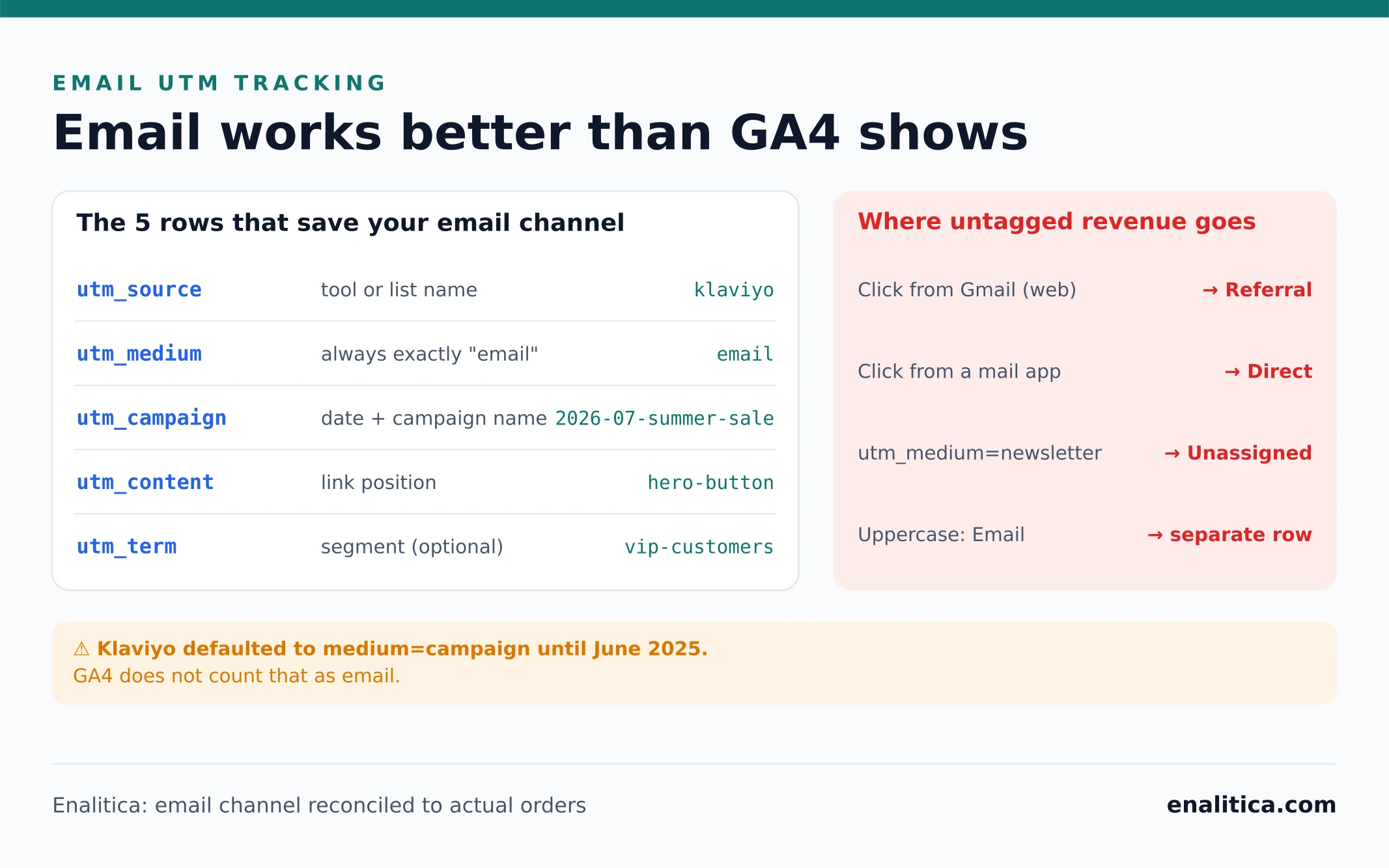
GA4's Email channel has a strict definition: session source or medium must match email, e-mail, e_mail or e mail (Google's default channel group definitions). Everything else, no matter how obviously it is a newsletter, goes elsewhere:
- Untagged link, clicked in a mail app (Outlook, Apple Mail, Gmail app): no referrer at all, lands in Direct.
- Untagged link, clicked in webmail (Gmail in the browser): the referrer is
mail.google.com, lands in Referral. utm_medium=newsletter: does not contain the word "email", so it matches no channel rule and lands in Unassigned, the channel nobody looks at (Google: Unassigned is used "when there are no other channel rules that match").- ESP defaults you never checked: Klaviyo's default
utm_mediumwascampaignandflowuntil June 2, 2025, when it finally switched to message type. Anyone who "just enabled UTM tracking" before that has years of email revenue filed outside the Email channel.
The result is a GA4 report where email looks like a hobby while it quietly finishes journeys other channels started, and starts journeys other channels finish.
In Enalitica's data (last 90 days to 28 September 2026), the GA4 Email channel carried only 2.4% of more than 1 million sessions, and email was the last touch on 3.3% of more than 6,500 order journeys. Yet on 35.6% of the orders it touched, email appeared earlier in the journey without being the last touch, the highest assist rate of any channel.
Email UTM tracking: the 5-row convention to set once
One convention, set once in your ESP's global UTM settings, covers every future send:
| Parameter | Convention | Example |
|---|---|---|
utm_source | the tool or list name, lowercase | klaviyo |
utm_medium | always exactly email | email |
utm_campaign | date + campaign name, dashes | 2026-07-summer-sale |
utm_content | link position or variant | hero-button |
utm_term | segment, optional | vip-customers |
Two of these carry all the weight. utm_medium=email is the row that decides the channel. utm_campaign with a date prefix is the row that makes reports readable a year later, when "newsletter-final-v2" tells you nothing. The same five rows, extended to social, affiliates, QR codes and every other channel, are in our UTM naming convention guide.
In Klaviyo: Settings → Other → UTM tracking → enable, and set utm_medium to Message type so email sends email and SMS sends sms. Check a few historic campaigns too; if they carry utm_medium=campaign, you now know why your Email channel looks small.
In Mailchimp: in the Settings & Tracking section of the email builder, check Google Analytics link tracking (automations have the same box under Edit Settings), then open the UTM drop-downs and verify the medium it sends. Hand-built templates in particular love to carry someone's old typo forever.
Five UTM mistakes that still break email attribution
Five tagging mistakes undo email attribution even after the convention is set: uppercase values, spaces, the newsletter medium, untagged flows and UTMs on internal links.
- Uppercase. UTM parameter values are case sensitive:
Email,EMAILandemailare three different rows in your reports. Lowercase everything, always. - Spaces in values.
utm_campaign=summer salebecomessummer%20saleand splits into inconsistent variants depending on which app encoded it. Use dashes. utm_medium=newsletter. The intent is obvious to a human and invisible to GA4: straight to Unassigned, a bucket we took apart in our guide to unassigned traffic. Newsletter belongs inutm_campaignorutm_source, never in the medium.- Tagging campaigns but not flows. Welcome series, abandoned cart, back-in-stock: automations often produce more revenue per send than campaigns, and they are exactly the sends people forget to tag. In Enalitica's data, flow orders often arrive without a
utm_campaignwhile campaign sends carry one, so a report keyed onutm_campaignshows per-flow revenue as zero. The same convention applies, withutm_campaign=flow-welcome-1style names. - Tagging internal links. UTMs are for links that enter your site from outside. Put them on internal navigation and every click restarts the session with a fake source. Emails yes, your own site never.
Why do Klaviyo and GA4 report different email revenue?
Even with perfect tagging, Klaviyo or Mailchimp will report more revenue than GA4's Email channel. That is not a bug in either tool: your ESP attributes on its own window (often including opens, not just clicks, across days), while GA4 counts last-click sessions. Both are opinions, and GA4 does not even see every order: across the stores in Enalitica's data, 76.6% of real orders came with a GA4 purchase event, the rest did not.
The tiebreaker for email revenue is neither Klaviyo nor GA4 but the order itself: which orders actually had an email touch on their journey.
That is the reconciliation an order-based view does. Exactly how Klaviyo hands out credit (the 5-day window, opens, Apple's server) is broken down in our guide to Klaviyo attribution.
How Enalitica reconciles email revenue to actual orders
Enalitica attributes orders, not sessions, and applies one email definition everywhere: UTM-tagged clicks from any of 17+ ESPs (Klaviyo, Mailchimp, Omnisend, Brevo, MailerLite, ActiveCampaign and the rest, even when the medium is missing), the newsletter medium GA4 throws into Unassigned, and webmail referrers like Gmail, Outlook, Seznam or Siol that GA4 files under Referral. All of it lands in one Email view, reconciled against real orders:
- Pure vs multi-touch email revenue. Orders where email closed alone, separated from orders where email worked together with ads or organic, the same journey logic as multi-touch attribution for ecommerce, so the channel's assist role is visible instead of vanishing into last-click.
- Per-campaign, down to the order. Each email order with its products and its full journey, so "the newsletter did well" becomes "these two campaigns sold these products".
- The second purchase, per acquisition channel. In the customer cohort view you can group buyers by acquisition channel and compare repeat purchase share and lifetime contribution per channel. In Enalitica's data (nearly 30,000 customers with an order in the 12 months to 28 September 2026), 14.7% of customers ordered again within the year and 23.4% of all orders were repeat orders. The economics compound, because a repeat purchase triggered by email costs nothing to acquire; on a profit-on-ad-spend (POAS) view those orders are close to pure margin, which is exactly why the channel deserves accurate credit in the first place.
- Same logic for service businesses: enquiries and calls attributed to the email that produced them, even when the conversion arrived days later through another channel.
Book a demo and we will show you, on your own orders, how much your email channel really sells and how often its customers come back.
Frequently Asked Questions
Is utm_source=newsletter with utm_medium=email okay?
Yes. The medium drives the channel, so utm_medium=email guarantees correct classification; the source can be your ESP or list name. Just keep it consistent, because every variant becomes its own reporting row.
Should automated flows be tagged differently from campaigns?
Same convention, different utm_campaign values (flow-welcome-1, flow-cart-abandon). The point is to see flows and campaigns side by side, since flows often win on revenue per recipient.
Why does Klaviyo report 3x the revenue GA4 shows?
Different attribution: ESPs typically credit any purchase within a window after a click or even an open; GA4 credits last-click sessions. Neither is the truth about orders; reconciling against actual orders with their full journey is.
Do UTM parameters affect deliverability or SEO?
Deliverability no. SEO only if UTM-tagged URLs get indexed, which canonical tags on your store prevent; the rule that matters is simply to never put UTMs on internal links.
Sources
The outside pages this article relies on. Links checked on 28 September 2026.
- Google's default channel group definitions (support.google.com)
- Klaviyo's default utm_medium was campaign and flow (help.klaviyo.com)
- Google Analytics link tracking (mailchimp.com)
- UTM parameter values are case sensitive (support.google.com)
Figures marked "in Enalitica's data" are aggregates from the real orders of the stores we measure, with no names and no individual orders. How we measure.
See your real numbers
Import 30 days of orders or leads during a 5-minute onboarding. Works for e-commerce and service businesses.
See plans and pricing