
Microsoft Ads Attribution: How Bing Counts a Conversion and What Your Orders Say
Microsoft Ads attribution explained for store owners: the msclkid click id, UET, conversion windows, data-driven attribution since 2026, why Microsoft and Google both claim the same order, and how order-based attribution settles it with one click id.

Tilen Ledic
Written by
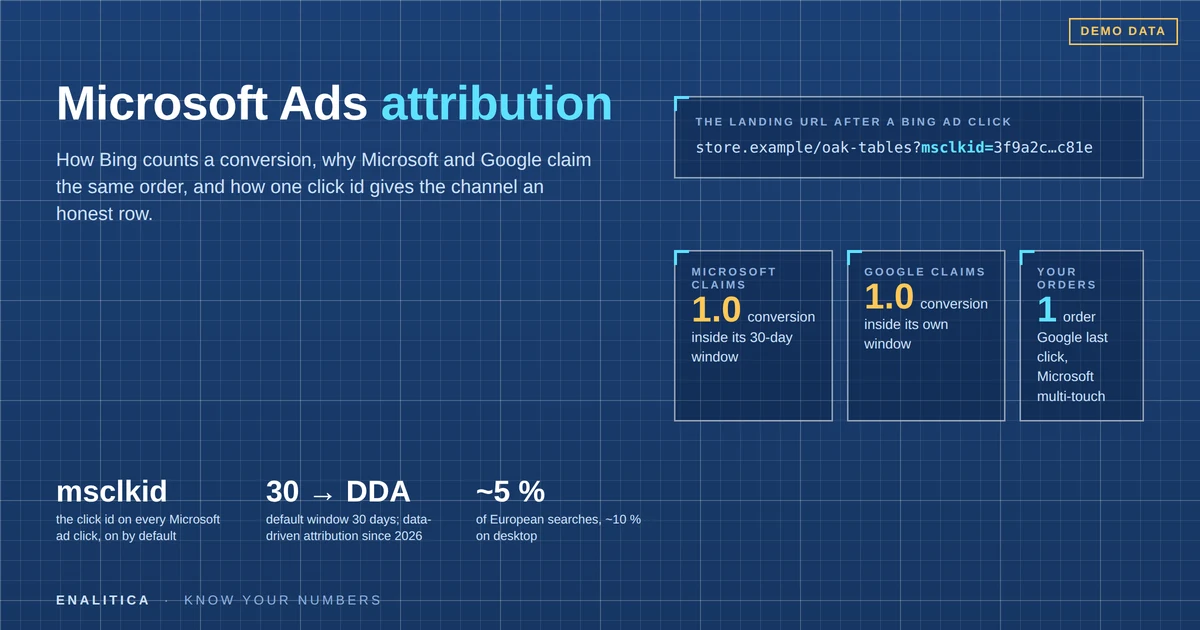
Microsoft Ads is the channel most European stores add last and read least. The clicks cost a third less than Google's, the share of searches is small, and the report looks like Google's report from five years ago, so the account runs on the same campaigns imported from Google and nobody asks whether it earns its budget. Then one month the Microsoft dashboard claims eighteen conversions, Google claims the same customers, and the owner asks which of them to believe.
This guide is about Microsoft Ads attribution: how Microsoft counts a conversion, why its number overlaps with Google's, what changed when Microsoft switched to data-driven attribution in 2026, and how order-based attribution gives the channel one honest row from the click id it appends to every landing URL. It is the companion to the ChatGPT ads attribution guide: the two channels are measured the same way, and where they differ, this article says so.
What Microsoft Ads is in 2026, and how much of your market it reaches
Microsoft Advertising is one account that buys search ads on Bing, Yahoo, AOL and DuckDuckGo, sponsored answers inside Microsoft Copilot, and native placements on the Microsoft Audience Network (MSN, Outlook, the Edge new tab). Bing alone holds about 5 percent of European searches, roughly 10 percent in Germany, and the split by device is the part that matters for a store: around 10 percent of desktop searches against well under 1 percent of mobile. A Microsoft Ads customer is disproportionately at a desk, on Windows, in a browser they did not choose.
The economics are the reason to be there at all. Across published benchmarks, a Microsoft search click costs 30 to 40 percent less than the same query on Google, conversion rates are similar or higher, and advertisers put about 6 percent of their search budgets into it. Most accounts are created by importing the Google Ads campaigns and letting them run, which is fine, as long as the measurement is not imported with them.
How does Microsoft count a conversion?
Microsoft's measurement is Google's, with different names.
- The click id. With "Add Microsoft Click ID (MSCLKID) to URLs" switched on, which it is by default at the account level, every ad click lands with
msclkid=and a 32-character id appended to the landing URL. Likegclid, it identifies the click, not the person, and it is the only thing that separates a Bing ad click from a Bing organic click. - The UET tag. The Universal Event Tracking tag is Microsoft's JavaScript, the equivalent of the Google tag. It reads the click id, stores it in a first-party cookie, and reports the page views and events you define as conversion goals: purchase, form, add to cart, a page visited.
- Conversion goals and windows. Each goal has a conversion window from one minute to 90 days, 30 days by default, and view-through conversions on their own window when the account has them switched on. Conversions appear in reporting up to 24 hours after they happen.
- Data-driven attribution. Until 2026 Microsoft credited the last click. From the April 2026 wave data-driven attribution became the default for eligible accounts: credit is split across the Microsoft clicks on the path in fractions, which is why a report now shows 3.4 conversions where it used to show 3 or 4.
- The Conversions API and offline import. Since August 2026 Microsoft documents a server-side Conversions API alongside UET, and offline conversion import has existed for years: you upload the
msclkidwith the sale and Microsoft credits the click. This is how a CRM sale or a phone order reaches the bidding. - Import from Google. Microsoft can import Google Ads campaigns and, since 2025, Google's conversion goals. Convenient, and the first place double counting starts.
Microsoft Ads attribution at a glance
| Setting or fact | What Microsoft offers | Default | What your orders do with it |
|---|---|---|---|
| Click id | msclkid appended to every ad click's landing URL (account setting) | on | captured on landing, kept 90 days in a first-party cookie, read from the order and the landing URL |
| Conversion window | 1 minute to 90 days per goal | 30 days | 90 days on the same browser; 30 days across devices through the captured email |
| View-through | separate window, account switch | off unless enabled | never counted: no click, no proof |
| Attribution model | data-driven since April 2026 (fractional credit); last click before | data-driven | one order, one channel on last click, plus a multi-touch view that never sums |
| Measurement | UET tag; Conversions API since August 2026; offline conversion import by msclkid | UET | none needed for the count; UET or the API needed for Microsoft's bidding |
| Conversion goals | purchase, lead, add to cart, page visit, custom; goals importable from Google Ads | real orders for a shop, real enquiries for a service | |
| Reporting delay | up to 24 hours | an order counts the moment it exists | |
| Networks | Bing, Yahoo, AOL, DuckDuckGo, Copilot, Audience Network | one msclkid rule for all of them | |
| What you cannot see | the Copilot conversation, whether the same person also clicked a Google ad | the whole journey, every click id, the order |
Where Microsoft's number and Google's number overlap
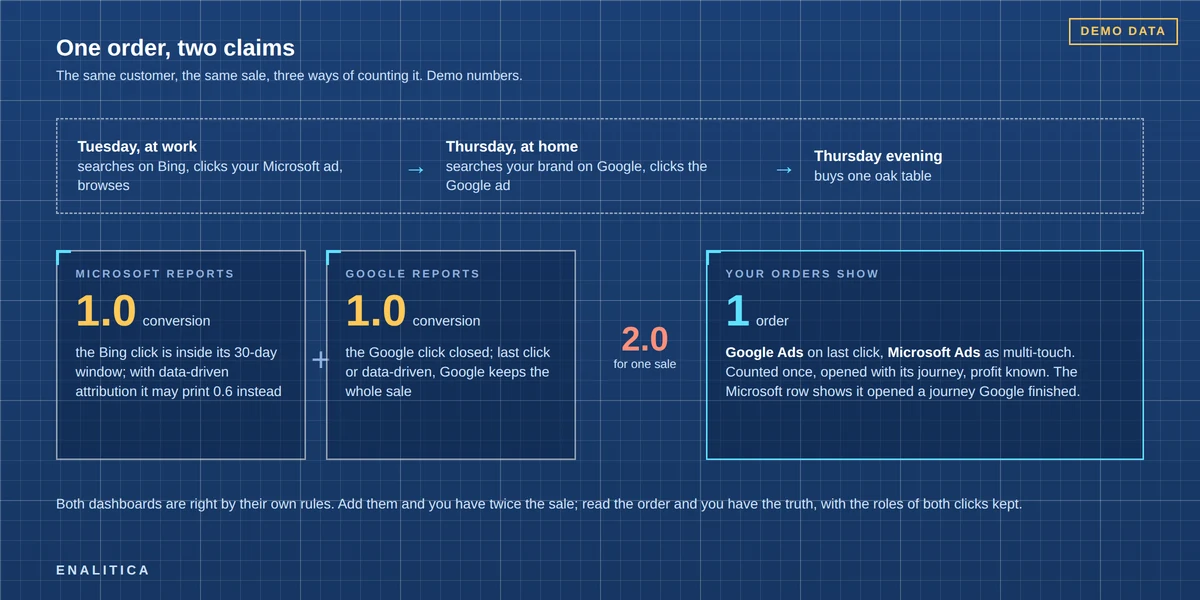
A person searches on Bing at work, clicks your Microsoft ad, searches your brand on Google at home, clicks the Google ad and buys. Microsoft counts a conversion inside its 30-day window; Google counts one inside its own; your store has one order. Both platforms are right by their own rules, and the sum of the two dashboards is twice the sale. The conversion counting guide explains the general case; Microsoft adds three twists of its own.
- Fractions. Data-driven attribution reports 0.6 of a conversion here and 0.4 there. Orders do not come in fractions, and a fraction of an order cannot be matched to a profit.
- Imported goals. A Google conversion goal imported into Microsoft carries Google's definition, including Google's modeled and view-through conversions, so a "purchase" in the Microsoft report may be a purchase Google inferred.
- The same customer on both. Brand searches are the usual overlap: someone who saw you on Bing finishes on Google, or the other way round. On a small account this can be a third of the Microsoft conversions.
How Enalitica counts a Microsoft Ads order
Microsoft Ads is a click-id channel in Enalitica, the same shape as ChatGPT Ads, and the rules are the same ones the Google row follows.
The click id names the channel. The tracking script captures msclkid from the landing URL into a first-party cookie for 90 days, the WooCommerce sync reads it from the order's own meta and, failing that, from the landing URL WooCommerce stored, and the Shopify, Shopamine and custom-shop paths take it from the thank-you-page beacon. An order with msclkid is a Microsoft Ads order on last click; an order from Bing without one is organic Bing. The click-id capture guide shows the mechanics.
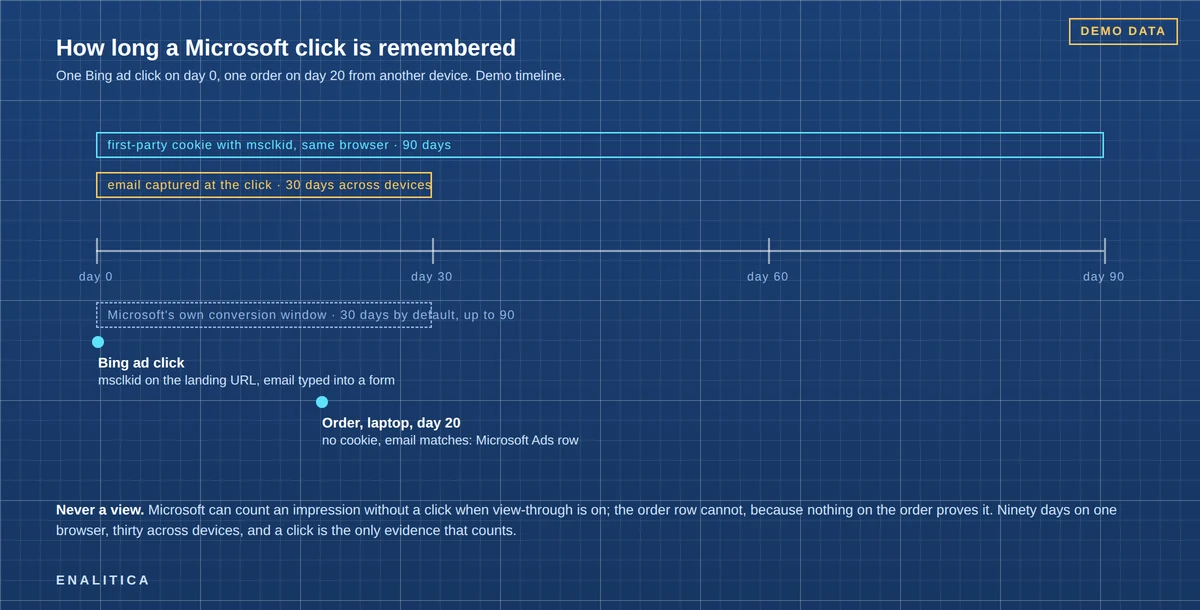
Thirty days across devices. The click at work and the order from the sofa have no cookie in common. When the email on the order matches an identity captured with the click, the msclkid is stitched back onto the order within 30 days of the click, never over a value the order already has. Ninety days on one browser, thirty across devices, never a view.
Two buckets, one spend. The Microsoft Ads tab shows spend, clicks and impressions synced nightly from Microsoft's reporting API per campaign and day, against direct orders (Microsoft was the only channel on the journey) and multi-touch orders (Microsoft plus another channel, and the same order appears under that channel too). ROAS is computed from the direct bucket only, the conservative floor; multi-touch ROAS sits beside it and is never added in, and the assisted conversions guide explains why. Cost per order, average order value and the multi-touch share complete the row, and a service business reads the same tab in enquiries.
No fractions, no imports. An order is one order under one last-click channel, with a multi-touch view for the others. Microsoft's own conversion count never enters our column, because it carries data-driven fractions, view-through and possibly Google's imported goals; it can be read in Microsoft's report, and the gap is explained below.
Connected through MCP, the whole tab is one question: "What did Microsoft Ads bring in September, direct and multi-touch, and which campaigns spent the most?"
Why Microsoft's number and yours will disagree
- Fractions against whole orders. Data-driven attribution hands out tenths of a conversion across Microsoft clicks; the order row has one channel on last click and the rest as multi-touch. A Microsoft report of 12.4 conversions and an order count of 9 direct plus 4 multi-touch are the same reality in two notations.
- View-through and imported goals. Anything counted without a click, and anything Google modeled before Microsoft imported it, is in Microsoft's figure and not in yours.
- Windows. Microsoft's default is 30 days and can be set to 90; your cookie is 90 days on the same browser and 30 days across devices. The two windows overlap for most orders and differ at the edges.
- The event. A goal set on add-to-cart or a page visit reports those; only a purchase goal compares to orders at all.
The rule is the same one that holds for every platform: the platform's figure is the ceiling, the direct bucket is the floor, and the budget decision reads the floor plus what multi-touch shows.
What you get that the Microsoft report cannot give you
Owners ask why they need a second report when Microsoft already has one. The honest answer is a short list.
- One rule for every channel. Google, Microsoft, Meta, LinkedIn, ChatGPT: the same click-id rule, the same direct and multi-touch buckets, the same order counted once. The Microsoft report cannot see the Google click, and the Google report cannot see the Microsoft one. Yours sees both on the same order.
- Profit per euro, not conversions. With cost prices loaded, every Microsoft campaign carries profit on ad spend against break-even 1.0, next to Google's campaigns on the same scale. The POAS guide explains why revenue-based ROAS misleads on a mixed catalogue.
- A longer memory. Ninety days of click id on the browser and thirty across devices, so a considered purchase (furniture, equipment, anything with a quote) still lands on the channel that started it.
- Orders, not fractions. Every figure in the row is a whole order you can open, with its journey, its products and its margin. Nothing is modeled and nothing is 0.4 of a sale.
- The same tab for enquiries. A service business sees Microsoft's cost per enquiry on the same rules, with the enquiry's outcome once the CRM says whether it became a customer.
- Ask, do not export. Through MCP the row is a sentence in ChatGPT or Claude, with Google beside it, without a login to either ads console.
How to decide whether Microsoft Ads pays for your store
- Keep auto-tagging on and check it. It is on by default; if someone turned it off to keep URLs tidy, every Bing ad order becomes organic Bing. Open a landing URL from a test click and look for
msclkid. - Install UET and set one purchase goal. Not for your count, for Microsoft's bidding: without a goal the account bids blind. Do not import Google's goals if you can avoid it; define the purchase in Microsoft directly, so the report does not inherit Google's modeling.
- Import the campaigns, not the conclusions. The Google import is a fine starting point. Read the Microsoft campaigns on your orders after four weeks, with the first week discarded, before deciding they perform like their Google twins.
- Judge on direct orders against break-even. Profit per euro of Microsoft spend on direct orders, with cost prices loaded, against 1.0. Cheaper clicks are not the question; whether the cheaper clicks buy is.
- Watch the overlap. If most Microsoft orders are multi-touch with Google closing, the channel is opening journeys Google finishes; that is a reason to keep it, not to fund it like a closer. The brand bidding guide covers the brand-search side of the same overlap.
Frequently Asked Questions
Is the Microsoft click id on by default?
Yes. "Add Microsoft Click ID (MSCLKID) to URLs" is an account-level setting and is enabled by default; Microsoft's own docs describe it as the way conversions are tied to clicks. If it is off, no click carries an id, UET falls back to its cookie, and order-based attribution cannot see the channel at all. Check one landing URL after a test click.
My Microsoft Advertising account signs in with Google. Does attribution still work?
Attribution never depended on the login: the click id is on the URL whichever identity created the account. What the login changes is how a tool connects to Microsoft's reporting to pull spend; Enalitica connects such accounts through Google's consent screen and reads the same reports, so the spend lands on the same tab.
Why does Microsoft report conversions with decimals?
Because data-driven attribution, the default since 2026, splits one conversion across the Microsoft clicks on the path. Your orders do not split: one order, one last-click channel, and a multi-touch view for the other channels. Compare Microsoft's decimals to the direct plus multi-touch buckets, not to the direct count alone.
Can I send my orders back to Microsoft the way I send them to Google?
Microsoft supports offline conversion import by msclkid and, since August 2026, a Conversions API. Enalitica sends confirmed orders to Google and Meta today and does not upload to Microsoft yet; UET remains the source Microsoft's bidding learns from. The Google conversions API guide explains what an upload changes and what it does not.
Do Copilot ad clicks carry the same click id?
Sponsored results in Copilot are bought through the same Microsoft Advertising account and carry msclkid on the landing URL like a Bing search click, so they land on the same Microsoft Ads row. Like ChatGPT, Copilot does not show you the conversation behind the click; the ChatGPT ads guide covers what that means for measurement.
Is Microsoft Ads worth it for a store in a small market?
It is cheap to find out. The share of searches is small, the clicks are cheaper, the customers skew to desktop and to work hours, and the only way to know is four weeks of orders read on the direct bucket against break-even. A store that sells considered products to people at their desks often finds a profitable small channel; a store that lives on mobile impulse usually does not.
See your real numbers
Import 30 days of orders or leads during a 5-minute onboarding. Works for e-commerce and service businesses.
See plans and pricing