How Many Ad Sales Come From Customers You Already Have?
A third of Google Ads orders and nearly 4 in 10 brand campaign orders come from people who bought before. The split by channel, from real orders.
 Tilen Ledic Written by
On this page
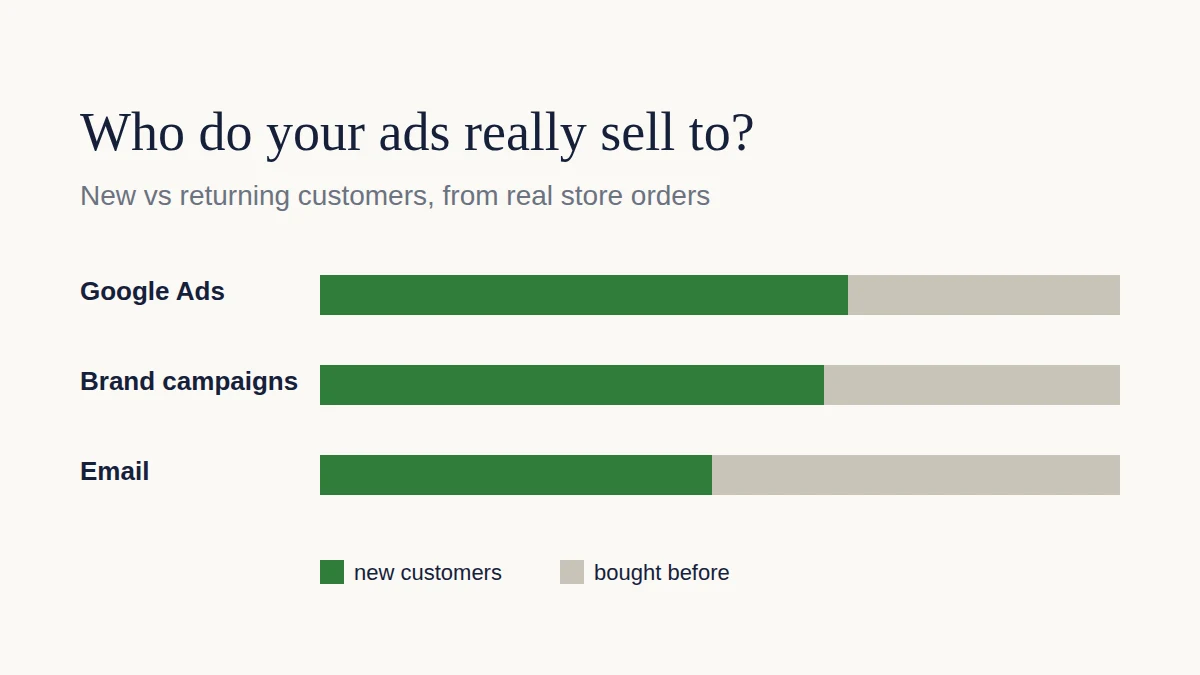
A third of the orders Google Ads brings to an online store come from people who had already bought there. On brand campaigns it is closer to 4 in 10. Google counts every one of them as a conversion, and most reports treat them as customers the ad just won.
Those buyers are not worthless. But a returning customer who types your name into Google would very likely have found you without the ad, and a campaign full of them tells you little about whether your advertising is growing the store.
The numbers below come from more than 14,000 orders in Enalitica's data, placed in the six months to 10 November 2026, in stores with at least a year of order history behind them, so a returning buyer can actually be recognised.
New customers in more than 14,000 orders
- 1 in 3
- Google Ads orders placed by someone who had bought before
- 63%
- new-customer share of brand campaign orders, against 80% for non-brand search
- ~1 in 2
- email orders that come from existing customers
- 88%
- new-customer share of orders from AI assistants
Which channels bring new customers?
We count an order as a new customer when it is the first order ever placed with that email address in the store's history. The channel is the one that gets the order. Only stores where at least 8 in 10 orders carry an identified customer are included, and only orders placed after the store had a full year of history in Enalitica, because without history every buyer looks new.
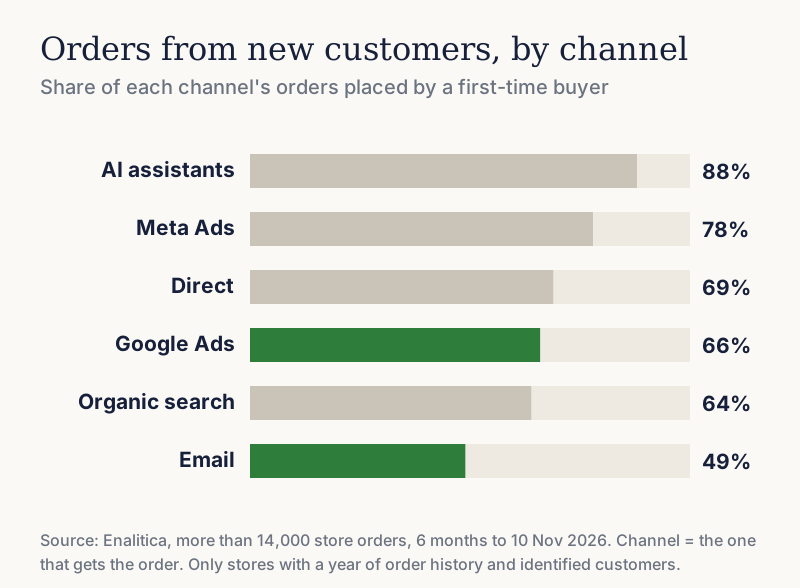
Three things stand out.
- Paid social and AI assistants mostly find new people. About 4 in 5 Meta orders and nearly 9 in 10 AI assistant orders are first purchases. That matches what we saw in our analysis of ChatGPT sales.
- Google Ads sits in the middle. Two thirds new, one third returning. Store by store the share varies a lot, from under half to almost all new, so the only number that matters is yours.
- Email sells mostly to people you already have. About half of email orders, and in the typical store closer to 6 in 10, come from returning customers. That is email doing its job, which is why it needs a different yardstick (more on that below).
We found no published numbers built on orders for email, organic, direct or AI assistants, so treat these as a first reference point rather than a benchmark.
Brand campaigns mostly sell to people who know you
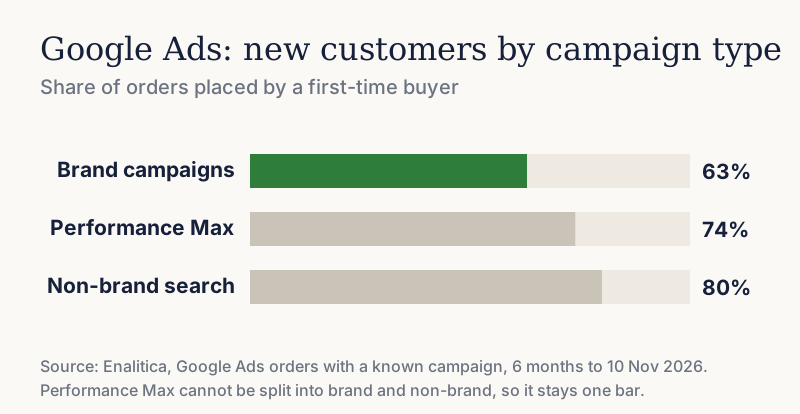
Split Google Ads by campaign type and the difference sharpens. Brand campaigns, the ones bidding on your store's name, had a new-customer share of 63%. Non-brand search campaigns had 80%. In every store we measure that runs both, the brand campaign had the lower share.
That does not make brand campaigns useless. Research on brand bidding points both ways. eBay's well-known experiment found that switching off brand ads moved almost all the traffic to the organic result below. A later study found that when competitors bid on your name and you do not, they take 18 to 42% of your clicks. Whether your brand campaign pays is a separate question, covered in our guide to bidding on your own brand name.
What the new-customer split adds is honesty about what the campaign is for. A brand campaign with a spectacular ROAS and a 60% new-customer share is partly collecting money from people who were coming anyway. Judge it on that, not on the ROAS.
What Performance Max shows, and what it does not
Performance Max came out at 74% new, between the two. It is one bar because it cannot be split cleanly.
Google has improved PMax reporting. Since 2025 it has a search terms report with the same detail as Search campaigns, a channel report, brand exclusions you can set per ad format, and campaign negative keywords. What it still does not have is a brand versus non-brand split. To estimate how much PMax revenue came from your brand, you match its search terms against your brand name yourself, and two gaps remain:
- Low-volume terms are hidden. Google groups them for privacy, so part of the clicks have no visible term.
- Not every PMax sale starts with a search. Orders from YouTube, Display, Gmail and Discover have no search term at all.
So any brand share for PMax is an estimate. If you have a separate brand campaign, exclude your brand from PMax, so PMax has to prove itself on people who do not know you yet. How to do that step by step is in our guide to Performance Max campaigns.
Google and Meta count "new" differently from your store
Ad platforms can show new customers too, but their definition is not your store's.
- Google treats a buyer as new if it has not seen them purchase within 540 days, based on its own tracking and any customer lists you upload. Google itself calls automatic detection the least complete method, because deleted cookies and opt-outs reduce coverage.
- In the EU customer lists only contain people who gave consent for ad use of their data. A loyal customer who declined cookies is missing from the list, and Google can count them as new.
- Meta splits Advantage+ results into new, engaged and existing customers, but the advertiser decides who is "existing" by assigning audiences. If the audience is incomplete, so is the split.
Your store's orders are the only place where "has this person bought before?" has a definite answer. That is why the numbers in this post come from orders, not from ad platforms.
Why email needs a different yardstick
Email sending half its orders to existing customers is not a weakness. Repeat sales are what email is for. The problem starts when email sits in the same ROAS table as acquisition channels and looks like the cheapest way to grow, while most of what it "earns" would have come in some other way.
Judge email on repeat purchase rate, revenue per subscriber and, when you can, a holdout test (a group that gets no email for a month). Judge acquisition channels on new customers. If you use Klaviyo, our guide to Klaviyo attribution shows why its own revenue figure runs higher than your orders.
What to do with the split
- Look at the new-customer share per channel and per campaign, from your orders, not from platform reports. A share that drops month after month means a channel is drifting toward people you already have.
- Separate brand and non-brand campaigns. In Search that is two campaigns. In PMax it means brand exclusions, if necessary only for text ads, so Shopping can still appear on brand searches.
- Tell Google who is new. Google's new customer acquisition goal can bid more for new buyers or only for them. It works far better when the store sends a new customer flag with each purchase than when Google guesses from its own lists.
- Track two acquisition numbers next to ROAS: cost per new customer (ad spend divided by new customers, often called nCAC) and new-customer ROAS (revenue from new customers divided by ad spend). Both are explained in our guide to customer acquisition cost.
- Give returning customers their own budget, if you advertise to them at all. Google recommends a separate campaign when you bid for new customers only, so smart bidding does not chase the easy conversions.
How Enalitica shows new and returning customers
Enalitica marks every order as a first or repeat purchase from the store's own history, then shows the split where you make decisions.
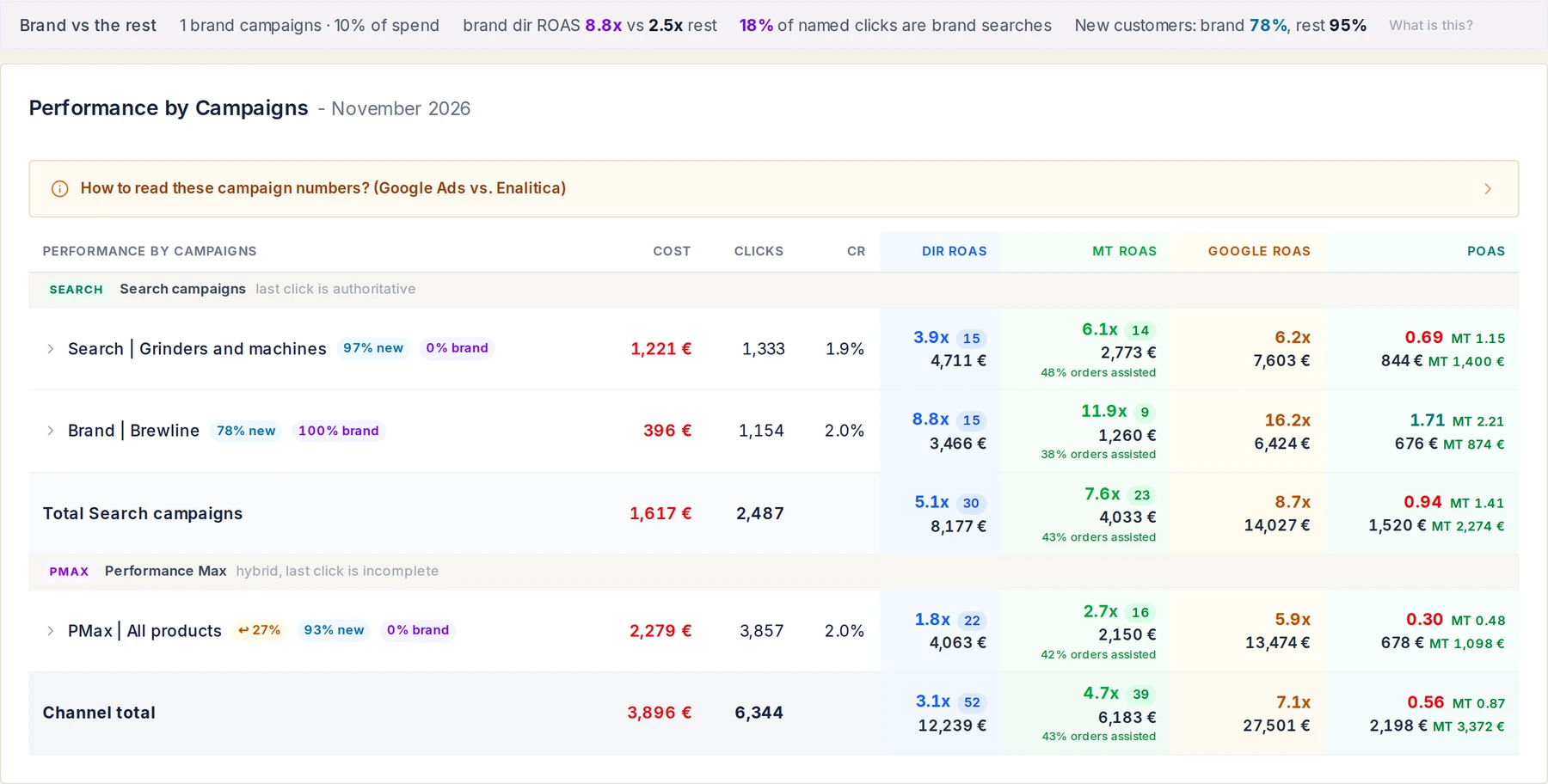
- 1Brand vs the rest. New-customer share of brand campaigns next to all other campaigns, from your own orders.
- 2Two labels per campaign. How much of its revenue came from first-time buyers, and how many of its clicks were searches for your name.
- 3Performance Max too. The brand share comes from Google's search terms, so for PMax it is an estimate.
On the Google Ads tab each campaign carries two labels: the share of its revenue from new customers and the share of its clicks that were searches for your brand. The strip above the table compares brand campaigns with the rest.
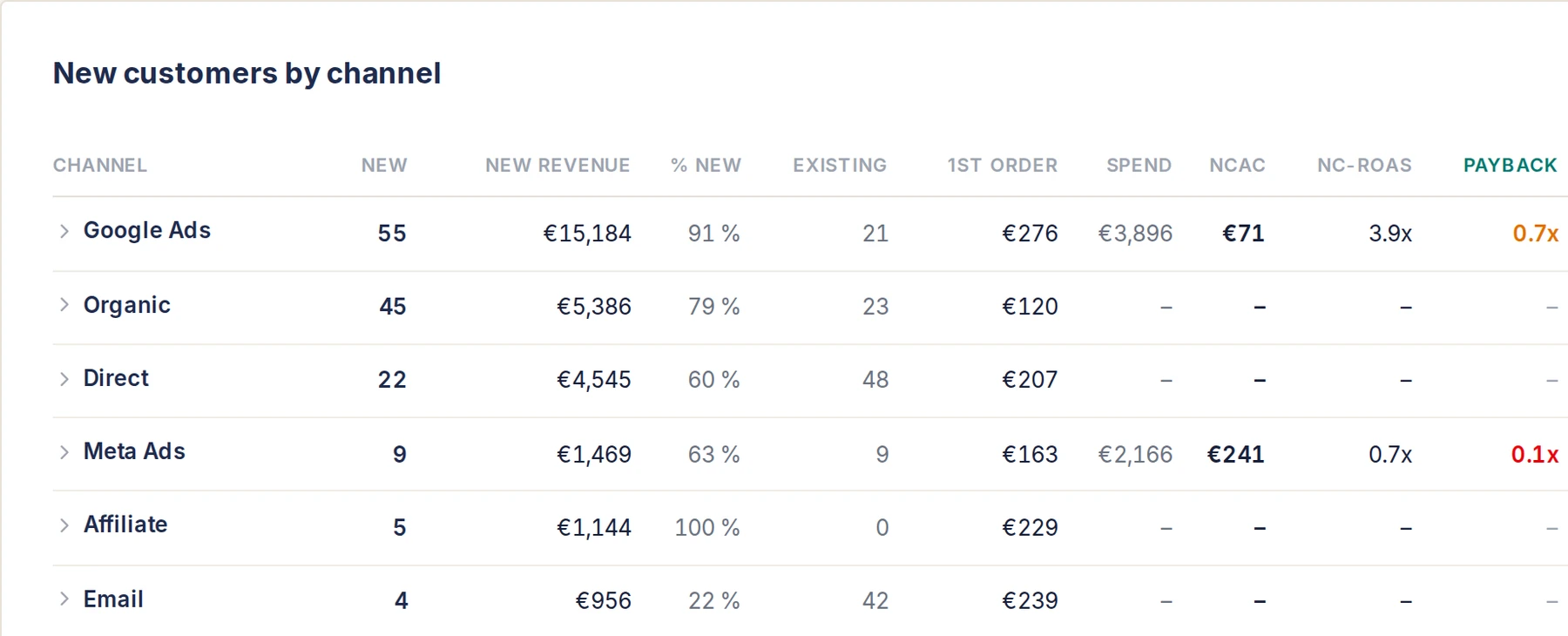
- 1Acquisition channel. New and existing buyers, cost per new customer and new-customer ROAS for each paid channel.
- 2Retention channel. Email sells mostly to people who already bought, so judge it on repeat sales, not on new customers.
The New customers tab shows the same per channel: new and existing buyers, the first order value, cost per new customer and new-customer ROAS. With Enalitica MCP connected, you can also ask ChatGPT or Claude "which channel brought the most new customers last month?" and get the answer from your own orders.
Frequently Asked Questions
What is a good new-customer share for Google Ads?
There is no universal number. In Enalitica's data Google Ads averages about two thirds new customers, with individual stores ranging from under half to almost all. A store selling furniture, where people rarely buy twice a year, should sit higher than a store selling coffee or cosmetics. Watch the trend in your own store rather than a benchmark.
Do brand campaigns bring any new customers?
Yes. In our data 63% of brand campaign orders came from first-time buyers. People who heard about you from a friend, an ad or an AI answer often search your name before buying. The question is whether they would have found the organic result without the ad, which only a pause test can answer.
Why does Google Ads report more new customers than my store?
Google decides who is new from its own tracking and customer lists. Customers who deleted cookies, switched devices or did not consent to ad tracking are missing from those lists, so Google can count a loyal customer as new. Your order history does not have that gap, because it matches on the email address used at checkout.
Can I see brand and non-brand results inside Performance Max?
Only approximately. The Performance Max search terms report shows which queries led to conversions, so you can match them against your brand name. Low-volume terms are hidden for privacy, and sales from YouTube, Display and Gmail have no search term, so the result is an estimate.
Should I exclude existing customers from my ads?
Not always. Returning customers buy more often and some campaigns, like a product launch, are meant for them. What you should avoid is paying acquisition prices for them by accident. Give them a separate campaign with its own budget, so the cost of winning new customers stays visible.
How do I count new customers if many orders have no email?
Leave them out of the share instead of counting them as new. Phone orders, showroom sales and some B2B orders often arrive without an email address. Counting them as new inflates acquisition numbers. Enalitica only shows the new-customer share when enough of the store's orders carry an identified customer.
Sources
The outside pages this article relies on. Links checked on 10 November 2026.
- almost all the traffic to the organic result below (faculty.haas.berkeley.edu)
- they take 18 to 42% of your clicks (business.columbia.edu)
- search terms report (support.google.com)
- brand exclusions you can set per ad format (blog.google)
- within 540 days (support.google.com)
- consent for ad use of their data (support.google.com)
- new customer acquisition goal (support.google.com)
- new customer flag (support.google.com)
Figures marked "in Enalitica's data" are aggregates from the real orders of the stores we measure, with no names and no individual orders. How we measure.

See your real numbers
Import 30 days of orders or leads during a 5-minute onboarding. Works for e-commerce and service businesses.
See plans and pricing