
How to Evaluate Marketing Agency Performance: Owner's Guide
How to evaluate marketing agency performance: transparency first, ROAS, MER, CAC and POAS in plain words, and three numbers that show progress.

Tilen Ledic
Written by
To evaluate marketing agency performance is an awkward task for most owners: you pay experts precisely because they know ads better than you do, yet you still have to judge whether they are doing a good job. This guide puts the evaluation on the only fair foundation there is: numbers from your own orders. No guessing, no post-meeting gut feelings, no distrust by default.
One thing should be clear immediately: this is not an article against agencies. A good agency is one of the best growth levers a store can hire, and good specialists welcome transparency because it proves their work.
A bad campaign month is not the sign of a bad marketing agency; a hidden bad month is.
Transparency Is the First Criterion of a Good Marketing Agency
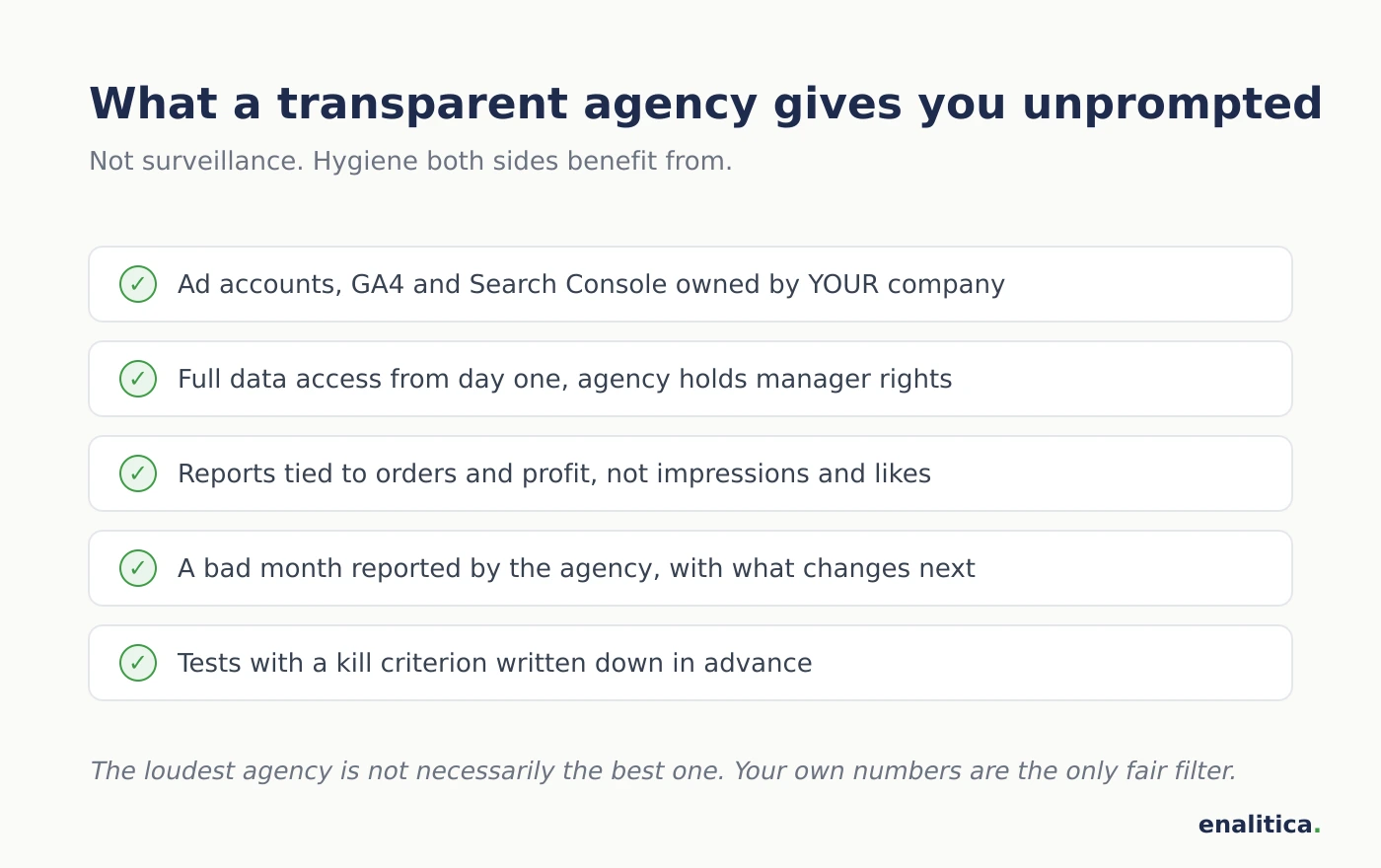
A transparent agency gives you three things on its own, without being asked: account ownership, data access, and reports tied to sales. The ad accounts (Google Ads, Meta), Google Analytics and Search Console belong to your company while the agency holds its own access, not the other way around; in Google Ads the company keeps the Admin access level, the one that grants and removes everyone else's access. If the relationship ever ends, the history and settings stay yours, and the report talks about orders, revenue and acquisition cost, not impressions and likes.
Those orders should come from the store itself, not from Google Analytics. Our own numbers show why. Of the orders that stores in Enalitica's data actually had (more than 10,000 of them, stores with both connected, last 90 days to 28 September 2026), 76.6% produced a GA4 purchase; in the median store the figure was only 68.5%, so a GA4-based report misses roughly one order in four.
And one rule too few owners hear out loud: there is nothing wrong with a campaign doing badly. Advertising is testing; some tests fail by definition. The question is never whether a bad month happened, but whether you learned about it from the agency or from your own bank statement, and what the agency changed because of it.
Marketing Agency Report Glossary: ROAS, MER, CAC and POAS
The acronyms in agency reports are simpler than they sound; each one is a single fraction. A director does not need to know how to build a campaign, but does need to know what the numbers in the report mean and what they are computed from:
| Acronym | What it tells you | Formula |
|---|---|---|
| ROAS | revenue per ad euro, as the platform counts it | platform-reported revenue / campaign spend |
| MER (blended ROAS) | revenue per euro across ALL marketing | all revenue / all marketing spend |
| Break-even MER | the MER below which ads lose money | computed from your own margins |
| aMER | NEW-customer revenue per marketing euro | new-customer revenue / all spend |
| CAC | what a new customer costs you | all marketing spend / new customers |
| Allowable CAC | the most a new customer may cost | customer contribution in the first months |
| POAS | profit (not revenue) per ad euro | (revenue - cost of goods) / spend |
| AOV | average order value | revenue / number of orders |
| LTV | what a customer brings over time | cumulative customer profit by month |
Two notes resolve most misunderstandings. First, platform ROAS and real orders are two different numbers; Meta and Google each credit themselves, so their ROAS figures cannot be added up. Second, revenue is not profit: a 4x ROAS campaign on low-margin products can lose money, which only POAS reveals.
Orders carrying a Meta click ID versus conversions Meta reported: 4.6 times as many of the latter, in Enalitica's data from stores with Meta and Google Ads connected (more than 10,000 orders, over €700,000 revenue, 90 days to 28 September 2026).
How to Evaluate Marketing Agency Performance With Three Numbers
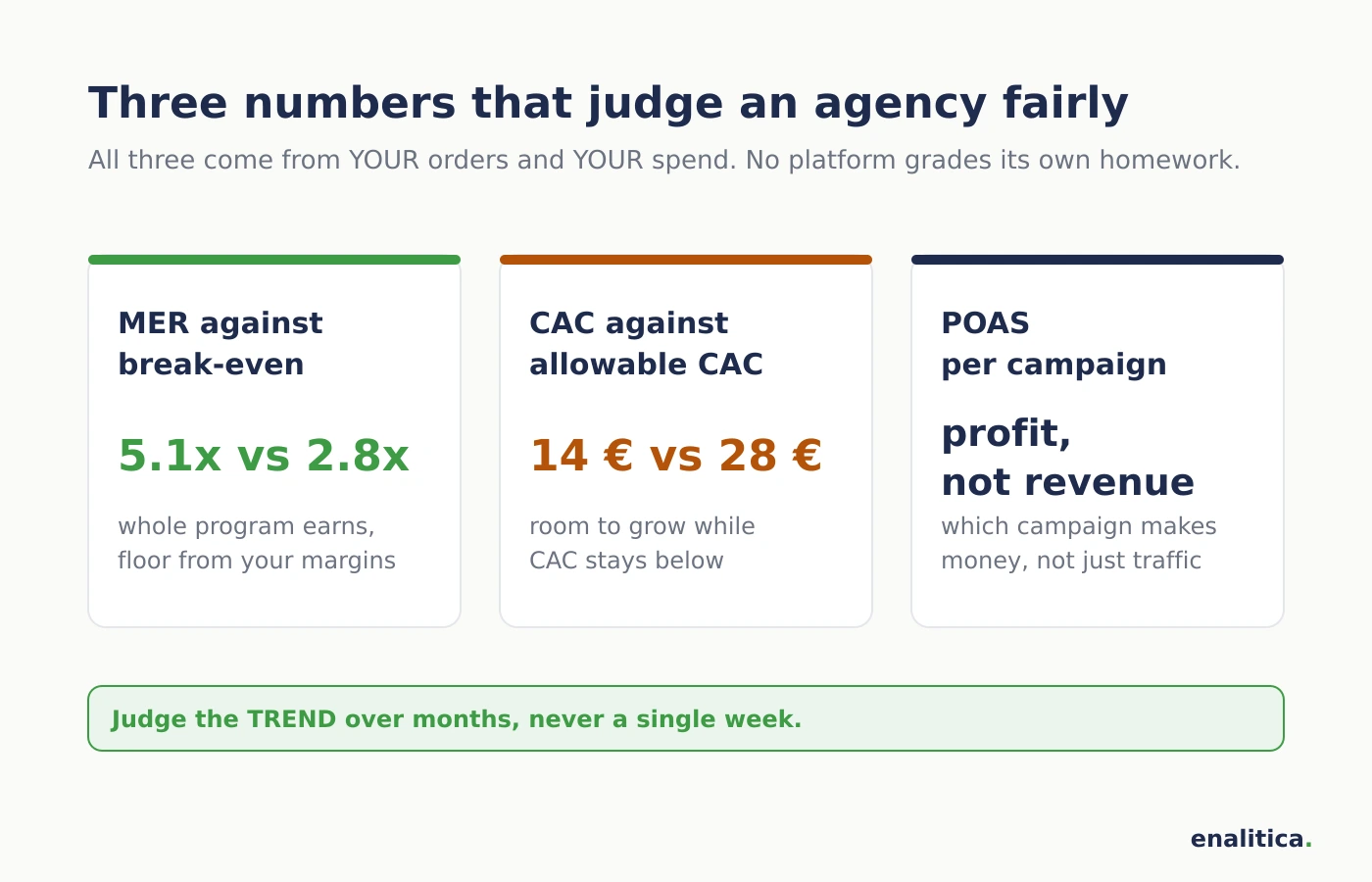
Marketing agency performance is fairly judged over months with three ratios: MER against your break-even floor, CAC against your allowable CAC, and POAS per campaign. All three are computed from your orders and your spend, so it does not matter which platform claims the credit.
MER against break-even. MER folds all revenue and all spend into one ratio, and the break-even floor from your margins shows where profit begins. An agency that keeps MER above the floor and moves it toward your target over months is doing its job; a single weak week means nothing here.
CAC against allowable CAC. Customer acquisition cost is the one number that says whether you are buying growth too expensively. As long as CAC sits below allowable (below what a new customer contributes in the first months), there is room to grow; once it crosses, growth is financed by future purchases, and that must be a conscious decision, not an accident.
POAS per campaign. Profit per campaign separates campaigns that make traffic from campaigns that make money. This is also where the quality of the agency's decisions shows: which campaigns it scaled, which it paused, and whether it read assisted conversions instead of judging on the last click alone.
Does a High ROAS Mean the Agency Is Doing a Good Job?
A high platform ROAS by itself does not tell you whether a marketing agency performs well, because every platform grades its own homework and because ROAS measures revenue, not profit. A high-ROAS campaign on thin margins can lose money; a brand campaign with a spectacular ROAS may only be collecting buyers who were coming anyway.
Brand search is a large slice of most Google Ads accounts. In Enalitica's data (more than 1,700 Google Ads orders, last 90 days to 28 September 2026), keywords containing the store's own name delivered 40% of the Google Ads orders with a known keyword, about 3 in 10 in the median store. Platform ROAS is therefore always read NEXT TO order-truth numbers: MER says whether the whole program earns, POAS says which campaign contributes. An agency that shows you both, unprompted, is an agency you can trust.
Agency Progress Shows Over Months, Not Weeks
A fair agency evaluation needs months, because ad platforms have learning periods and stores have seasons. After every major change Google's Smart Bidding recalibrates, which by Google's own guidance takes a few conversion cycles, typically one or two; seasonality moves demand regardless of the agency, and a single week is too small a sample for anything. What an owner may expect is direction: a MER converging toward the target over months, a CAC that does not drift above allowable, and tests with a kill criterion written down in advance rather than an eternal "let's wait a little longer".
There are plenty of genuinely excellent ad specialists out there. It is just not written on anyone's forehead, and the loudest agencies are not necessarily the best ones. The only filter that works in your favour is your own numbers: an owner who understands them recognises a good agency within two months of working together, not after two years.
Which Questions Should You Ask Your Agency Each Month?
Five questions tied to numbers turn the monthly meeting from reporting into collaboration:
- Where are we on MER against break-even, and against last month?
- Why did CAC move, and where are we against allowable CAC?
- Which campaign ran below its own usual range this month, and what did you do?
- What did we test, what was the kill criterion, and what did we learn?
- What do you propose we scale and cut next month, and why?
A good agency has the answers ready before you ask. A better one sends them first.
How Enalitica Shows the Owner and the Agency the Same Numbers
Enalitica computes every number in this guide automatically from your orders and ad accounts: MER against the break-even floor from your margins, CAC and allowable CAC from customer cohorts, POAS per campaign with direct and multi-touch attribution, and a morning email that compares the running month with the same days of the previous one. The owner and the agency look at the same page with the same numbers, so the monthly meeting stops wasting time reconciling sources.
For agencies the same numbers are a way to prove their work: transparent reporting on real orders with zero manual report-building, and multiple client accounts in one view. Agencies already use Enalitica in exactly that role. See plans and pricing or book a demo; bring your latest agency report and we will translate it into these three numbers together.
Frequently Asked Questions
How often should a marketing agency report results?
A short check-in weekly and a substantive report monthly. Weekly, one line is enough: spend, revenue from orders and MER against break-even, because a week is too small a sample for decisions. The monthly report should connect numbers to decisions: what worked, what did not, what was tested, and what changes next month. A formal review of the relationship makes sense every three months.
What is the most important metric for evaluating a marketing agency?
If it has to be a single one, it is MER against your break-even floor, because it folds all revenue and all spend into one ratio and compares it with a limit computed from your own margins. But MER grades the program, not the strategy: only CAC against allowable CAC says whether you are buying growth at a sustainable price, and POAS per campaign shows where profit is made. The trend of all three over months says more than any single value.
Should I have access to my own ad account?
Yes, without exception. The ad account, Google Analytics and Search Console should be registered to your company, with the agency holding manager access. Think of it as ordinary housekeeping: campaign history, audience lists and conversion data are store assets that must not disappear when agencies change. Transparent agencies arrange this themselves, at the start of the engagement.
Sources
The outside pages this article relies on. Links checked on 3 October 2026.
- Admin access level (support.google.com)
- Google's own guidance takes a few conversion cycles, typically one or two (support.google.com)
Figures marked "in Enalitica's data" are aggregates from the real orders of the stores we measure, with no names and no individual orders. How we measure.
See your real numbers
Import 30 days of orders or leads during a 5-minute onboarding. Works for e-commerce and service businesses.
See plans and pricing