
How to Optimize Your Ad Budget From Real Orders
How to optimize your ad budget as a store owner: four questions answered from orders and margins, when to raise, keep or cut, and how to check your agency.

Tilen Ledic
Written by
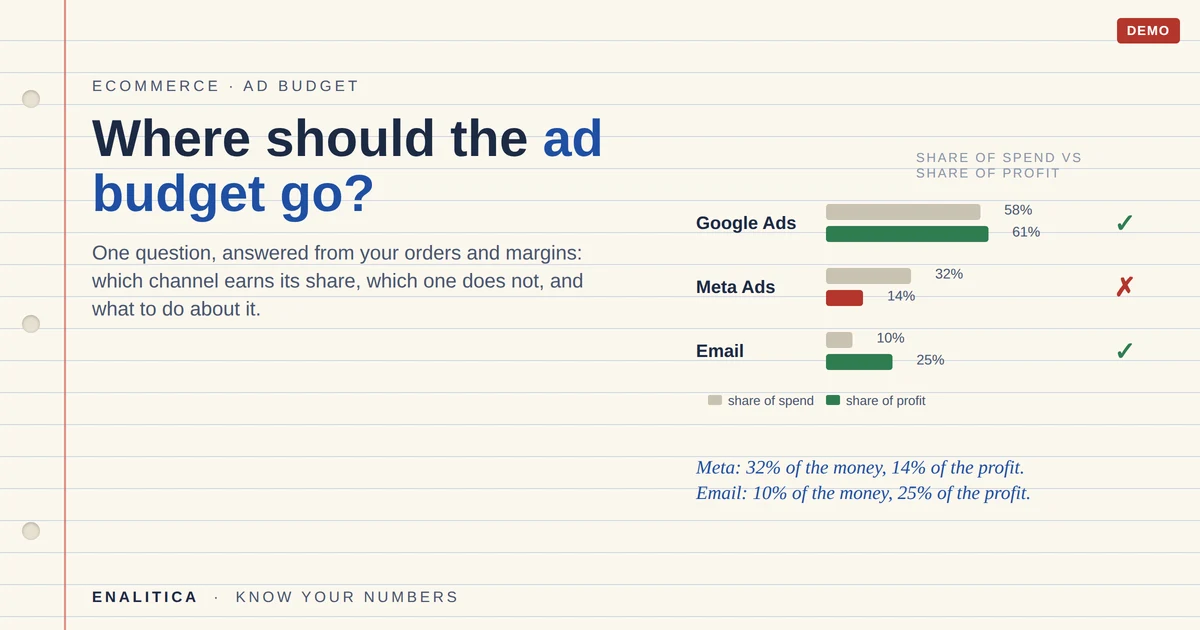
The budget meeting starts with the ROAS slide and ends with a feeling. Google Ads returned 4.1, Meta 2.6, the agency proposes plus 20 percent on Google, and the owner nods because there is nothing on the slide to argue with. In one Intuit Mailchimp survey of 500 business owners, 31 percent said they have little or no idea which channels bring their revenue, and the average owner spends up to 10 hours a week on manual analysis to feel less lost.
This guide is about how to optimize your ad budget when you are the owner, not the media buyer. You do not tune bids or write ad copy; your team or agency does that. Your job is the one decision the platforms cannot make for you: where the money goes. The rest of this article is the four questions that decision needs, answered from your orders and margins, and the rules for raising, holding and cutting that follow from them.
What does it mean to optimize your ad budget?
To optimize your ad budget means to move money between channels and campaigns based on what each one earns per euro spent, measured on your own orders and margins, not on the platform's reported return. The unit of the decision is the campaign, the evidence is four weeks of orders, and the possible moves are four: keep, raise, improve first, cut.
That definition rules out two things owners are usually offered instead. It is not a percentage of revenue: "spend 8 percent of revenue on ads" says nothing about whether the eighth percent earns more than it costs. And it is not a ROAS target: a campaign at ROAS 4 on a 20 percent margin loses 200 euros on every 1,000 spent, while a campaign at ROAS 3 on a 45 percent margin earns 350. The order-based attribution guide explains why the order, with its click evidence and its cost price, is the only unit that can carry this decision.
An ad budget is not a number to set once a year. It is a weekly answer to the question "which of these campaigns deserves more of my money than it has today", and the answer changes.
Why ROAS and a percentage of revenue are not enough
Every framework you will find on the first page of Google is revenue-based, and revenue is the wrong side of the ledger. The 70/20/10 rule (70 percent to proven channels, 20 to promising, 10 to experiments) assumes you already know which channels are proven. The "percent of revenue" rules quoted by agencies, 5 to 15 percent depending on who is selling, assume the marginal euro earns what the average euro earned. Neither survives contact with cost prices.
Break-even is the number that makes both usable. Break-even ROAS equals one divided by your contribution margin: 40 percent margin means 2.5, 25 percent means 4.0. A campaign above its break-even earns money, one below it loses money at whatever ROAS the platform shows. Our POAS guide turns this into a single number, profit on ad spend, where break-even is always 1.0 and two campaigns with different margins compare honestly.
Two more things the revenue view hides:
- Returns. A fashion campaign with a 28 percent return rate reports the sale on the day of the click and never reports the refund. Profit per campaign only holds when returns are subtracted where they happened.
- Modeled conversions. The platforms' ROAS includes conversions they estimated, including view-through ones. Modeled conversions are fine for bidding and useless for deciding a budget; your orders are not modeled.
The four questions a store owner actually asks
Owners do not ask "what is my marginal ROAS curve". They ask four plain questions, and a good budget process answers each of them in one sentence with a number attached.
- Which campaigns work and which do not? The answer is a list with a verdict per campaign, keep, raise, improve or pause, and the four-week evidence behind each: spend, orders, revenue, profit when your cost prices are loaded, and the trend.
- Where should I raise the budget and where should I cut it? The same list read from both ends: raise candidates are above break-even for three or more weeks and limited by budget; cut candidates are below break-even for three clean weeks with no upward trend and no assists to other channels.
- I raised the budget two weeks ago. Did it help? A before-and-after comparison of the same length, campaign spend against the orders it brought, with a 15 percent dead band so normal fluctuation is not called a result and the first seven days after the change are not judged at all.
- How much of what I earn actually comes from ads, and is the month on track? MER, net revenue divided by total marketing spend, next to its break-even, plus the month so far against the same days of the month you actually compare with: last month for a steady store, the same month last year for a seasonal one.
The animation below is the first two questions answered in one go, with invented numbers, the way it reads when you type them into ChatGPT connected to your store.

Notice what the answer does not do: it does not change anything. It names the campaign, the verdict, the number and the next step, and stops. That is the whole point of the next section.
When to raise, keep or cut a campaign's budget?
The rules are simple enough to write on one page, and the discipline is in applying them weekly instead of whenever someone is nervous.
Raise when profit (or revenue, without cost prices) has been above break-even for three consecutive weeks, the campaign is limited by budget rather than by rank, and the last raise was at least a week ago. Step up to about 20 percent at a time; the scaling guide covers the ladder and the three conditions before every step.
Keep when the campaign sits above break-even without a trend either way, or when a raise would buy nothing because the campaign is not budget-limited. Brand search usually lives here: cheap, profitable and unable to absorb more money.
Improve first when the campaign is below break-even but not decisively: fix the search terms that spend without orders, the placements, the creatives, before touching the budget. Cutting a fixable campaign throws away its history.
Cut when three clean weeks in a row sit below break-even, the spend is large enough to mean something, the trend is not up, and the campaign does not assist sales that close on other channels. The pause rules spell out the countdown; the assist check is the one most owners skip and the one that most often turns a "cut" into a "keep".
One honest note on the learning phase, because every agency deck repeats it. Neither Meta's help page on significant edits nor Google's on learning periods states a percentage; the "changes above 20 percent reset learning" rule is a practitioner heuristic, and Google's own 2026 note says target-based strategies now hold efficiency when budgets rise. Treat 20 percent as a sensible step size, not a law, and let the orders after the change tell you whether it worked.
A campaign is never paused by a rule. A rule produces a proposal with its evidence; a person with context decides, and the decision is measured two weeks later like any other.
How do you know your agency is spending it well?
The question owners ask most often in forums is not about ROAS, it is "how do I know my agency is doing a good job with the budget". The agency's own report cannot answer it, because it is graded in the platform's currency. Three columns from your order data can.
- Reported ROAS against order MER. Put the platform-claimed return next to net revenue from real orders divided by total ad spend. A widening gap means more of the claimed conversions are modeled or double-claimed; the MER guide shows what a healthy gap looks like.
- Share of spend on your own brand. Google's own research puts ad clicks at roughly 50 percent incremental when you already rank first organically for the term. A budget that grows mostly on brand terms grows the report, not the business.
- Share of spend on non-buyers. How much of the money went to search terms, placements or audiences that produced zero orders in four weeks? Ten percent is hygiene; forty percent is a conversation.
Bring these three to the next meeting and the discussion changes from "trust us" to "here is what the money did". The agency evaluation guide has the full checklist, including what to ask before you sign.
Who optimizes the campaigns, and what Enalitica brings
Here is the honest division of labour. Enalitica does not optimize your campaigns. Every verdict it produces, keep, raise, improve or pause, is a recommendation with its evidence, and it needs a person who can act on it well: an in-house marketer who knows Google Ads and Meta properly, or an outside team that does. Bid strategies, negative keywords, creatives, audiences and the actual budget edits are their craft, and a tool that pretended otherwise would be selling you a mistake.
What Enalitica brings is the clear picture that makes their work and your decision faster and safer. Every Monday it judges each Google Ads campaign on four weeks of order-truth evidence and files it under one of four verdicts, with profit where your cost prices exist and the expected next step in euros. Every morning it checks the decisions already made, yours or your team's, and says whether they are working, with the level to restore when they are not.
Google Ads is where the picture is sharpest, because a Google campaign leaves a click ID on every order and the profit per campaign can be measured to the euro. For Meta the same page reads the channel as a whole: spend, revenue from orders, POAS against break-even 1.0, the share of orders it assisted rather than closed, and the share of new customers it brought. That is enough to answer whether Meta as a channel earns its budget and whether the last change helped; the per-campaign fine print, which ad set to feed, stays with your team.
One thing we keep seeing across our clients deserves saying here, because last-click numbers put Meta in a harsher light than it earns: when a store invests seriously in Meta, its organic and direct traffic rise with it, brand searches multiply, and orders arrive days later through channels Meta never gets credit for. We can see the lift; we cannot measure how much of it is Meta's, and neither can anyone honestly. Read the Meta row as a floor, not a verdict; the Meta halo guide explains what we see and why nobody can size it.
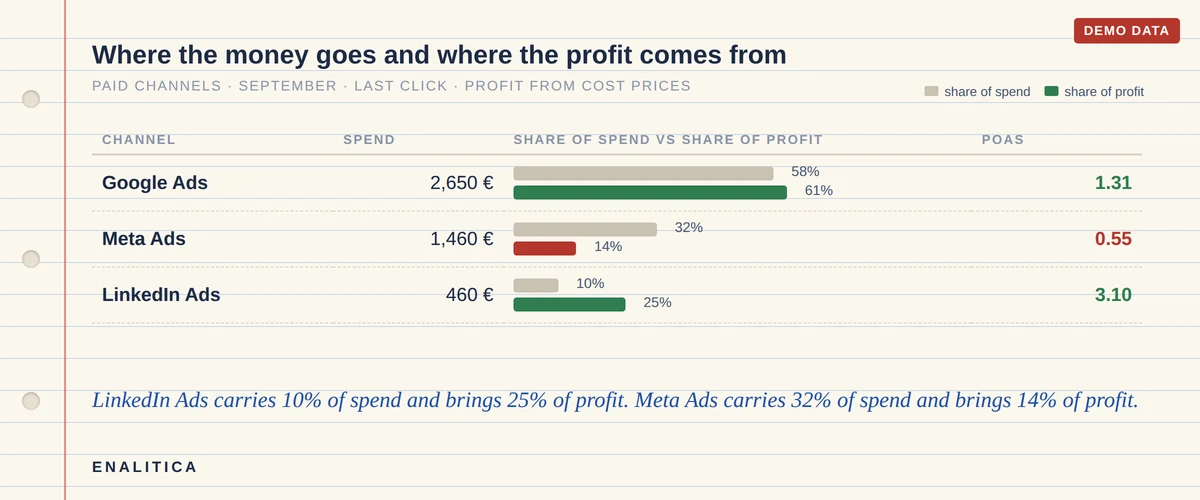
For the owner who reads the overview and not the drill-downs, the summary page carries one table at the bottom: where the money goes and where the profit comes from, per paid channel, share of spend against share of profit, with one sentence naming the channel that earns more than its share and the one that earns less. It shows only to the owner, never to a media buyer's login.
And because most owners now ask their assistant instead of opening a dashboard, all of it is available through Enalitica MCP: ChatGPT, Claude, Gemini or Grok can read the weekly verdicts, the outcomes of your recent changes and the month's pace against the same days of last month or of last year, whichever your report settings compare with, read-only and without any customer data. "Which campaigns should I raise, keep or pause this month" is now a question with an answer, not a meeting.
We set up the cost prices, the break-even and the connections together with you, because a verdict on the wrong margin is worse than no verdict. Budget confidence comes from the numbers being right, and that part we do not leave to a wizard.
Frequently Asked Questions
How much should I spend on ads?
Start from break-even, not from a percentage. With your contribution margin known, break-even ROAS is 1 divided by the margin, and the right budget is the largest amount that stays above it on your own orders over four weeks. In Enalitica you see it as the break-even line under MER on the summary page, computed from your cost prices or your average margin, and per campaign as POAS against 1.0, which is the same rule expressed in profit. One agency survey found that 59 percent of stores spending more than 30 percent of revenue on ads were unprofitable; the percentage was never the problem, the margin was.
When should I increase my ad budget?
After three consecutive weeks above break-even on orders, when the campaign is limited by budget, in steps of about 20 percent, one step per week, and only once the previous step has been judged. Raising a campaign that is not budget-limited buys nothing; raising one that assists other channels can look worse than it is on the last click.
I spent 1,500 euros and got no sales. Should I stop?
Judge it on weeks and margin, not on the round number. If three clean weeks of meaningful spend sit below break-even with no upward trend and no assisted orders elsewhere, yes. If the campaign is two weeks old or was changed last Wednesday, you are still inside the window where nothing is evidence yet.
Does raising the budget reset the learning phase?
Any significant change can restart the platform's learning, and neither Meta's nor Google's documentation names a percentage at which it happens; the 20 percent rule is a heuristic. The practical answer is to make one step, wait seven days before judging, and compare the two weeks after with the two weeks before on your orders.
How should I plan the budget for Q4 and seasonal peaks?
Compare the same days of the same month last year, not last month: November orders run about 64 percent above the annual average for a typical store and Q4 CPMs rise 30 to 50 percent, so October against September reads like a crisis or a miracle and means neither. Lock the plan by early October and read the Black Friday profit guide before the season, not after.
See your real numbers
Import 30 days of orders or leads during a 5-minute onboarding. Works for e-commerce and service businesses.
See plans and pricing